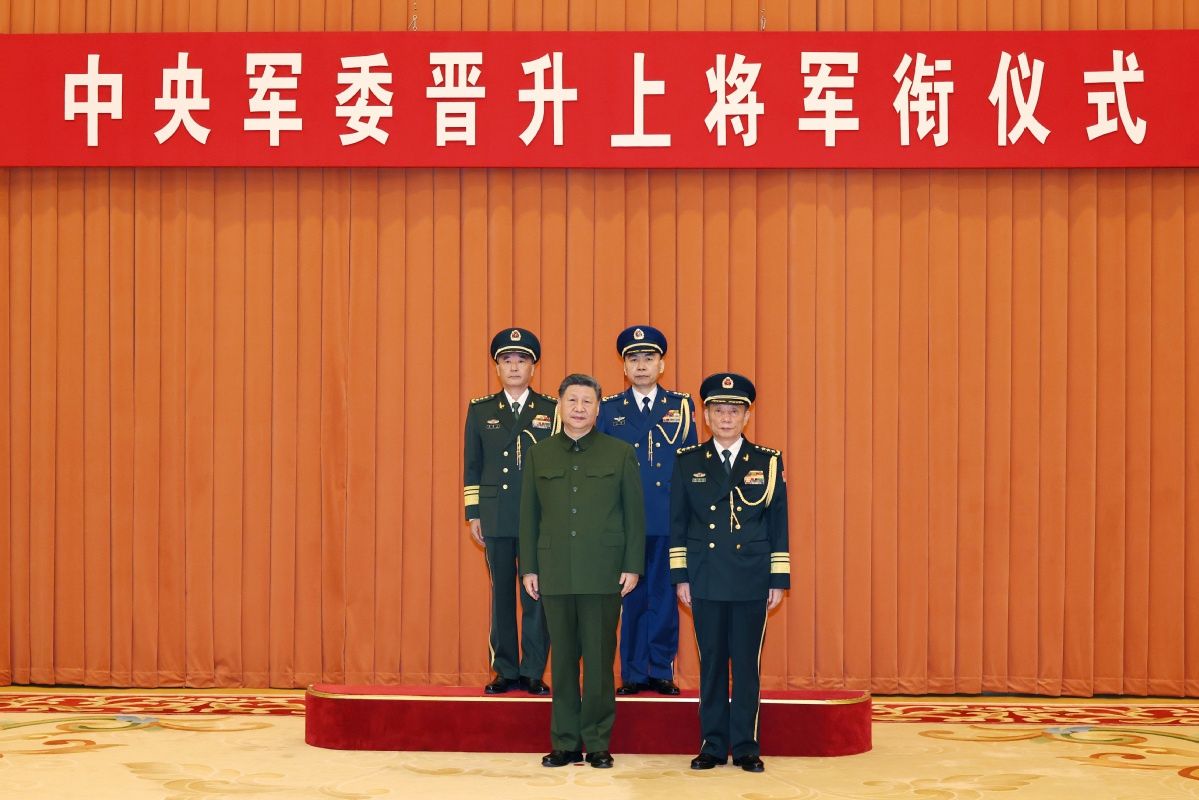
Chinese President Xi Jinping has restructured the military's corruption watchdog by appointing Zhang Shuguang as secretary of the Central Military Commission's discipline inspection commission, marking another significant personnel shift in what has become the country's most extensive armed forces reorganisation in decades. The appointment, confirmed by state-run Xinhua News Agency at a ceremony in Beijing on July 3, underscores the continuing intensity of Xi's consolidation of military power as he secures his grip on one of the world's largest defence establishments.
The reshuffle involved multiple promotions and reassignments across the defence hierarchy. Wang Gang has assumed command of the People's Liberation Army Air Force, replacing Chang Dingqiu whose next assignment remains undisclosed. Both Zhang Shuguang and Wang Gang received promotions to the rank of general, China's most senior active-service military position, elevating them to the apex of the officer corps. These changes represent more than routine administrative adjustments; they signal Xi's determination to install trusted figures throughout the military structure at critical junctures.
Zhang Shengmin, the previous holder of the anti-corruption portfolio, has been repositioned as vice chairman of the Central Military Commission, a lateral move that technically broadens his authority while removing him from day-to-day oversight of graft investigations. This transition reflects a pattern whereby Xi relocates officials rather than purging them outright, though their removal from sensitive positions effectively diminishes their influence. The CMC serves as the apex of military decision-making and defence policy coordination, making the vice chairman role ostensibly prestigious but potentially constraining compared to control over disciplinary mechanisms.
The timing of these appointments coincides with the second phase of Xi's military anti-corruption campaign, which commenced in earnest during mid-2023, several months after he secured an unprecedented third consecutive term as Communist Party general secretary. This campaign represents a deliberate strategy to consolidate authority by targeting potential rivals and entrenched power networks within the armed forces, traditionally a source of factional competition within China's political system. The scope has been extraordinary by contemporary standards, encompassing the removal of two vice chairmen of the Central Military Commission, three other CMC members, a former defence minister, and no fewer than a dozen senior military region commanders and service branch leaders.
One of the most dramatic interventions occurred earlier in 2024 when Xi ordered an investigation into Zhang Youxia, his former close ally and one of China's highest-ranking generals serving as CMC vice chairman. The decision to target Zhang Youxia demonstrated that even proximity to Xi provides no immunity from political vulnerability, signalling to other senior commanders that loyalty is conditional and that power can evaporate rapidly. This move particularly shocked China's military elite because Zhang had been widely regarded as among Xi's most trusted confidants, making the investigation a watershed moment in the purge's psychological impact.
The military purge must be understood within the context of Xi's broader consolidation strategy that has characterised his presidency since 2012. The armed forces represent an essential pillar of Communist Party rule, and controlling their leadership ensures that no alternative power centre can challenge the paramount leader's authority. Unlike civilian institutions where party mechanisms provide oversight, the military operates according to distinct hierarchies and protocols, creating opportunities for ambitious commanders to accumulate independent power bases. By systematically removing potential rivals and installing dependable subordinates, Xi mirrors the tactics employed by previous paramount leaders seeking to secure unassailable control.
The implications for Southeast Asia are noteworthy, as military personnel changes in Beijing frequently presage shifts in defence posture or strategic emphasis. A more consolidated military leadership theoretically reduces the risk of factional disagreement over external policy, potentially making Chinese defence strategy more coherent and predictable. However, concentration of power also eliminates internal checks that might otherwise counsel restraint on militarised approaches to regional disputes. The appointments of commanders loyal to Xi rather than representing diverse institutional interests may therefore affect how aggressively the People's Liberation Army pursues maritime claims or responds to perceived challenges in the Taiwan Strait and South China Sea.
The broader pattern of removals extends beyond the defence ministry itself. Beijing last week disqualified six military representatives from their positions in the National People's Congress, the rubber-stamp legislature that technically exercises oversight of defence affairs. This parliamentary purge demonstrates that Xi's reach encompasses not merely the operational military structure but also the formal institutional channels through which military interests traditionally gain representation in civilian governance forums. The cumulative effect is to concentrate military decision-making authority narrowly within Xi's circle while eliminating alternative channels through which competing military factions might exercise political influence.
For regional observers monitoring China's strategic intentions, these personnel changes carry significance beyond mere administrative shuffling. The installation of trusted commanders in air force leadership and other critical posts suggests Xi is actively shaping the military apparatus to execute whatever strategic vision he has formulated for the coming years. The combination of anti-corruption investigations targeting potential rivals and the advancement of loyalists creates an armed forces establishment aligned with paramount leader preferences, reducing the likelihood of bureaucratic resistance to controversial directives. This represents a qualitative shift from periods when military commands enjoyed greater autonomy and when different service branches might advocate competing strategic approaches.
The duration and scope of Xi's military purge indicate that consolidation remains incomplete despite the removal of numerous senior figures. The continuing reassignments and appointments suggest that Xi perceives ongoing risks from insufficiently aligned military networks. Understanding which commands remain subject to investigation and which commanders are promoted provides crucial insights into Xi's priorities and his assessment of where residual opposition might exist. The absence of clear information about Chang Dingqiu's future assignment, for instance, may indicate either that his reassignment is pending further investigation or that he faces marginalisation through an obscure posting, a traditional Chinese political tactic for sidelining officials without dramatic purges.

