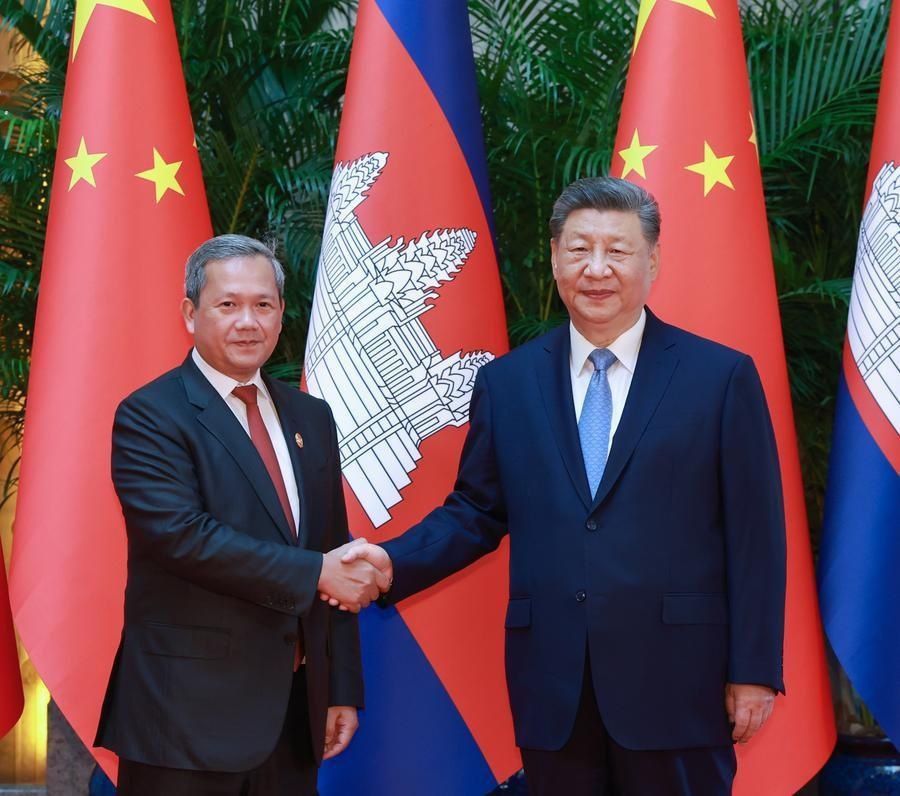
Chinese President Xi Jinping and Cambodian Prime Minister Hun Manet reinforced their countries' enduring strategic partnership during a bilateral meeting in Shanghai on July 17, emphasizing the historical bonds that have linked Beijing and Phnom Penh through successive generations of leadership. The encounter took place alongside Hun Manet's attendance at the 2026 World Artificial Intelligence Conference and High-Level Meeting on Global AI Governance, providing an opportune moment for the two leaders to chart the trajectory of their relationship in an evolving geopolitical landscape.
Xi articulated a vision for elevated cooperation between China and Cambodia, calling for renewed dedication to the legacy of friendship established by their predecessors whilst simultaneously advancing contemporary strategic frameworks. The Chinese President referenced the "Diamond Hexagon" cooperation structure as a blueprint for comprehensive engagement, signalling Beijing's commitment to multifaceted partnership that extends beyond traditional diplomatic channels into economic, technological, and security domains. This nomenclature reflects the intricate web of collaborative mechanisms that have been developed to sustain and deepen bilateral ties.
Economic integration emerged as a cornerstone of the bilateral agenda, with Xi emphasizing accelerated development of two pivotal corridors designed to bind the nations through complementary growth strategies. The Industrial Development Corridor and the Fish and Rice Corridor represent infrastructure and sectoral initiatives aimed at maximizing comparative advantages and fostering mutual prosperity. These initiatives carry particular significance for Southeast Asia, as they demonstrate how China is leveraging economic integration to strengthen diplomatic relationships whilst addressing regional development aspirations.
Beyond infrastructure, the dialogue encompassed a deliberate pivot toward emerging technological domains that will define the region's competitive position in the twenty-first century. Both leaders committed to advancing cooperation in artificial intelligence and the digital economy, recognising that technological capability increasingly determines national influence and economic competitiveness. This forward-looking dimension reflects acknowledgment that Cambodia's development trajectory cannot remain tethered to traditional sectors alone, and that partnership with China in high-value industries could accelerate modernisation efforts across Phnom Penh's economy.
Xi simultaneously stressed the importance of preserving and strengthening traditional economic pillars, particularly electricity and agriculture, underscoring a balanced development approach that neither abandons established sectors nor neglects emerging opportunities. For Malaysian observers, this framework offers instructive parallels regarding the imperative of maintaining economic diversity whilst pursuing innovation—a principle increasingly relevant as Southeast Asian economies navigate post-pandemic recovery and technological transformation.
Security cooperation occupied a significant portion of the bilateral discussion, with the Chinese President highlighting shared concerns regarding transnational criminal enterprises that destabilise the region. Cross-border counterfeiting operations, smuggling networks, online gambling platforms, and telecommunications fraud represent multijurisdictional challenges that individual nations cannot effectively combat in isolation. By positioning these issues centrally in their strategic dialogue, both leaders signalled recognition that economic development and security are inextricably linked, and that safeguarding legitimate commerce requires coordinated enforcement across borders.
Xi's remarks concerning the Cambodia-Thailand border situation revealed China's self-perception as a constructive mediator capable of facilitating dialogue between disputants. By endorsing a negotiated resolution pathway and pledging continued diplomatic engagement, Beijing reinforced its position as a stabilising regional actor invested in peaceful settlement of interstate disagreements. For Malaysia and other Southeast Asian nations, China's mediation approach holds relevance, particularly given Myanmar's ongoing instability and longstanding tensions elsewhere in the region.
Hun Manet's response articulated Cambodia's strategic orientation with unmistakable clarity, affirming that domestic political shifts and evolving international circumstances will not alter Phnom Penh's commitment to deepened collaboration with Beijing. This declaration carries significance beyond ceremonial politeness; it represents an explicit reaffirmation of Cambodia's anchoring within China's strategic ecosystem despite potential pressure from Western capitals and regional partners. The Prime Minister's emphasis on unwavering adherence to the one-China policy further underscores Phnom Penh's alignment with Beijing's core diplomatic positions.
The bilateral commitment to combating telecommunications fraud assumes particular urgency within Southeast Asia's context, where organised crime syndicates have exploited porous borders and inadequate cross-border law enforcement coordination. Cambodia and Thailand have emerged as transit points for criminal networks targeting victims across multiple countries, including Malaysia. Enhanced Sino-Cambodian cooperation on this front could yield spillover benefits for other regional nations struggling with similar challenges, provided that intelligence and enforcement mechanisms are effectively coordinated through established regional frameworks.
The meeting reflects broader patterns of China's strategic engagement with Southeast Asian partners, wherein Beijing leverages economic incentives, technological partnerships, and security cooperation to deepen relationships and expand its influence. For Malaysia, Cambodia's explicit positioning within China's orbit presents both competitive challenges and potential collaborative opportunities, depending on how Kuala Lumpur calibrates its own regional strategy and seeks to maintain productive relationships with all significant powers.
Looking forward, the ambitious development corridors discussed during this meeting will require substantial capital investment, technical expertise, and sustained political commitment from both governments. The success or failure of these initiatives will significantly influence Cambodia's economic trajectory and its capacity to deliver tangible benefits to its population—factors that could reshape regional development patterns and migration pressures affecting neighbouring countries including Malaysia. The parallel emphasis on emerging technologies suggests that both nations recognise their interdependence in accessing global value chains and maintaining competitive positioning within the rapidly evolving digital economy.

