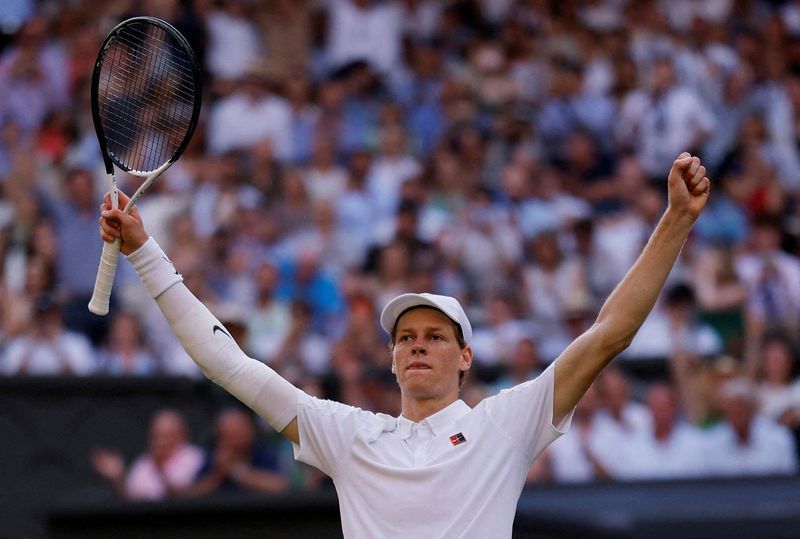
The narrative around Jannik Sinner's Wimbledon defence has shifted dramatically in the weeks leading to the All England Club's gates opening on Monday. Once regarded as an unstoppable force following a dominant clay-court season, the 24-year-old Italian world number one now faces the significantly more complex task of proving his prowess extends beyond favourable surfaces. His unexpected second-round exit at Roland Garros, which halted his 30-match winning streak dating back to February, has inadvertently created an opening for rivals who believed the season's narrative had already been written.
What transpired in Paris was less a dramatic collapse and more a gradual unravelling rooted in physical depletion. The demands of competing frequently across two months with minimal recovery time proved unsustainable even for a talent of Sinner's calibre. His decision to bypass traditional warm-up tournaments before Wimbledon—a strategy typically reserved for players maintaining peak form—has invited scrutiny about his current readiness. Yet this deliberate rest period also presents an opportunity for genuine recovery in ways that the relentless clay-court schedule did not permit. The question facing observers and competitors alike is whether ten days of recuperation suffices for a player whose tank ran dry at the worst possible moment.
Mats Wilander, the seven-time Grand Slam champion offering commentary on European networks, provides perhaps the most measured assessment of Sinner's predicament. He characterises the setback as stemming from tactical scheduling decisions rather than fundamental flaws in Sinner's game. The Italian, Wilander suggests, simply lacked sufficient downtime and dedicated training blocks to maintain the intensity that defined his February-to-May period. However, Wilander's optimism about Sinner's recovery comes tempered with a crucial caveat: the grass-court environment itself presents inherent unpredictability that even rest cannot fully mitigate. Grass has historically humbled superior clay-court performers, rewarding different technical attributes and punishing those whose footwork becomes uncertain on its slippery surface.
The most significant threat to Sinner's title defence emerges from an unlikely source in terms of recent trajectory. Novak Djokovic, at 39 years old and appearing to be in the twilight of his exceptional career, nonetheless commands attention at Wimbledon in ways few other venues permit. The Serbian champion's movement and return capabilities remain among the sport's most formidable attributes precisely on surfaces where reactions must be instantaneous. More than personal glory, however, Djokovic chases an elusive standalone 25th Grand Slam title—a milestone that would represent the final major achievement within his reach. With time rapidly depleting for such accomplishments, Wimbledon represents something approaching a last genuine opportunity to add another chapter to his historical legacy.
Djokovic's French Open exit, which saw him fail to advance beyond the opening rounds, might ordinarily represent conclusive evidence of declining powers. Yet Andy Roddick, a three-time Wimbledon finalist himself, articulates why dismissing the Serb would constitute a dangerous miscalculation. Roddick's perspective, offered through his podcast commentary, suggests that Djokovic's assessment of his own capabilities at the All England Club differs fundamentally from observers' judgements. The Serb's proven grass-court mastery, his understanding of what it takes to win the trophy he last captured four years ago, and his innate competitive instinct combine to make him a legitimate title contender despite recent disappointing results.
Alexander Zverev's emergence as a genuine threat adds another dimension to the contest that few anticipated weeks earlier. The German's triumph at Roland Garros represented far more than a single tournament victory; it constituted the breakthrough Grand Slam title that had eluded him despite years of consistent excellence. More relevantly for Wimbledon's verdant courts, Zverev possesses the serving weaponry that consistently frustrates opponents on grass while simultaneously undermining their confidence. Boris Becker, the six-time major champion and fellow German observer, suggests that Zverev has effectively become the default favourite following Alcaraz's injury absence and Sinner's credibility questions. According to Becker's analysis, a serve that places opponents perpetually on the back foot essentially delivers semi-final positioning before the tournament's real challenges emerge.
The absence of Carlos Alcaraz, whose back injury forces him to bypass Wimbledon following dominant victories in 2023 and 2024, creates an unprecedented vacuum in the draw's architecture. The Spanish sensation represented one of the rare contemporary players capable of dictating play across all surfaces, wielding weaponry that neutralised grass-court traditionalists. His removal opens possibilities for a broader range of competitors who might otherwise have faced insurmountable obstacles. This redistribution of opportunity extends across both established contenders and emerging talents—a circumstance that would ordinarily suggest competitive uncertainty.
America's contribution to the contenders' list reflects the country's recent tennis resurgence at the elite level. Ben Shelton, alongside fellow Americans Taylor Fritz and Frances Tiafoe, possess the offensive capabilities to trouble even the tournament's elite players. The weaponry these players command—powerful serves, aggressive baseline play, and serve-and-volley capabilities—aligns precisely with grass-court demands in ways that their clay-court showings cannot predict. Flavio Cobolli, the Italian who reached Roland Garros's final, leads the secondary wave of aspirants who view Wimbledon as an opportunity to establish themselves among the sport's upper echelon. For Southeast Asian followers, these developments signal that the men's game has fundamentally shifted from Djokovic-Federer-Nadal dominance toward a more fractured, competitive landscape.
The broader context surrounding Sinner's defence reflects a crucial inflection point in contemporary professional tennis. The previous season's certainty—where Sinner and Alcaraz appeared positioned for a decade of dominance—has been rendered considerably more complicated by injury and inconsistency. This instability creates opportunities for players like Djokovic and Zverev whose careers, many believed, had entered their terminal phases. For Malaysian and regional audiences, the unfolding drama demonstrates that even in sports dominated by the sport's elite, unexpected narratives continually emerge. The tournament's outcome will partly depend on Sinner's physical recovery, but equally on whether Djokovic can convince himself that one final major remains within his reach, and whether Zverev's clay-court momentum translates convincingly onto surfaces where movement differs fundamentally. The defending champion's path to retaining his title, in other words, has become substantially more complicated than it appeared merely weeks ago.

