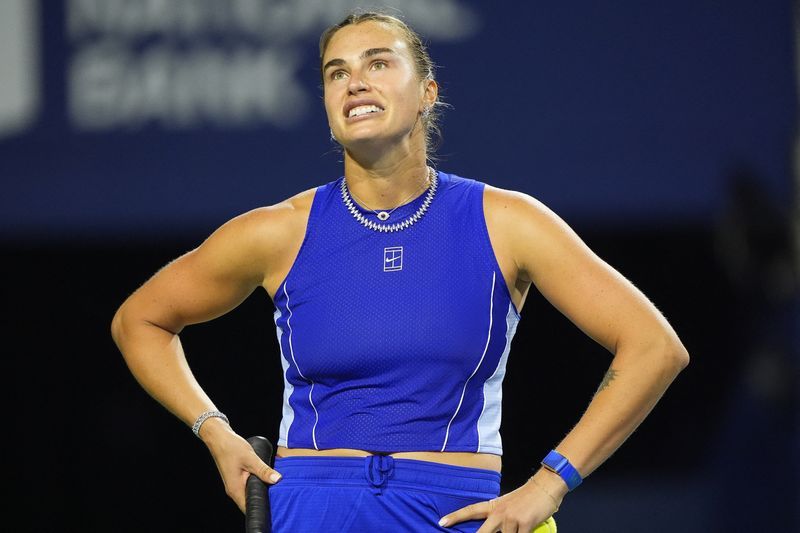
Aryna Sabalenka's preparations for the upcoming U.S. Open received a significant jolt on Saturday when the world's top-ranked player succumbed to an inspired performance by Russia's Ekaterina Alexandrova at the Canadian Open in Toronto. The 16th-seeded Russian claimed a 7-6(3) 4-6 6-4 victory in a gruelling encounter that extended beyond two hours, dealing a blow to Sabalenka's momentum as the season's final Grand Slam looms.
The Belarusian champion, seeking to build on her status as the defending U.S. Open winner and a four-time Grand Slam titlist, found herself overwhelmed by Alexandrova's relentless aggression, particularly in the closing moments. Despite engineering a comeback from a set down to force a deciding third set, Sabalenka's composure cracked at the critical juncture, with costly unforced errors paving the way for her opponent's advance. The match proved to be a stark reminder that even the most dominant players can falter against opponents operating at peak intensity.
The match unfolded in contrasting fashions, with each competitor seizing control during different phases. Sabalenka broke serve early in the opening set, but Alexandrova demonstrated considerable resolve by fighting back to force a tiebreaker. The Russian's clinical execution in the tiebreak, winning 7-3, gave her the crucial first-set advantage and suggested momentum might be shifting in her favour.
However, Sabalenka refused to capitulate immediately. The world number one reclaimed control in the second set, securing a crucial break that established a 4-3 lead before serving out comfortably to draw level. This response illustrated why Sabalenka has dominated the professional tour, showcasing the kind of adjustments and mental resilience expected of an elite player. The match appeared destined for a competitive final set where either player could reasonably expect to prevail.
The third set proved decisive, though not in the manner many observers might have predicted. As Sabalenka's unforced error tally mounted, Alexandrova maintained her nerve and converted her opportunities with admirable consistency. When Sabalenka faced match point while serving to remain in contention at 4-5, she managed to save two opportunities through skilled play. However, a double fault on the third match point proved fatal, handing Alexandrova the breakthrough victory that will significantly enhance her ranking and confidence moving forward.
Alexandrova's post-match reflections provided insight into the mental approach required to challenge elite opposition. The Russian acknowledged the difficulty of sustaining pressure against a player of Sabalenka's calibre, noting that opponents rarely afford multiple opportunities during competitive stretches. Her strategy involved compartmentalising her mindset, focusing purely on execution rather than monitoring the scoreline—a simple yet effective philosophy that evidently paid dividends. Alexandrova admitted that after surrendering the second set, she feared her moment had passed, making her final-set performance all the more impressive.
Alexandrova's quarter-final berth sets up a compelling matchup against Ukraine's Elina Svitolina, who dispatched American eighth seed Amanda Anisimova 6-2 6-4 in her own fourth-round encounter. This advancement extends Svitolina's own impressive tournament run and guarantees another fascinating semi-final encounter. The results in Toronto underscore the unpredictability of professional tennis at the highest level, where form, momentum, and mental fortitude can shift dramatically from one match to the next.
For Sabalenka, the defeat raises questions about her physical and mental readiness heading into the U.S. Open, traditionally one of tennis's most demanding tournaments. The Belarusian has dominated the hardcourt season, but this loss suggests potential vulnerabilities that competitors will eagerly study. With the New York hardcourt season beginning imminently, she possesses limited time to recalibrate and reassert her supremacy. The Canadian Open exit will undoubtedly provide valuable lessons, though whether Sabalenka can quickly reverse momentum remains an open question.
Alexandrova's performance against one of tennis's most formidable champions validates her status as an increasingly credible threat on the professional circuit. Her willingness to embrace aggressive tennis against a defending Grand Slam winner demonstrates the confidence required to upset top-seeded opposition. As she advances through Toronto, Alexandrova represents the next wave of challengers determined to dethrone the established hierarchy and forge their own Grand Slam legacy.

