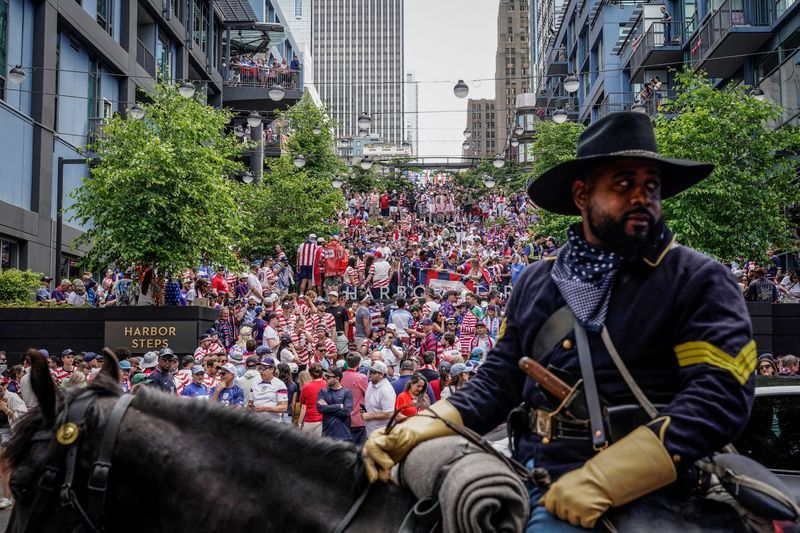
The 2026 FIFA World Cup has scattered itself across North America, and in doing so, has given sixteen cities an opportunity to showcase not just their sporting infrastructure, but their character, diversity, and deep connections to the world's most beloved game. Reuters photographers stationed throughout the tournament have documented these host communities at work and play, capturing moments that reveal how football transcends sport and becomes a reflection of society itself.
In Mexico City, the legendary Estadio Azteca has naturally drawn international attention as the venue for some of the tournament's marquee matches, continuing a tradition of hosting historic World Cup moments. Yet the true story lies beyond the famous stadium's walls. Photographer Raquel Cunha discovered that football's grip on the capital extends into ordinary neighbourhoods, where communities have physically reshaped their geography to accommodate pitches where children and adults gather. This grassroots passion represents the foundation upon which Mexico's football culture stands, a reality often invisible to those watching from the broadcast booth.
Westward in Guadalajara, nostalgia intertwines with present-day celebration. Locals still carry memories of Pelé's 1970 appearance in their city, and the recent unveiling of a statue honouring the Brazilian legend speaks to football's power to transcend generations. More striking than monuments, however, has been the spontaneous fellowship that emerged between rival supporters. Mexican and Colombian fans moved beyond their teams' competitive relationship to share meals, attend gatherings together, and create an atmosphere where supporting the opposing nation felt as natural as supporting one's own. This phenomenon reveals how the World Cup functions as a temporary suspension of national boundaries, replaced instead by human connection.
Monterrey's football culture operates through different rituals altogether. Here, the game weaves into the fabric of daily social life, where backyard gatherings paired with grilled meat and cold beverages become the setting for football discussion and appreciation. Such informal spaces, often overlooked in official tournament narratives, represent how deeply embedded the sport remains in Mexican identity across regions and social contexts.
Miami presented a different dynamic entirely. With its substantial Latin American population already in place, the World Cup did not arrive as an extraordinary disruption but rather as a natural extension of existing community life. Photographer Amanda Perobelli noted that the tournament felt almost seamless within the city's fabric, though the Florida heat and humidity posed genuine challenges for those tracking the action across multiple days. Yet the fans demonstrated remarkable resilience, undeterred by meteorological conditions that would have dampened enthusiasm elsewhere.
Texas embraced the tournament with characteristic grandeur. The scale of everything—from portion sizes at barbecue restaurants to six-lane highway systems to stadium capacities—impressed photographers Phil Noble and Hannah McKay alike. Mexican-shirted supporters appeared everywhere throughout the state, and interestingly, many voluntarily backed visiting nations when Mexico was not competing. Hannah McKay's presence at an Argentina match where Lionel Messi broke the men's World Cup goal-scoring record captured an atmosphere she describes as genuinely incredible, demonstrating how individual moments of athletic achievement can crystallise the emotional intensity of massive crowds.
Atlanta's unconventional stadium design—featuring a retractable roof and recessed seating that departs from traditional football architecture—initially seemed an oddity. Yet Claudia Greco discovered that this structural distinctiveness did not diminish atmosphere. Instead, the fan zones overflowed with energy, restaurants transformed into viewing venues, and local hospitality businesses experienced booming trade. The physical space facilitated rather than hindered community gathering.
Los Angeles, typically a city of isolated, car-dependent neighbourhoods, underwent a temporary transformation. Daniel Cole observed that residents and visitors emerged from their vehicles into the streets in unprecedented numbers, creating spontaneous communities organised around football. The various diaspora populations—Iranian, South Korean, Mexican—used the tournament as an occasion to publicly express their cultural heritage and national pride. For Carlos Barria in San Francisco, this diaspora enthusiasm carried particular significance given recent shifts in American migration policy. The World Cup provided immigrant communities a space to celebrate their origins openly, while simultaneously introducing American citizens to cultures they might otherwise never encounter directly. This cultural exchange, Barria suggests, represents the tournament's deeper purpose beyond tactical football.
Kansas City, straddling the Kansas-Missouri border, demonstrated that football had integrated itself successfully into a landscape historically dominated by baseball and American football. Kai Pfaffenbach found an overwhelmingly positive atmosphere where people gathered specifically to enjoy themselves and celebrate the game collectively, indicating that football's appeal transcends regions with established soccer traditions.
Philadelphia presented a notable contrast to other host cities. Siphiwe Sibeko, accustomed to covering football tournaments in South Africa where such events dominate public consciousness for weeks, found that World Cup atmosphere in Philadelphia largely concentrated around match days and stadium vicinity. Between matches, the tournament nearly disappeared from public awareness—a reflection of how American sporting consciousness divides itself among competing codes and seasons. This observation suggests that despite the tournament's global reach, regional sporting traditions retain powerful influence over local engagement levels.
New York embodied the tournament's ability to coexist alongside other major sporting narratives. Norwegian fans performed their traditional Viking row chanting, Latin American supporters claimed Times Square for pre-match celebrations, and simultaneously, the city celebrated the Knicks' first NBA championship in over fifty years. For Dylan Martinez, this simultaneous celebration of multiple sporting narratives confirmed New York's reputation as a city where diverse experiences unfold in constant parallel.
Boston photographer Brian Snyder possessed unique perspective, having covered the 1994 World Cup when the United States last hosted the tournament. Comparing that experience to the present revealed a substantial increase in fan engagement and visible support. Beyond the internationally documented embrace of Scotland's Tartan Army, Snyder observed that Haitian, Moroccan, and Cape Verdean communities mobilised to support their national teams—evidence of how major sporting events activate diaspora identities and create temporary spaces where immigrant communities assert cultural visibility.
Toronto offered unexpected dimensions beyond football itself. Bernadett Szabo's encounter with a falcon family residing at the stadium—mama, papa, and four chicks—reminded observers that stadiums function as ecosystems independent of human sporting purposes. Meanwhile, Vancouver presented a subdued atmosphere compared to other host cities. For Agustin Marcarian, accustomed to Buenos Aires' fervent football culture, the tournament felt less integrated into civic life, requiring deliberate effort to locate visible signs of the World Cup within the Pacific coastal city. Finally, Seattle embodied the American approach to sport as comprehensive entertainment experience. Albert Gea observed crowds dressed entirely in patriotic colours during American matches, supported by abundant concession stands designed to maximise consumer experience. This approach transforms football from isolated sporting contest into broader cultural event embedded within entertainment infrastructure.

