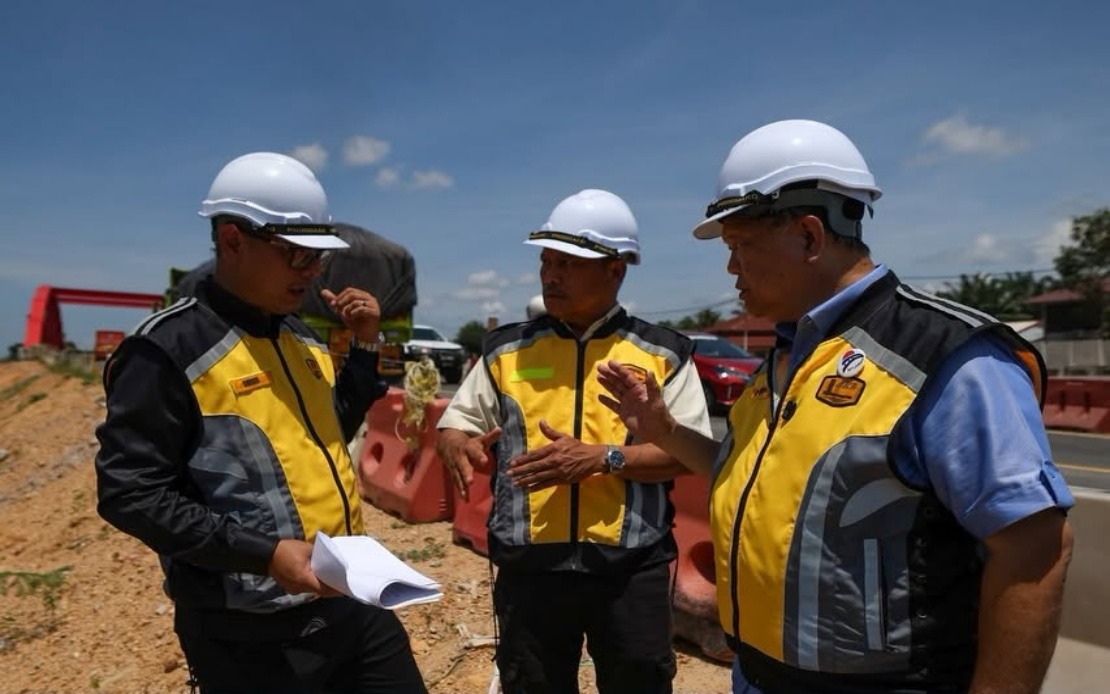
Works Minister Datuk Seri Alexander Nanta Linggi has taken direct action to break a cycle of persistent delays affecting the Sungai Durian Bridge Replacement Project in Kuala Krai, issuing a formal instruction to the contractor to significantly accelerate construction efforts. The minister's intervention comes despite the project already having received six separate Extensions of Time, a troubling sign that routine deadline adjustments have failed to produce tangible progress. His decision to visit the site unannounced underscores the seriousness with which the ministry views the situation and his determination to assess firsthand the obstacles preventing completion.
The project's technical challenges have proven more complex than initially anticipated, with borepile installation works encountering significant obstacles from existing utility pipelines running beneath the site. These underground infrastructure conflicts have disrupted the foundational work essential to supporting the bridge structure, creating cascading delays throughout subsequent construction phases. Beyond this, engineers have identified problems with the temporary support framework designed to hold the steel bridge components during assembly, requiring redesign work and additional safety protocols that have further compressed the already-stretched timeline.
Nanta's public statement, delivered via his official Facebook page, conveyed an unmistakable message to both the contractor and the broader public that indefinite delays are no longer acceptable. He emphasized that repeated Extensions of Time, while technically allowing the project to remain within contractual bounds, represent a failure to deliver infrastructure to the communities that depend on it. The Sungai Durian Bridge serves as a vital transportation link for residents in the Kuala Krai district, and prolonged construction disrupts local commerce, commutes, and daily activities.
The minister has explicitly directed the contractor to deploy additional human resources and equipment to the construction site, effectively demanding a surge in productive capacity to compensate for lost time. This approach reflects a common strategy in project recovery where throwing additional workforce at problem areas can sometimes compress timelines, though success depends heavily on whether bottlenecks are resource-constrained or fundamentally technical in nature. The instruction also mandates swift resolution of the technical issues through enhanced collaboration with the Public Works Department, creating a structured oversight mechanism to prevent future communication breakdowns.
For Malaysian infrastructure development broadly, the Sungai Durian Bridge situation exemplifies broader challenges in project delivery that have plagued numerous government initiatives. Cost overruns and timeline extensions have become almost routine features of major construction projects across the country, eroding public confidence in procurement processes and project management capabilities. This pattern raises uncomfortable questions about whether contract bidding procedures adequately account for site-specific challenges, whether contingency planning proves sufficient, and whether contractor selection adequately weighs technical capacity against price considerations.
The bridge replacement project holds particular significance for Kelantan's regional development, as improved transportation infrastructure can catalyze economic activity and improve connectivity between agricultural and manufacturing zones. The delay effectively postpones these potential benefits while simultaneously imposing costs on the local population through traffic disruptions and extended detours. Nanta's firm stance signals recognition that infrastructure delays carry real economic and social consequences extending well beyond the construction site itself.
From a governance perspective, the minister's personal intervention represents a necessary escalation when standard monitoring procedures fail to produce results. The Public Works Department presumably conducted routine progress reviews before the situation deteriorated to a point requiring ministerial attention, suggesting that existing oversight mechanisms may lack sufficient enforcement authority or that contractors had grown complacent regarding deadline commitments. By personally visiting the site and issuing direct orders, Nanta established clear political accountability for project completion, creating pressure that institutional monitoring alone apparently could not generate.
The contractor now faces explicit performance expectations backed by ministerial authority, fundamentally altering the project's negotiation dynamics. Any further delays will carry explicit political consequences for both the contractor and potentially for senior departmental officials, generating powerful incentives for genuine acceleration rather than incremental progress. This approach recognizes that infrastructure projects sometimes require forceful intervention to overcome entrenched obstacles, though such interventions also highlight systemic weaknesses in planning and execution that merit deeper institutional reform.
Looking forward, successful acceleration will depend on whether the underlying technical issues can genuinely be resolved through increased effort and resources, or whether physical constraints limit possible completion speeds. The borepile and temporary support structure challenges require engineering solutions that cannot be rushed without compromising structural integrity or safety. Nanta's directive essentially demands that the contractor prove these problems are solvable through dedication rather than being inherently intractable, placing the burden squarely on project management to demonstrate capability and commitment.

