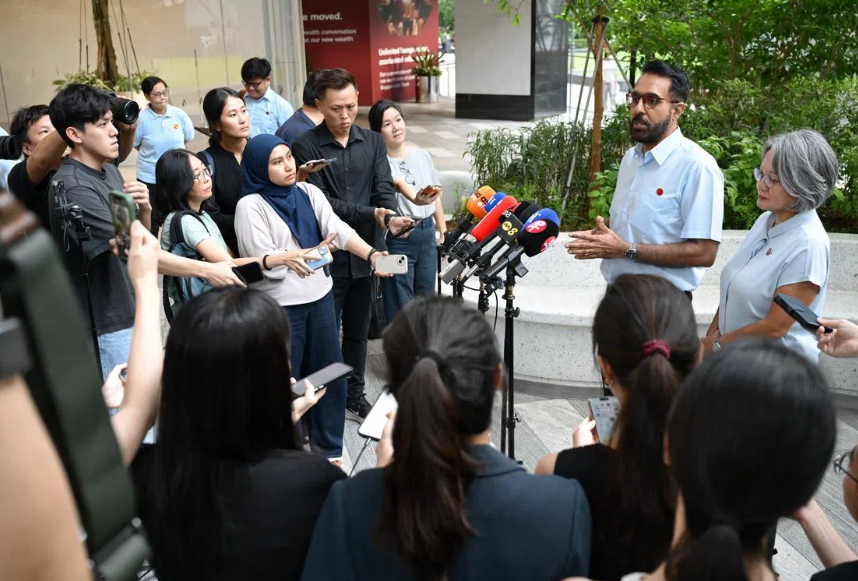
The Workers Party has moved decisively to put its internal turmoil to rest, with cadres voting decisively to keep Pritam Singh at the helm despite a conviction for lying to Parliament that has shadowed the party for years. Singh emerged from nearly six hours of meetings on June 28 with an air of confidence, declaring the party "pretty united" after securing a supermajority of 82 votes from 106 cadres at a special conference. His authority intact and internal challengers neutralised, Singh now faces the more complex challenge of rebuilding the opposition party's standing among moderate voters who may view his continued leadership as a liability to political credibility.
The vote concluded a period of genuine uncertainty within the party that had begun in 2021 when revelations surfaced that former Sengkang GRC Member of Parliament Raeesah Khan had fabricated an account of police mistreatment during a parliamentary speech. A subsequent inquiry by Parliament's Committee of Privileges determined that Singh had facilitated Khan's deception by allowing her fabrication to persist without correction. Following his conviction in court and its affirmation by the High Court in December 2025, Parliament passed a motion declaring him unsuitable to continue as Leader of the Opposition, leading Prime Minister Lawrence Wong to remove him from that specific post.
Despite these developments, the party's institutional machinery remained remarkably steadfast. Senior figures, including former party chief Low Thia Khiang, publicly endorsed Singh ahead of the June 28 meetings, and the party's leadership refused to nominate an alternative member to fill the Leader of the Opposition role, signalling their continued confidence in him. The party's disciplinary process, while finding that Singh had violated the party's Constitution, resulted in merely a formal letter of reprimand—a response that observers characterised as lenient given the gravity of his infraction. This pattern of institutional support proved decisive when cadres were asked to vote.
The absence of a credible challenger to Singh proved telling. Despite efforts by dissident cadres to recruit an alternative candidate in the weeks leading to the conference, no one with sufficient standing stepped forward. This reflects a broader reality within the opposition party: Singh remains its most publicly prominent figure, with unmatched parliamentary experience and name recognition. No other Workers Party member commands the combination of seniority and public profile necessary to mount a genuine leadership challenge, making his removal practically untenable regardless of the circumstances. His cadres understood this dynamic and voted accordingly, preferring institutional continuity to uncertain succession.
Yet the vote masks deeper tensions about the relationship between political pragmatism and democratic principle. When asked directly about those who might view the Workers Party as being "run by a convicted liar," Singh deflected by directing questioners to his website and repeating previous parliamentary statements without substantively addressing the character question raised. This response, while politically expedient, sidesteps rather than resolves the credibility challenge facing the party. For voters positioned in the political centre—the demographic most crucial for opposition electoral growth—questions about integrity in leadership carry considerable weight, and reassertion alone may prove insufficient.
The party's leadership has pointed to electoral results as vindication of their position. The May 2025 general election, held after Singh's lower court conviction but before the High Court's affirmation, saw the Workers Party not only maintain its existing constituencies but gain two Non-Constituency Member Parliament seats, expanding its parliamentary footprint. Party officials interpret this outcome as evidence that voters have either forgiven Singh or deprioritised his legal troubles compared to policy considerations and performance in parliament. This reading of voter sentiment, however, may underestimate the importance of political credibility in long-term opposition development, particularly as the party seeks to broaden its appeal beyond its established base.
The consolidation of party unity around Singh carries both immediate advantages and latent risks. In the short term, the absence of public infighting protects the Workers Party from the destructive internal battles that have periodically undermined other opposition movements in the region. Several opposition parties across Southeast Asia have suffered acute electoral damage from visible leadership disputes, suggesting that Singh's cadres made a pragmatic calculation in preventing such spectacle. With internal matters settled, the party can ostensibly redirect energy toward parliamentary performance and constituency work.
Yet the very rapidity with which dissent was suppressed—insufficient cadres voted against Singh to create a genuine intra-party debate, and the vote of no confidence failed to generate the contested discussion its proponents envisioned—raises questions about the health of the party's internal culture. A robust opposition party should tolerate serious questioning of leadership without requiring unanimity, and the difficulty in even mounting a formal challenge suggests that internal discussion may have been constrained. This dynamic mirrors broader patterns in Singapore's political environment, where the dominance of one political force can suppress contestation even within opposition structures.
Party chair Sylvia Lim's comments about leadership renewal add another layer to this assessment. Acknowledging her 23-year tenure and hinting that "someone else" may appear at future media conferences, Lim signalled awareness that the party cannot indefinitely depend on Singh and her own stewardship. Yet the absence of obvious successors underscores a potential vulnerability. The Workers Party has not demonstrably developed a second or third tier of leadership capable of sustaining the party's trajectory should political circumstances force a change. This succession deficit makes the party appear dependent on individuals rather than institutions—a structural weakness in long-term opposition development.
The Singapore context shapes these dynamics significantly. The Workers Party operates as the only credible opposition voice in a parliament dominated overwhelmingly by the People's Action Party, which commands 83 of 93 seats. This imbalance, while ensuring the Workers Party's relevance as a check on government, also means it faces considerably less electoral and media scrutiny than opposition parties in more competitive systems. Voters may be more forgiving of leadership controversies precisely because alternatives appear limited. For Malaysians observing this situation, the relative weakness of opposition structures across the region becomes apparent: even in developed city-states with educated electorates, building durable opposition institutions capable of transcending individual personalities remains profoundly challenging.
Looking forward, Singh's political survival hinges partly on the party's ability to convert parliamentary performance and expanded representation into tangible policy wins or at minimum visible effectiveness in scrutinising the government. The Workers Party's recent electoral gains provide a platform for such demonstration, but whether Singh can rebuild sufficient political credibility to anchor long-term party growth remains uncertain. The conviction will likely remain a limiting factor in attracting voters from the political centre—those whose support determines whether an opposition party can genuinely threaten incumbency.
The party's decision to close ranks behind Singh reflects a calculation that institutional unity outweighs the reputational costs of backing a convicted leader. Whether this gamble pays off depends on whether voters ultimately view the matter as a closed chapter or as a persistent indicator of questionable judgment and integrity. The Workers Party has secured internal peace, but whether it can convert that peace into electoral advancement among the moderate voters necessary for opposition breakthrough remains the critical unanswered question.
For opposition movements across Southeast Asia, the Workers Party's experience offers a cautionary lesson: unity without principle can be costly, and leaders who survive internal challenges through institutional advantage rather than genuine democratic renewal may find their authority ultimately hollow when facing public judgment.

