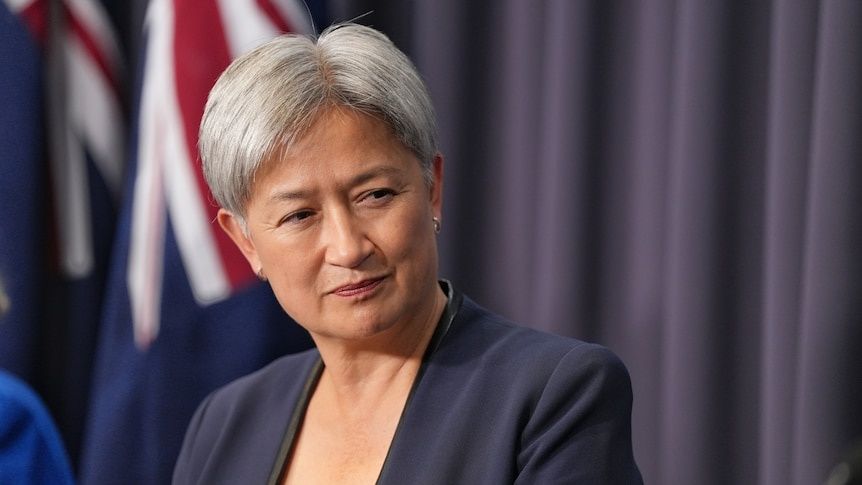
Australia's Foreign Minister Penny Wong is mounting a vigorous defence of multiculturalism ahead of potentially significant political shifts, arguing that cultural diversity rather than homogeneity represents the country's authentic identity and strategic advantage. In remarks prepared for delivery to the Lowy Institute in Sydney on Friday, the Malaysian-born Wong—who holds the distinction of being Australia's first Asian-federal minister—will articulate a vision of Australia as inherently multicultural, rejecting calls from the ascendant One Nation party for what it terms a "monoculture" approach to national identity and policy.
Wong's intervention carries particular weight given her own biographical significance within Australia's political establishment. As the first minister of Asian descent to reach federal cabinet level, her position allows her to speak with personal authority about integration and national belonging. The speech represents an effort to counter the narrative that One Nation has successfully amplified over recent months, one that frames Australia's multicultural character as a liability rather than an asset. Her remarks will highlight how half of all Australians were born overseas or have at least one parent born abroad, according to census data, underscoring the demographic reality that cultural diversity is not a recent phenomenon but rather foundational to modern Australia.
The timing of Wong's address reflects genuine anxiety within the Labor government about One Nation's political trajectory. Opinion polls show the party has become Australia's most popular political force this year, positioning it potentially to hold significant influence in any coalition negotiations following the next federal election scheduled for 2028. Pauline Hanson, One Nation's leader, has drawn frequent international comparisons to figures like United States President Donald Trump and France's Marine Le Pen, highlighting the broader populist currents running through Western democracies. The senator's recent public invocations of Australia's historical "White Australia" policy—which formally restricted non-white immigration until abandoned in the 1970s—caused considerable uproar and crystallised concerns about the direction One Nation intends to push national conversation.
Wong's framing positions the multicultural question as more than a domestic cultural matter; she will argue that embracing cultural homogeneity would fundamentally weaken Australia's international position. In her prepared remarks, she contends that the "melancholic fantasy of a monoculture" would damage Australia's security architecture and commercial relationships globally. This argument reflects a sophisticated understanding that middle powers like Australia maintain their strategic relevance through economic connections, cultural soft power, and diplomatic networks that depend fundamentally on openness to international engagement. By contrast, One Nation has signalled intention to revisit Australia's commitments to international organisations and to reduce foreign aid, positions that align with its broader nationalist orientation.
The Foreign Minister will emphasise how refugees and first-generation migrants have contributed visibly to Australia's success in business and sport, providing concrete examples of how cultural integration has strengthened rather than diluted national achievement. She plans to warn explicitly against what she characterises as "external and internal forces" seeking to exploit divisions within Australian society for narrow political advantage. This language suggests concern that foreign actors may be amplifying already-present social tensions while domestic political figures capitalise on economic anxieties to advance restrictionist agendas. Wong's assertion that "those who seek to divide us for clicks and votes should know that they make us weaker at home and more vulnerable in the world" connects domestic cohesion directly to national security and international standing.
The Australian government under Prime Minister Anthony Albanese has acknowledged that genuine economic pressures—particularly surrounding housing affordability and cost-of-living concerns—have created vulnerability to populist messaging. Rather than dismissing these concerns, Labor has indicated it intends to announce policy adjustments to immigration levels while maintaining that such changes need not involve stigmatisation or deliberate community division. Albanese himself invoked his Italian heritage in recent comments affirming that modern Australia is multicultural, attempting to model an approach to national identity that respects both diversity and the reality of legitimate policy debates about immigration scale and composition.
The political context extends beyond Australia's borders in ways particularly relevant to Southeast Asia and the wider region. Australia's positioning as an increasingly important security and economic partner to countries including Malaysia, Singapore, and Indonesia depends substantially on its international credibility and its ability to maintain stable relationships with diverse populations and nations. A shift toward nationalist isolation would alter the strategic calculus across the Indo-Pacific region and potentially create uncertainty about Australia's commitment to regional institutions and arrangements that have underpinned stability and prosperity.
Wong's intervention also reflects broader concerns within Australia's foreign policy establishment about the sustainability of the international rules-based order in an era of great power competition. She plans to highlight how military power, economic coercion, and control of critical materials and technologies are increasingly being weaponised to constrain the choices available to middle powers. In this context, she views cultural and economic openness not as vulnerabilities to be closed off but as sources of resilience and connectivity. The suggestion that adopting a "monoculture" approach would represent a curtailment of Australia's options reflects this strategic calculus—that diversity of international partnerships and domestic cultural resources strengthen rather than weaken national capacity to navigate an increasingly contested global environment.
The government's approach to the immigration debate suggests recognition that One Nation's rise reflects real anxieties rather than merely irrational prejudice, but also determination to shape how those anxieties are addressed and resolved. By positioning immigration policy adjustment as consistent with multicultural values rather than as a capitulation to monoculturalist demands, Labor seeks to occupy middle ground between acknowledging legitimate concerns and resisting the more radical cultural transformation that One Nation advocates. How successfully this navigation occurs will likely influence not only Australia's domestic political trajectory but also its standing and influence across Southeast Asia and the Indo-Pacific region more broadly.

