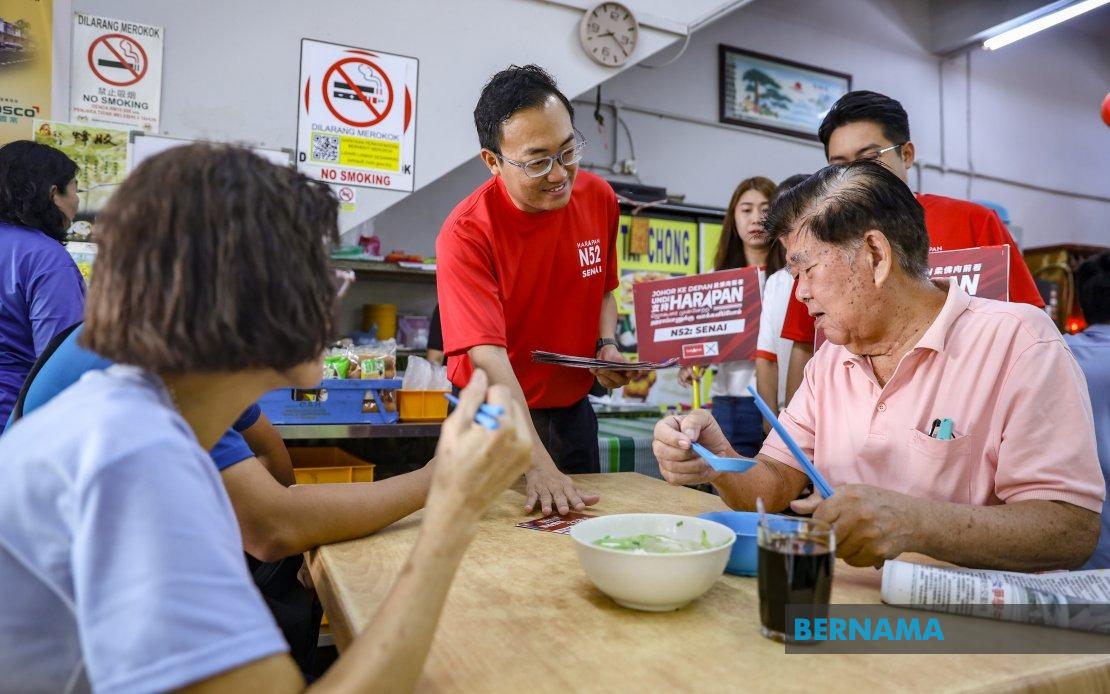
Wong Bor Yang, the incumbent assemblyman for Senai, is mounting his re-election campaign on the foundation of practical accomplishments achieved during his previous tenure, confident that Pakatan Harapan will retain the seat in Johor's 16th state election scheduled for July 11. The candidate has structured his appeal around tangible infrastructure and welfare initiatives rather than partisan rhetoric, positioning himself as someone capable of delivering results across political divides.
During his earlier parliamentary term, Wong has established himself as a persistent advocate for flood mitigation in the constituency. He highlighted his efforts in securing government funding to address chronic flash flooding that has plagued multiple neighbourhoods. His approach combined petitions and assembly debates to pressure relevant agencies, eventually resulting in RM1 million allocated for drainage upgrades in Taman Aman, channelled into Sungai Skudai. An additional RM3 million was subsequently obtained through collaboration with Kulai Member of Parliament Teo Nie Ching, targeting drainage systems in Peladang Kulai Besar and Saleng, thereby removing both areas from the district's inventory of recurring flood hotspots.
Wong's professional background as a journalist has informed his approach to constituent services and community engagement. He framed his experience spanning over a decade as encompassing multiple roles within Malaysia's evolving political landscape, beginning with work as a special officer at the Kulai MP's office from 2014. This progression from opposition-aligned representative to government-affiliated local councillor in 2018, subsequently to state assemblyman, has provided him exposure to governance from various vantage points. He contends this breadth of experience equips him to navigate bureaucratic systems more effectively than newcomers to electoral politics.
Beyond infrastructure, Wong has invested in cultural and recreational heritage projects. He orchestrated the conversion of a derelict cinema into a community operations centre and oversaw rehabilitation of an aging badminton facility into a family recreation area designated Tiny Lake under the Sejati MADANI programme. These initiatives reflect an understanding that state assembly work extends beyond physical infrastructure into preserving local identity and enhancing quality of life. The projects underscore his thesis that effective local governance requires attention to diverse community needs rather than narrow policy focus.
Healthcare provision emerges as Wong's identified priority should he secure a second term. He has been vocal regarding inadequacies at Kulai Hospital, whose 93-bed capacity he argues will prove insufficient for the district's projected population of 500,000 by 2030. A graduate of Shih Hsin University in Taiwan, Wong brings a journalism-informed perspective to advocacy, having consistently raised this issue through multiple channels. He has also flagged bureaucratic impediments delaying construction of a new health clinic in Taman Mewah, Senai, where unresolved land issues at state level have stalled Health Ministry progress.
The electoral landscape in Senai presents a three-way contest among 66,635 registered voters. Wong confronts competition from Barisan Nasional's Tai Chee Chee and independent candidate Tew Chien How associated with Bersama. His campaign messaging emphasizes voter sophistication, particularly within what he describes as the politically mature and dynamic Bangsa Johor electorate. Wong argues that constituents increasingly discriminate between substantive track records and campaign promises unmoored from delivery capacity, a claim that reflects broader shifts in Malaysian electoral behavior toward performance-based evaluation.
Wong's positioning carries implications for Pakatan Harapan's Johor strategy heading into the election. His emphasis on practical accomplishment rather than ideological differentiation may resonate in state seats where swing voters determine outcomes. The focus on flood management and healthcare speaks to immediate quality-of-life concerns that transcend partisan boundaries. In constituencies where opposition parties previously held seats, such demonstrated capacity to deliver during earlier terms provides evidence counter to narratives of governmental ineffectiveness.
The timing of Wong's campaign also reflects Johor's broader political dynamics. The state has experienced coalition shifts and recalibrations, with Bangsa Johor sentiment playing an increasingly important role in electoral calculations. Wong's appeal to local consciousness through heritage preservation and community infrastructure suggests recognition that state-level elections increasingly turn on parochial concerns rather than national political currents. His willingness to operate within government structures while maintaining constituent focus may offer Pakatan Harapan a template for defending marginal seats.
Looking toward the July 11 polling date, with early voting scheduled for July 7, Wong's campaign represents the practical ground game that determines outcomes in closely contested three-way races. His strategy of emphasizing verifiable accomplishments—specific funding amounts, project names, and tangible outcomes—provides voters with concrete reference points. This approach stands in contrast to campaigns relying on broader political messaging, potentially advantageous in a constituency where infrastructure vulnerabilities like flooding create demand for evidence of governmental responsiveness.
Wong's trajectory from opposition representative to government participant also reflects the complexity of Malaysian electoral coalitions. His ability to function across political administrations, securing resources when in opposition and leveraging governmental position when in power, demonstrates adaptive capacity valuable in fluid political environments. Whether this pragmatic approach resonates with Senai voters will become apparent on July 11, with broader implications for how Pakatan Harapan campaigns across Johor's remaining state seats.

