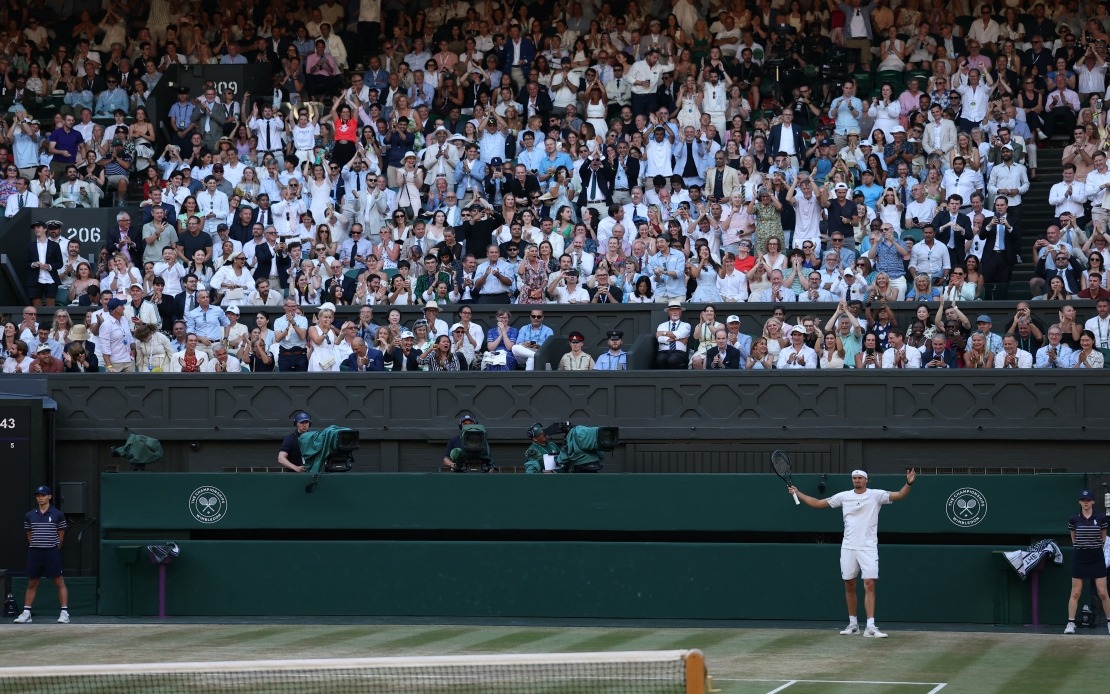
The 2026 Wimbledon Championships delivered a quartet of matches that will linger in the memory long after the grass courts return to their winter dormancy. Jannik Sinner's four-set triumph over Alexander Zverev in the men's singles final provided the tournament with a compelling conclusion, as the Italian captured his maiden grand slam title in southwest London. Yet the fortnight's true drama extended well beyond Centre Court, with several matches encapsulating the raw emotion, physical endurance, and human resilience that make Wimbledon a singular occasion in professional tennis.
The women's final between first-time grand slam finalist Marketa Noskova and her opponent became an unlikely study in redemption and psychological fortitude. Noskova's journey to the trophy hinged upon her ability to recover from a devastating collapse in the second set, where she surrendered five championship points after establishing a commanding 5-2 lead. The manner of her escape inevitably conjured memories of Jana Novotna, the late Czech legend whose tears on the shoulder of the Duchess of Kent following her loss to Steffi Graf in the 1993 final remains one of sport's most poignant images. Novotna endured a five-year wait before capturing her own grand slam crown at Wimbledon in 1998. Noskova, at just 21 years old, appeared determined to rewrite her own narrative more swiftly, reportedly walking past the championship trophies during a bathroom break and pledging to herself: "I'm taking the big one!" Her ultimate success in a wild final suggested that youthful conviction had proven justified.
British wild card Jack Fery emerged as the human interest story of the entire Championships, engineering an improbable run to the semi-finals that captured the imagination of the home crowd and commentators alike. The 23-year-old from Wimbledon, ranked 114th in the world, found himself trailing by a set on two separate occasions during his quarter-final encounter against Zizou Bergs on the sweltering Court 18. Fery endured three separate nosebleeds as temperatures soared, struggling physically yet displaying remarkable mental resilience as he clawed back from 4-1 deficits in both the fourth and fifth sets. His opponent Bergs, ranked 77 places higher, eventually succumbed to the pressure and the oppressive heat, losing composure as Fery held his nerve through a championship tie-break. The victory carried particular significance for British tennis, as Fery became only the fifth homegrown male player this century to advance to the second week at the All England Club, a statistic that underscores how rare such achievements have become for the tournament's host nation.
Novak Djokovic's quarter-final marathon against Felix Auger-Aliassime proved simultaneously heroic and cautionary, a five-hour 15-minute ordeal that ultimately extracted too steep a price from the 39-year-old Serbian. The match stretched to become the longest quarter-final in Wimbledon history, concluding with just eight minutes remaining before the venue's 11pm curfew. Djokovic displayed familiar flashes of genius and stubbornness in equal measure, battling through an early calf injury that required medical attention at the end of the opening set and subsequently engaging in a heated confrontation with tournament referee Denise Parnell over the closure of Centre Court's roof. The 24-time grand slam champion ultimately prevailed against the third seed, but his reserves of energy and resilience had been depleted to dangerous levels. His subsequent semi-final encounter with Sinner saw him unable to recapture the form and physicality required to overcome the tournament favourite, signalling perhaps the beginning of a gradual transition for one of tennis's greatest competitors.
Coco Gauff's narrow escape against Karolina Muchova in the semi-finals exemplified the wafer-thin margins that separate victory from heartbreak at the sport's highest level. The encounter resolved itself through a single, unforgettable tie-break that consumed a pulsating 18 minutes of play and saw both competitors hold match points in rapid succession. At eight points apiece, Muchova received a time violation before sending her next shot long, presenting Gauff with the first opportunity to close out the match. Yet the American faltered dramatically, depositing what appeared to be a straightforward drop-shot winner into the net with the match apparently at her mercy. Muchova's next chance seemed equally promising until she catastrophically slipped as she prepared for a volley, allowing Gauff's cross-court forehand to pass her defensively. The Czech ninth seed ultimately made no mistake with her subsequent opportunity, demonstrating superior court management and forcing the exhausted Gauff into an error, but the psychological toll on both players underscored the thin line between triumph and despair at this level.
Serena Williams' emotional return to professional competition at age 44 and nearly four years after stepping away from the sport captured the public imagination in ways that transcended mere tennis. The American legend's arrival at Centre Court sparked a standing ovation that visibly moved her, while her early dominance against Australian opponent Jill Teichmann raised tantalizing possibilities of an improbable victory. Teichmann, 24 and born after Williams first won at Wimbledon, found herself a break down in the deciding set as Williams' formidable power and experience initially overwhelmed her younger rival. However, Williams gradually lost momentum during the final stages, a decline that proved attributable to a knee injury sustained late in the opening set. Teichmann's composed response to the magnitude of the occasion and the presence of such a sporting colossus across the net demonstrated the emerging quality of the next generation, while Williams' resilience in competing as far as she did on an injured knee represented its own form of victory, even in defeat.

