Welfare systems must be continually enhanced to guarantee that individuals experiencing hardship receive adequate assistance and social protection, according to Minister of Entrepreneur Development and Cooperatives Steven Sim Chee Keong. Speaking during a visit to Butterworth on August 9, Sim underscored the inseparable link between a nation's economic advancement and its commitment to the welfare of its citizens, particularly those navigating challenging circumstances. He stressed that because life circumstances vary considerably from person to person, a functioning welfare apparatus becomes essential for ensuring stability and dignity across society.
Sim's remarks reflected broader concerns about inequality and social fragmentation in Malaysia. He articulated a vision where progress and prosperity serve not merely as economic metrics, but as measures encompassing the protection and dignity of all Malaysians. The minister's emphasis on welfare as a foundational element of state responsibility resonates with ongoing debates about inclusive development across Southeast Asia, where rising living costs and economic uncertainty have intensified pressure on vulnerable populations. By framing welfare expansion as a governance imperative rather than optional charity, Sim positioned the government's role in supporting disadvantaged communities as a matter of national priority.
Particular emphasis was placed on welfare initiatives as mechanisms for fostering social cohesion across Malaysia's multiethnic and multireligious society. According to Sim, robust assistance programmes create pathways for building compassionate communities where citizens of different ethnic and religious backgrounds develop shared responsibility for one another's wellbeing. This framing addresses a critical dimension of Malaysian governance, where social programmes serve simultaneously as economic instruments and as tools for strengthening national unity. The minister argued that welfare should transcend narrow sectoral interests, operating instead as a unifying force that recognises shared human vulnerability and interdependence.
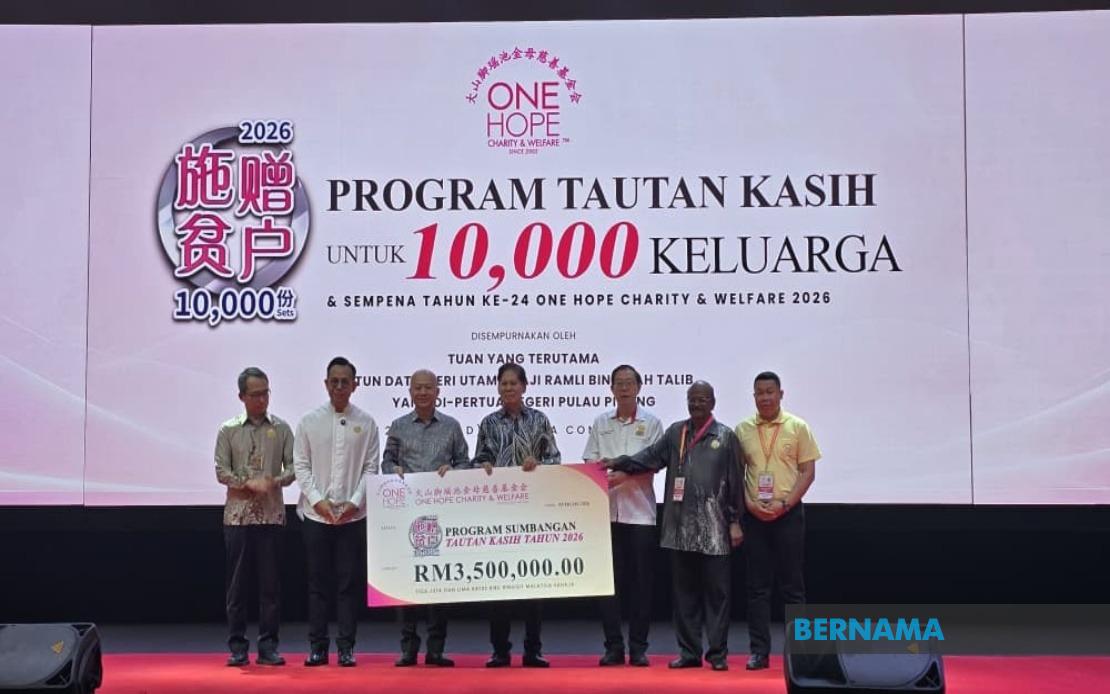
One Hope Charity emerged as a practical exemplar of welfare provision in action. The organisation demonstrates how private sector engagement and community networks can mobilise resources for systematic assistance regardless of beneficiaries' background. Founded in Bukit Mertajam as a modest initiative, One Hope Charity has evolved into one of Penang and Malaysia's most substantial welfare organisations, distributing at least RM20 million annually to communities across its operational areas. This trajectory illustrates how sustained commitment to social welfare can generate institutional capacity and community trust, transforming grassroots efforts into comprehensive assistance networks.
The scale of One Hope Charity's operations provides concrete evidence of need across Malaysian communities. During the current year, the organisation extended assistance to more than 10,000 families, with each household receiving support valued at approximately RM320. This assistance comprises both tangible goods—essential items and daily necessities—and cash transfers of RM200 per family, enabling recipients to address their most pressing individual needs. The dual approach of in-kind and cash assistance reflects evolving understanding about effective welfare delivery, recognising that standardised support cannot address the diverse requirements of different households.
Over the period from 2021 to 2025, One Hope Charity channelled more than RM100 million toward comprehensive welfare programming. Beyond immediate poverty alleviation, these funds supported medical treatment for patients, strengthened government hospital capacity through financial contributions, procured essential medical equipment, and funded diverse welfare schemes addressing specific community vulnerabilities. This diversified approach acknowledges that welfare extends beyond income support to encompass healthcare access, a critical concern in societies where medical expenses frequently precipitate financial crises for ordinary families. The organisation's medical focus reflects recognition that health emergencies represent a primary driver of vulnerability in developing economies.
One Hope Charity's planned expansion demonstrates confidence in escalating welfare demands across Malaysian communities. Approaching its 25th anniversary in the coming year, the organisation is developing welfare initiatives valued at approximately RM30 million. These initiatives will substantially expand the Medical Assistance Programme, extending healthcare access to additional vulnerable populations. This expansion trajectory reflects both the organisation's assessment of unmet needs and its capacity to mobilise resources for systematic assistance. For Malaysian policymakers, such expansion signals that current welfare infrastructure remains insufficient to address community vulnerabilities comprehensively.
Governor Tun Ramli Ngah Talib's presence at the event, accompanied by his wife Toh Puan Raja Noora Ashikin Raja Abdullah, underscored official recognition of welfare initiatives' significance within Penang's development framework. State-level engagement with private welfare organisations indicates government acknowledgment that comprehensive social protection requires collaboration between public institutions and civil society actors. This collaborative approach has become increasingly prevalent across Southeast Asia, where resource constraints and institutional limitations have prompted governments to formalise partnerships with capable non-governmental organisations.
Sim's statements carry implications for Malaysian welfare policy direction during a period of economic uncertainty and inflationary pressure. As cost-of-living challenges intensify across the region, welfare systems face growing demand precisely when public finances face competing pressures. The minister's emphasis on policy strengthening suggests government commitment to expanding, rather than constraining, safety nets despite fiscal challenges. This positioning contrasts with tendencies in some economies toward welfare retrenchment during economic slowdowns, reflecting Malaysian policymakers' assessment that social stability depends on maintaining or enhancing protection during downturns.
The welfare expansion framework outlined by Sim and exemplified by One Hope Charity's operations addresses a critical governance challenge: ensuring that rapid economic change and development do not leave substantial population segments behind. In Malaysia, where disparities between prosperous urban centres and less-developed regions persist, welfare policies represent instruments for distributing development benefits more equitably. By supporting vulnerable communities systematically, governments can reduce social tensions and maintain the consensus necessary for sustained development. This dimension proves especially important in multiethnic societies where economic disparities can acquire ethnic dimensions if welfare delivery lacks credibility and inclusivity.
Looking forward, the welfare agenda articulated by Sim suggests that Malaysian governance will increasingly emphasise social protection as integral to development rather than peripheral to it. One Hope Charity's trajectory—from small initiative to RM20-million-annually-distributed operator—demonstrates that systematic investment in welfare can generate substantial institutional capacity and demonstrate tangible impact on vulnerable populations. For other Southeast Asian nations grappling with similar challenges of inequality and social fragmentation, Malaysian experiences with collaborative welfare provision between government and civil society offer relevant lessons about scaling effective assistance programmes. The emphasis on welfare as a foundation for both social stability and national unity provides a framework within which development can acquire legitimacy across diverse communities.

