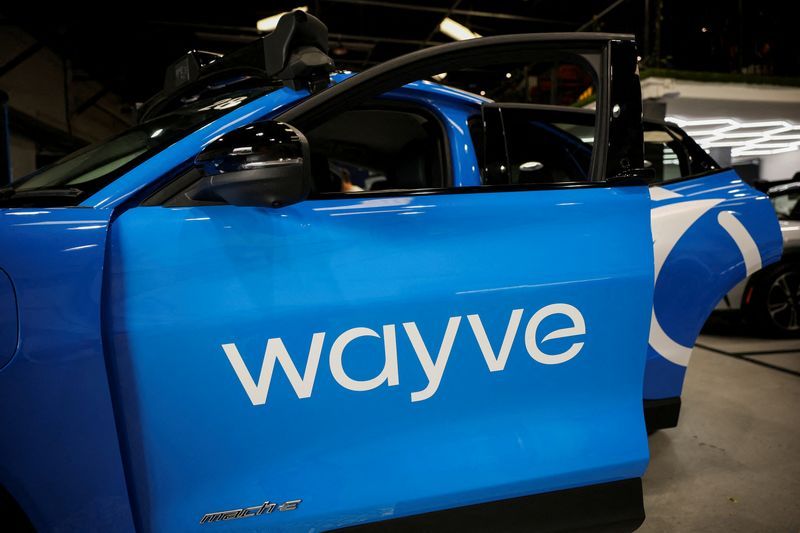
Wayve, a London-based autonomous-driving company, is capitalizing on a surge of investor confidence in the sector, having secured $2.8 billion in funding from a constellation of technology and automotive powerhouses including Nvidia, Mercedes-Benz, and Nissan. The funding round underscores growing belief among major industry players that Wayve's distinctive technological approach represents a viable pathway toward viable autonomous vehicles, with the company now preparing to deploy its systems in Stellantis vehicles operating on Uber's ride-hailing platform beginning in June.
At the heart of Wayve's proposition lies a fundamentally different philosophy about how autonomous vehicles should perceive and respond to road conditions. Rather than relying on the conventional method that combines pre-programmed software rules with high-definition mapping data, Wayve employs end-to-end machine learning—an artificial intelligence framework that processes raw sensor data and translates it directly into driving decisions, much as a human driver would instantaneously assess traffic and react appropriately. This technological divergence reflects a broader industry reassessment about which approaches might ultimately deliver safer, more adaptable autonomous systems.
Wayve's methodology shares philosophical common ground with Tesla's approach to autonomous driving, which similarly pivoted toward end-to-end learning several years ago. However, a critical distinction separates the two companies' implementations. While Tesla's system relies exclusively on camera vision as its sensory apparatus, Wayve deliberately engineered its platform to function across diverse sensor configurations and AI hardware architectures. This flexibility positions the technology as inherently licensable to virtually any vehicle manufacturer or autonomous-vehicle developer regardless of their existing sensor selections, according to the company's 33-year-old New Zealand-born CEO Alex Kendall, who founded Wayve in 2017 immediately after completing doctoral research in artificial intelligence deep learning at Cambridge University.
Kendall has articulated an expansive vision for the company's ambitions, stating that Wayve aims to democratize autonomous driving technology across all vehicle categories and global markets. Speaking from inside a Ford Mustang Mach-E equipped with Wayve's driverless system as it navigated San Francisco Bay Area streets, Kendall emphasized the company's commitment to removing geographical and manufacturing barriers that have traditionally constrained autonomous vehicle deployment. This universalist approach contrasts sharply with competitors who have pursued narrower paths focused on specific vehicle types or regional markets.
The autonomous-driving sector has experienced renewed momentum following years of disappointing timelines and overambitious claims. Alphabet's Waymo division has substantially contributed to this momentum, expanding operations over the past two years to provide paid autonomous ride services to the general public across approximately a dozen cities. Waymo's trajectory—spanning more than a decade of development before achieving commercial viability—has reignited investor enthusiasm and validation for the entire autonomous-vehicle space, signaling that technological maturity in this domain is attainable despite the lengthy development cycles required.
A decade ago, end-to-end learning methodologies were relegated to academic obscurity, pursued primarily by a handful of theoretical researchers including Kendall himself. The technological landscape has transformed dramatically as increasingly sophisticated computational resources and vast datasets have become available. Today, numerous autonomous-driving developers have incorporated at least partial end-to-end learning components into their operational systems, reflecting a wholesale methodological shift across the industry. This convergence suggests that the machine-learning approach represents a genuine technological inevitability rather than a boutique alternative.
Yet this paradigm shift introduces a troubling technical challenge that remains unresolved: the interpretability problem. End-to-end systems function somewhat like inscrutable black boxes, making it difficult for engineers or regulators to understand precisely why a vehicle made a particular driving decision in any given scenario. Traditional software-coded systems offered greater transparency—engineers could examine the programmed rules and trace the logic leading to specific actions. Nissan's technology chief Eiichi Akashi has directly confronted this challenge, describing Wayve's technology as undoubtedly advanced while simultaneously noting the fundamental difficulty in deciphering how the system arrives at its decisions. His team is conducting intensive assessment of Wayve's platform ahead of planned deployment in Japan's Elgrand people-mover van by March 2028.
Wayve engineers counter this interpretability concern with their own safety arguments. The company contends that conventional rule-based approaches, while transparent, struggle with unpredictable scenarios because writing exhaustive code to handle every conceivable traffic situation remains practically impossible. When extraordinary situations occur—circumstances that programmers failed to explicitly anticipate—pre-programmed safety systems become what Wayve's AI vice president Vijay Badrinarayanan terms "brittle," potentially failing catastrophically. By contrast, human drivers navigate safely precisely because they adapt conservatively when encountering novel situations they have not specifically encountered before. Wayve's end-to-end system, designed to mimic this adaptive capability, generates safety maps of evolving traffic scenarios and identifies secure vehicle trajectories through probabilistic prediction rather than exhaustive rule enumeration.
Waymo, the market's most commercially advanced competitor, has adopted a hybrid strategy that acknowledges merit in both approaches. The company now incorporates end-to-end AI alongside more traditional rules-based methodologies derived from software coding and mapping infrastructure, maintaining that this combined approach remains necessary to guarantee safety at commercial scale. This strategic hedging by Waymo—arguably the autonomous-driving sector's most successful operator to date—suggests that neither pure end-to-end learning nor purely rule-based approaches may independently suffice for the safety assurances required by regulators, insurers, and the public.
Wayve's geographical flexibility constitutes a significant competitive advantage if the interpretability and safety concerns can be adequately addressed. Unlike traditional autonomous-vehicle developers who have invested years in meticulous road mapping and custom code development for each new deployment region, Wayve claims its AI system operates effectively in hundreds of cities globally without requiring this preliminary infrastructure establishment. The company maintains substantial operations in Tokyo, Stuttgart, and Vancouver, positioning itself to penetrate Asian and European markets more rapidly than competitors hamstrung by locale-specific mapping requirements. This scalability represents perhaps the company's most compelling economic argument to potential partners evaluating licensing arrangements.
Academic experts remain cautiously noncommittal about whether end-to-end approaches genuinely offer superior safety outcomes compared to traditional methodologies. Siddartha Khastgir, a safe autonomy professor at the University of Warwick in England, suggests that end-to-end models should achieve faster commercial deployment than conventional approaches, yet stops short of claiming inherent safety superiority between competing paradigms. Carnegie Mellon University's autonomous-technology expert Phil Koopman similarly characterizes Wayve's methodology as one viable approach among several potentially promising alternatives. Koopman projects that safely deploying autonomous systems across the United States will require an additional decade of development and will demand technological innovations yet to be conceived or implemented.
For Malaysian and Southeast Asian stakeholders evaluating autonomous-vehicle technology adoption, Wayve's funding milestone carries significant implications. Malaysia's automotive industry, traditionally dependent on imported technology and manufacturing partnerships, faces potential disruption from autonomous-driving platforms that blur traditional supply-chain advantages. Companies considering autonomous public transportation systems or ride-hailing services must weigh whether Wayve's adaptability to diverse sensor architectures and geographical contexts presents a more implementable path than competitors requiring extensive local mapping infrastructure. As the autonomous-driving sector matures from speculation toward infrastructure deployment, the choice between competing technological philosophies will substantially shape regional competitive advantages and consumer experiences across Southeast Asia.

