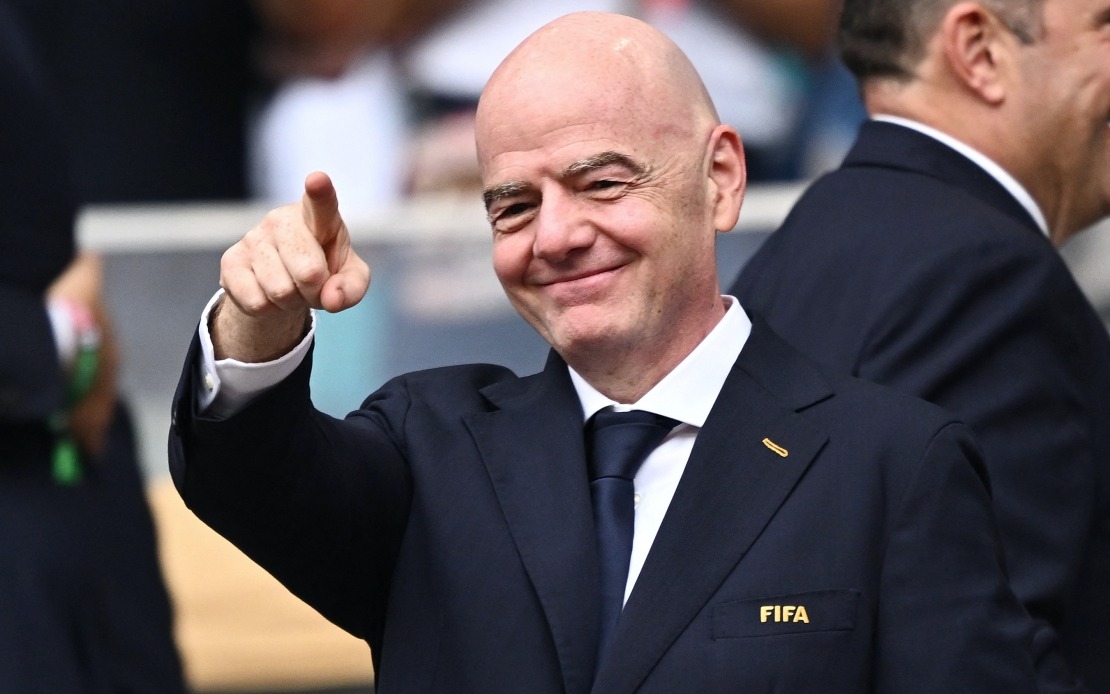
The Football Association of Wales has formally withdrawn its backing for FIFA president Gianni Infantino's bid to secure another term, marking a significant blow to the embattled leader's political standing ahead of next year's election. The decision comes in the aftermath of Infantino's controversial proposal to create FIFA Forward Enterprise, a scheme designed to attract private capital into World Cup operations that drew swift rejection from major football confederations worldwide.
Infantino announced the shelving of the FFE initiative only last week, but the reversal has done little to rehabilitate his image or restore confidence among football's governing bodies. The Welsh governing body's statement on Monday emphasised that successive lapses in governance, institutional procedures, and judgment have fundamentally eroded trust in his leadership. Officials declared that Infantino had lost the FAW's confidence in his ability to steer world football, citing his failure to prioritise the sport's core interests above commercial adventurism.
The momentum against Infantino extends well beyond Wales. On Friday, UK Prime Minister Andy Burnham characterised the FIFA chief as fundamentally unsuited to the role, while England's Football Association has called for a comprehensive examination of his stewardship. Behind the scenes, the English FA has reportedly conveyed its lack of support directly to FIFA officials, signalling that the sport's traditional powerhouses have lost patience with his direction.
Prior to the FFE controversy, the Welsh FA had indicated willingness to endorse Infantino's re-election, demonstrating that his standing among national associations has dramatically shifted. The bungled privatisation scheme appears to have served as a decisive test of leadership competence, with football authorities concluding that his judgment and stakeholder management capabilities have fallen short of acceptable standards. This reversal underscores how rapidly political allegiances can crumble once fundamental trust is breached.
Europe's continental federation UEFA delivered a pointed statement on Saturday affirming its alignment with the growing scepticism surrounding Infantino. The confederation notably avoided ruling out any procedural avenue, thereby leaving open the theoretical possibility that national associations might trigger a formal no-confidence vote. Such a mechanism would compel an Extraordinary FIFA Congress, requiring a relatively modest 43 associations to initiate proceedings. However, political reality suggests that associations would only pursue such confrontational tactics if they possessed confidence that a genuine majority among FIFA's 211 members would materialise to unseat Infantino.
North American football bodies have similarly requested a thorough leadership review over the weekend. CONCACAF, representing associations across North America, Central America, and the Caribbean, joined the chorus of concern. Combined with UEFA's European membership, these two confederations collectively encompass 96 associations, providing a substantial power base that could theoretically challenge Infantino's tenure. Intriguingly, sources have indicated that CONCACAF president Victor Montagliani, who currently serves as a FIFA vice-president, would potentially be interested in contesting for the presidency himself.
The situation presents a complex political calculus for FIFA's global membership. While considerable momentum has built against Infantino in Europe and North America, the picture remains considerably murkier in Africa and Asia. Morocco, Egypt, and Qatar have publicly reaffirmed their support for the FIFA president, suggesting that geographic divisions characterise the current crisis. These endorsements indicate that Infantino retains meaningful backing among influential football nations, complicating any potential effort to remove him through formal institutional channels.
For Malaysian football stakeholders and Southeast Asian readers, this institutional turbulence at FIFA holds several implications. The governance failures and poor decision-making that have triggered this leadership crisis reflect broader questions about accountability and transparency in international sports administration. Malaysia's Football Association, like other Asian confederation members, faces pressure to position itself thoughtfully within this evolving diplomatic situation. The outcome may influence FIFA's relationship with Asian football and potentially affect the distribution of tournament hosting opportunities and development resources across the region.
The fundamental issue transcends personality or individual competency. The FFE controversy exposed how FIFA leadership can pursue commercially driven initiatives that lack proper consultation, vetting, or alignment with confederational interests. This pattern of governance breakdown resonates particularly for smaller football nations that depend on FIFA's regulatory framework and financial support mechanisms. The push for systemic reform and enhanced accountability represents an opportunity for Asian associations to advocate for institutional changes that better protect their interests within global football's power structures.
The timeline for potential resolution remains uncertain. If no confidence in Infantino crystallises sufficiently to trigger formal procedures, he could feasibly navigate through to next year's election while his authority has been substantially undermined. Alternatively, accelerating opposition across confederations might force a more immediate confrontation. Asian football bodies will need to monitor developments closely, as the continental federation's ultimate positioning could prove consequential in determining FIFA's institutional future.

