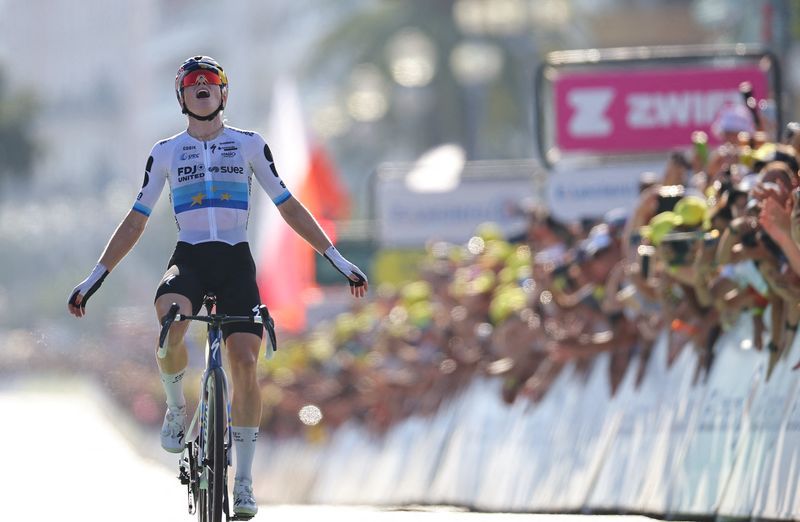
Demi Vollering has seized control of the Tour de France Femmes, capturing the prestigious yellow jersey after delivering a powerful solo performance on Saturday's gruelling mountain stage. The Dutch rider's triumph on the eighth stage, which stretched 171.9 kilometres from Sisteron to Nice, represents a dramatic shift in the race's complexion with just one day remaining. Vollering's decisive acceleration on the steep Chemin de l'Arieta climb—with six kilometres left to race—proved decisive, allowing her to drop her rivals and extend her lead on the technical descent into the coastal city. The victory gives her an eight-second advantage over Poland's Kasia Niewiadoma-Phinney heading into Sunday's finale, transforming a deficit into a commanding position at the race's critical moment.
The day's developments unfolded dramatically even before the riders took to the road. Pauline Ferrand-Prevot, the defending champion from Visma-Lease a Bike, withdrew from the race due to illness, removing one of the race's most dominant forces from contention. This withdrawal reshaped the dynamics among the remaining contenders, though Vollering's performance suggested she needed no assistance to reclaim her position. The FDJ United-Suez rider had faced a setback the previous day on Mont Ventoux, where she lost one minute and 16 seconds to Niewiadoma-Phinney—a gap that appeared potentially decisive. Her response demonstrated the psychological resilience required at cycling's highest level, where momentum and confidence can swing dramatically from one day to the next.
Vollering's post-race comments reflected the mental approach necessary to recover from yesterday's disappointment and execute today's victory. "In a stage race, you live day-by-day," she explained, acknowledging the emotional rollercoaster that characterises multiday competitions. "So you can be disappointed tonight, but then the next morning you need to put on a new mask and you go again." This philosophy proved prescient, as she delivered precisely the kind of aggressive racing required to overcome her overnight deficit. The victory represents her fifth stint wearing the yellow jersey during this edition, underlining her status as a central figure throughout the race's narrative arc.
Her triumph on the mountain stage carries particular significance given the nature of cycling hierarchy. Mountain stages in grand tours function as tests of climbing prowess, tactical acumen, and physical resilience—the disciplines that separate elite cyclists from merely accomplished competitors. Vollering's ability to generate a decisive move with sufficient kilometres remaining to consolidate her advantage demonstrated mastery of these elements. She isolated her principal rival at precisely the right moment, forcing Niewiadoma-Phinney to respond to an attack she apparently could not counter with sufficient force to maintain contact.
The stage podium itself reflected the intensely competitive field challenging for overall honours. Elisa Longo Borghini of UAE Team ADQ claimed second place, marginally outsprinting Niewiadoma-Phinney in the run to the finish line. This positioning proved consequential in the overall classification, as bonus seconds awarded for high stage placings contributed to Vollering's final margin. The Italian rider's presence among the contenders adds another dimension to Sunday's finale, creating a three-way tussle for glory that extends beyond the simple Vollering-Niewiadoma-Phinney duel.
Niewiadoma-Phinney's post-stage commentary introduced a notable flashpoint, with the Polish rider alleging that tactical maneuvering by FDJ United-Suez's Celia Gery had compromised her position on the climb. According to Niewiadoma-Phinney, Gery intentionally directed her towards the barriers, forcing her to cease pedalling at a critical juncture. "I was super annoyed at the bottom of the climb because (Celia) Gery blocked me on purpose into the barriers so I had to stop pedalling," she stated, expressing frustration at what she characterised as unsporting conduct. The allegation highlights the complex tactical environment within professional cycling, where the boundary between aggressive racing and prohibited obstruction occasionally becomes contested.
Niewiadoma-Phinney's criticism extended beyond the specific incident, articulating broader concerns about competitive conduct. "So I feel like if they want to compete, they should compete fair play and not block to me the barriers because it's so childish," she remarked, indicating that the episode had damaged her respect for the rival team. This commentary suggests that psychological elements—frustration, perceived injustice, and damaged relations—accompany the purely physical demands of professional cycling. Whether such sentiments influence Sunday's racing remains uncertain, though they establish an emotionally charged backdrop for the finale.
Vollering's yellow jersey makes her the fifth different rider to lead this edition of the race, a statistic that underscores the competitive depth within women's professional cycling. Rather than a single dominant force controlling proceedings, the 2026 Tour de France Femmes has featured multiple contenders taking turns in the lead, reflecting either parity among elite competitors or, alternatively, the selective moments when particular riders have capitalised on fortuitous circumstances or rival misfortune. This rotation of leadership has sustained narrative tension throughout the race's duration, maintaining viewer and reader engagement through genuine uncertainty about the ultimate victor.
The final stage around Nice represents unfinished business for all three leading contenders. Vollering carries the psychological advantage of holding the yellow jersey while possessing recent evidence of her climbing capabilities. Niewiadoma-Phinney remains within striking distance, separated by a margin sufficiently small that determined effort might yet reverse the overnight deficit, though the psychological impact of yesterday's loss—whether through tactical obstruction or superior climbing—may weigh upon her confidence. Longo Borghini's presence within eight seconds of the leader ensures that Sunday's racing will feature genuine three-way competition rather than a two-person contest.
For Malaysian and Southeast Asian cycling enthusiasts, the women's Tour de France Femmes represents an increasingly prominent fixture within the international cycling calendar, showcasing the sport's elite female competitors and expanding the traditional emphasis on the men's race. The dramatic nature of this year's edition—with multiple lead changes, tactical intrigue, and stage performances capable of reshaping the overall standings—demonstrates the sport's capacity to generate compelling narratives regardless of gender. As professional cycling continues expanding opportunities for female athletes across Asia-Pacific regions, the visibility and prestige of events such as the Tour de France Femmes encourages broader participation and fan engagement throughout the region.

