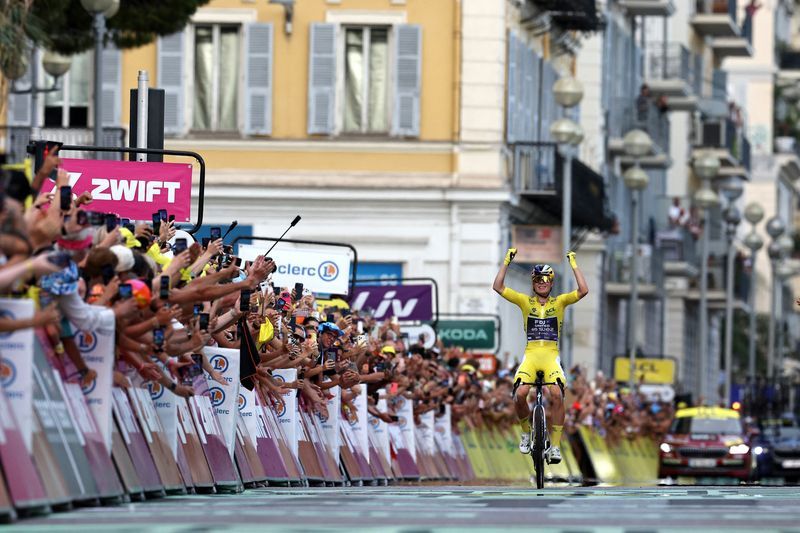
Dutch professional cyclist Demi Vollering proved her status among the sport's elite by securing the Tour de France Femmes crown for the second time, capping off a dominant performance with an authoritative display on Sunday's concluding stage. The 29-year-old rider from FDJ-Suez launched a powerful surge on the Col d'Eze, the race's final major climbing challenge, to cross the finish line near Nice with her lead substantially strengthened. Her masterful execution of the stage reflected a career trajectory marked by consistent excellence at cycling's highest levels.
Vollering arrived at Sunday's 99.2-kilometre finale holding a slender eight-second advantage over Katarzyna Niewiadoma-Phinney, the Polish-Canadian competitor who had held the yellow jersey until Vollering's decisive move the previous day. The narrow margin entering the final stage meant that the outcome remained genuinely uncertain, yet Vollering's command of the mountainous terrain demonstrated why she is considered among the most complete cyclists of her era. Her tactical acumen and physical preparation came to fruition precisely when it mattered most.
The race's conclusion vindicated Vollering's aggressive approach during the final climb, where she distanced Niewiadoma-Phinney decisively to cross the finish line alone. Spain's Paula Blasi finished second on the stage, trailing Vollering by one minute and four seconds, while Niewiadoma-Phinney collected third place honours. In the overall classification, Vollering's winning margin expanded to one minute and eighteen seconds, a commanding advantage that reflected her performance consistency throughout the three-week competition. Italy's Elisa Longo Borghini completed the podium in third position overall.
Vollering's victory represents her third stage win of this particular edition and her sixth stage triumph across all Tour de France Femmes competitions she has contested. These statistics underscore not merely her ability to win individual stages but her capacity to deliver when races reach their decisive moments. The breadth of her palmares extends well beyond this grand tour, encompassing the 2023 Tour triumph, the 2026 Giro d'Italia Women title, and consecutive La Vuelta Femenina victories in 2024 and 2025.
In her post-race reflections, Vollering articulated the emotional weight of the achievement, acknowledging both personal motivations and collective endeavour. She noted that winning in the yellow jersey held particular significance, representing a milestone she had not previously achieved. Her gratitude extended to teammates, particularly teammate Celia Gery, whose contributions during what Vollering described as a difficult overnight period had nonetheless supported the leader's ambitions. This acknowledgement of interdependence reflects the reality of professional cycling, where individual glory depends fundamentally on coordinated team effort.
Vollering's remarks emphasised the holistic satisfaction derived from the victory, framing it within a broader context of shared commitment and mutual passion. She articulated her determination to attack decisively once the decisive climb emerged, recognising that a conservative approach would risk allowing rivals the opportunity to recalibrate their strategy. This offensive mentality, combined with her technical proficiency on mountain stages, proved decisive in settling a competition that had remained competitive throughout.
The Dutch cyclist's second Tour de France Femmes title consolidates her position among cycling's contemporary greats, ranking her alongside athletes who have dominated the sport's most demanding stage races. Her capacity to deliver performances of this calibre across multiple grand tours over successive seasons demonstrates a consistency that transcends the vagaries of individual competitions. For Malaysian and Southeast Asian cycling enthusiasts, Vollering's achievements provide compelling evidence of women's professional cycling's continuing evolution toward greater competitive depth and athletic excellence.
The significance of Vollering's performance extends beyond mere statistics. Her methodical dismantling of Niewiadoma-Phinney on the race's decisive terrain illustrated the technical and mental fortitude required to succeed at this level. The ability to execute a calculated attack precisely when conditions aligned, while simultaneously managing the psychological pressure of a narrow lead entering the final day, separated Vollering's performance from adequate professional cycling and elevated it into the realm of championship-defining displays.
This women's competition concluded mere weeks after Tadej Pogacar of Slovenia claimed his record-equalling fifth Tour de France title in the men's race, representing his third consecutive triumph. The back-to-back scheduling of elite men's and women's grand tours has increasingly allowed media and audience attention to encompass both competitions, gradually normalising the concept of equivalent prestige and viewership. Vollering's dominance in her domain merits consideration alongside Pogacar's achievements in terms of contemporary cycling excellence.
The competitive landscape surrounding Vollering's victory reflected evolving standards within women's professional cycling. The presence of formidable competitors including Niewiadoma-Phinney and Longo Borghini on the podium indicated that the Tour de France Femmes attracts genuine world-class talent. The increasing depth of the field, combined with the sophistication of team tactics and the physical demands of the three-week format, has transformed women's grand tour racing into genuinely compelling sporting theatre worthy of sustained international attention.

