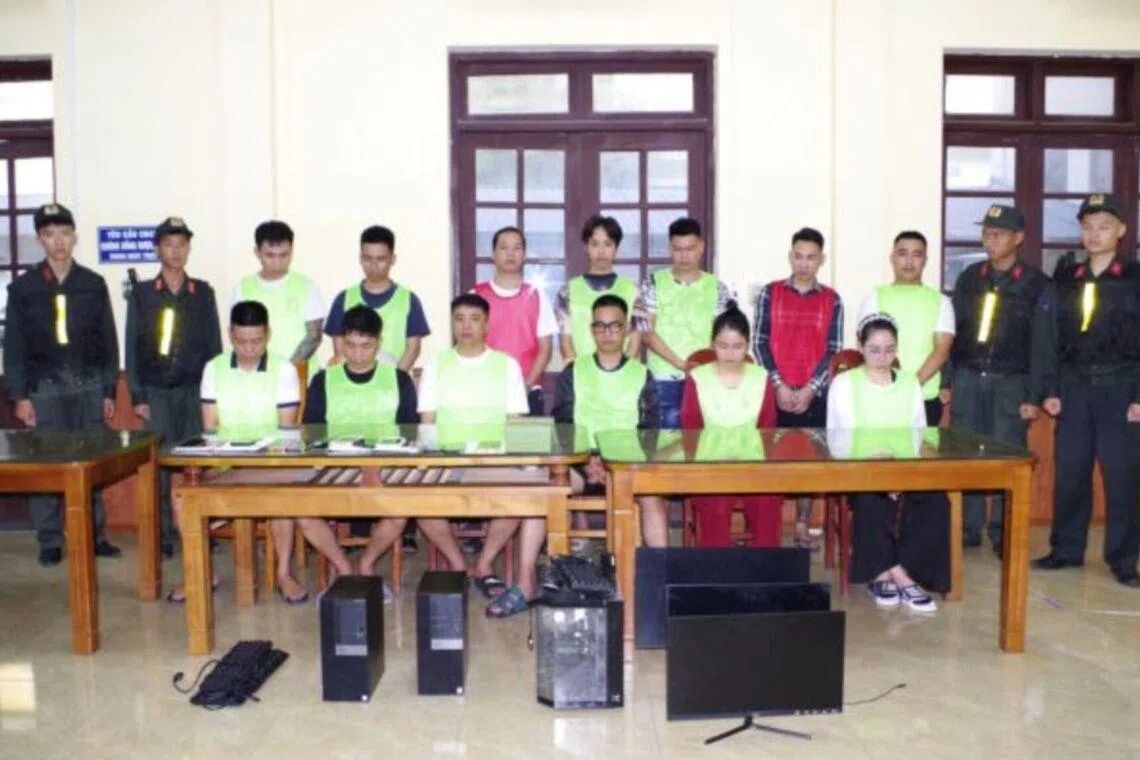
Law enforcement authorities in Vietnam's northern Ninh Binh province have successfully shut down an elaborate transnational cyberfraud operation, resulting in the arrest of 12 individuals implicated in a sophisticated scheme that defrauded over 500 victims nationwide of approximately 250 billion dong, equivalent to RM39.2 million. The dismantling of this criminal network represents a significant victory against organised online fraud, which has proliferated across Southeast Asia in recent years and poses mounting challenges for regional law enforcement.
Investigations identified Nguyen Van Cuong, aged 28, and Nguyen Van Phuong, aged 34, as the principal architects of the syndicate. The pair orchestrated a complex operation that recruited Vietnamese nationals and transported them across borders to Cambodia, where they established their illicit base of operations. This transnational structure, increasingly common among Southeast Asian fraud rings, reflects how criminal networks exploit loose regulatory frameworks across neighbouring countries to evade detection and prosecution.
The syndicate employed a multi-faceted approach to deceiving victims, leveraging technological sophistication combined with social engineering tactics. Members impersonated government officials including police officers, prosecutors, judges, revenue authorities and banking personnel, exploiting public trust in institutional figures. The perpetrators constructed counterfeit digital infrastructure, replicating authentic government agency and business websites alongside fraudulent mobile applications designed to appear legitimate, thereby establishing false credibility with unsuspecting targets.
The criminal operation deployed diverse deception scenarios tailored to different victim profiles and circumstances. Fictitious employment opportunities for part-time work lured job seekers into the network's snare. Financial fraud centred on false investment opportunities in securities, equities and cryptocurrency markets, exploiting growing interest in digital assets among middle-class Vietnamese seeking wealth accumulation. Romance scams emotionally manipulated victims into transferring money to supposed romantic interests. Compromised social media accounts became tools for extracting loans from victims' networks under false pretenses.
Particularly sophisticated was the procurement scam, wherein fraudsters posed as military procurement officers contacting commercial establishments. They would fabricate large purchase orders, subsequently persuading business operators to acquire additional inventory on the syndicate's behalf. Victims, believing they were facilitating legitimate military transactions, deposited advance payments and down payments into bank accounts controlled by the perpetrators, effectively transferring capital directly into fraudster-controlled accounts with no legitimate transaction underlying the arrangement.
The temporal scope of the investigation reveals alarming scale. Authorities determined that since October 2024, the network had successfully defrauded approximately 500 documented victims throughout Vietnam, though the actual number may be considerably higher as many fraud victims remain unreported. The consistent targeting across Vietnam suggests organised distribution channels and systematic victim identification mechanisms, indicating this was not opportunistic criminality but rather a professionally structured enterprise with hierarchical organisation and division of labour.
Police raids recovered substantial physical and digital evidence during enforcement operations. Seized materials included liquid cash reserves, a motor vehicle, multiple mobile telecommunications devices, computing equipment, forged identity documentation, jewellery and comprehensive records of criminal transactions and victim information. This evidentiary material provides investigators with documentary proof of the operation's scope and will facilitate victim compensation efforts and prosecution proceedings.
Six suspects have been formally charged with fraudulent appropriation of property and remain in temporary detention pending trial, reflecting Vietnam's legal framework for cybercrimes. Six additional suspects are subject to ongoing procedural measures as investigations continue, suggesting authorities anticipate supplementary charges or require further interrogation to establish individual culpability. The distinction between detained and procedurally-managed suspects may reflect different levels of involvement within the organisational hierarchy.
Vietnam's law enforcement agencies have signalled commitment to expanding investigative scope beyond the initial 12 arrests. Authorities are pursuing identification and apprehension of additional conspirators connected to the network, indicating recognition that the visible structure likely represents only a portion of a larger criminal apparatus. The ongoing investigation suggests networks of recruiters, money launders, technology specialists and managers operating beyond the initially-apprehended core group.
Asset recovery constitutes a critical parallel priority. Vietnamese authorities are implementing freeze orders and seizure procedures targeting financial holdings associated with the syndicate members, seeking to recover misappropriated funds and return them to victims. This approach acknowledges that financial penalty enforcement represents the only meaningful restitution mechanism for defrauded parties, particularly critical for lower-income Vietnamese victims who lost substantial life savings to these schemes.
The operation's Cambodia-based structure underscores growing regional concerns regarding criminal sanctuary jurisdictions. Southeast Asian fraud networks increasingly establish operational bases in countries with limited enforcement capacity, enabling them to target multiple nations while maintaining relative insulation from prosecution. This pattern has prompted calls for enhanced regional law enforcement cooperation and mutual extradition frameworks.
For Malaysian readers and businesses, this case offers cautionary lessons about fraud vulnerability. Scammers using identical methodologies operate throughout Southeast Asia, and sophisticated impersonation techniques cross border constraints with ease. Enhanced digital literacy, verification protocols and international coordination among financial institutions provide necessary defensive measures against similarly-structured transnational schemes targeting this region.

