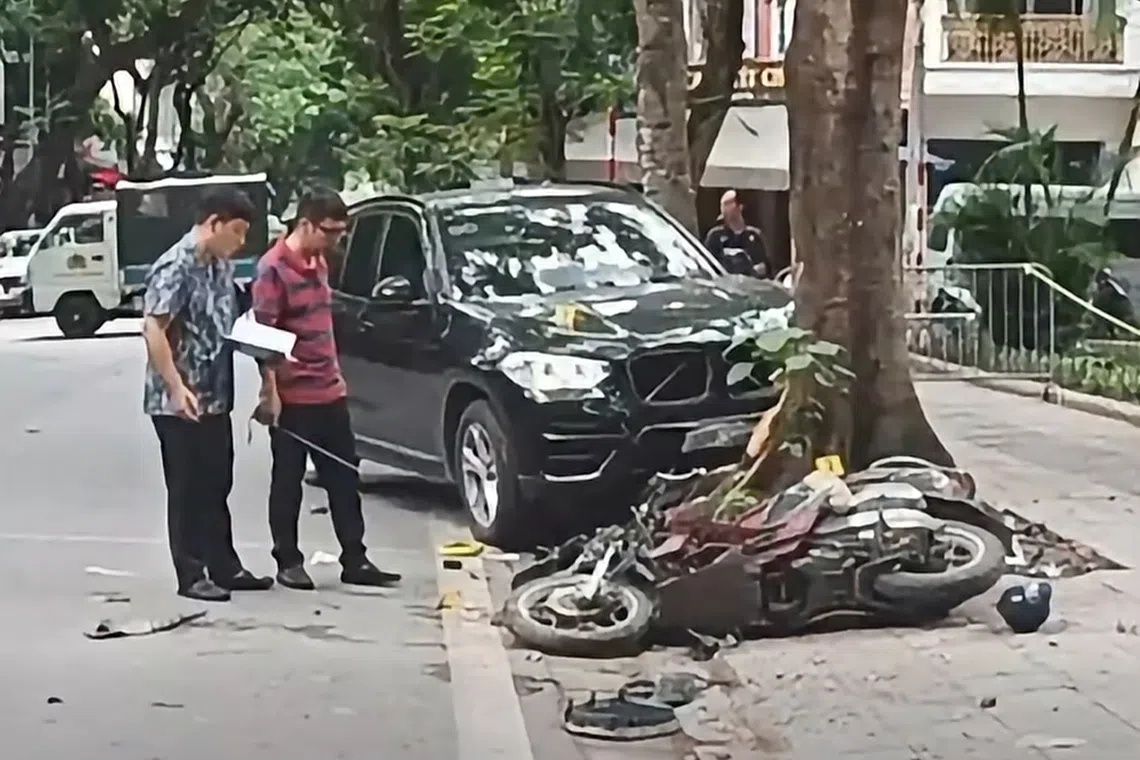
More than a year of silence around a fatal traffic accident in Hanoi has finally broken, but only after millions of Vietnamese youth flooded social media with demands for justice and transparency. The catalyst was a six-minute report broadcast by state television VTV on Monday, August 17, examining a collision that occurred on May 30, 2025, between a luxury car driven by former senior politician Nguyen Sy Cuong, 64, and a motorbike carrying an 18-year-old girl and her father. The incident has triggered what observers describe as an unprecedented coordinated digital campaign by Generation Z, signalling a new form of civic engagement in a country where public protest remains tightly controlled.
The tragedy itself was devastating. When Nguyen Sy Cuong's vehicle suddenly veered into oncoming traffic at high speed, it collided with the motorbike carrying Do Ngoc Phuong Thuy and her father, Do Viet Hung. The impact severed the teenager's right leg, causing catastrophic blood loss and excruciating injuries. Do Ngoc Phuong Thuy was transported to hospital but succumbed to her wounds ten days later, just as she was about to sit for her high school graduation examinations. Her father survived the crash.
What makes this incident remarkable is its stark contrast with the broader statistics surrounding road fatalities in Vietnam. The country records more than 10,000 traffic deaths annually, a sobering figure that typically generates minimal media attention or public outcry. The collision should have followed the same pattern of administrative handling and fade into obscurity. Instead, it has become a rallying point for social activism, largely because the driver was a prominent figure and because questions about the investigation's conclusion went unanswered for so long.
Immediately after the accident, Hanoi Police initiated an investigation. The incident received a single mention in domestic media on May 31, the day after it occurred. Thereafter, absolute silence descended. No updates were released, no findings were announced, and no further information about the case entered the public domain for over thirteen months. For families and observers seeking clarity, there was nothing—only an information vacuum that would eventually fuel suspicion and demands for accountability.
The digital awakening came dramatically in mid-August, when millions of social media posts began circulating across platforms including Threads, Facebook, Instagram and X. Young people, primarily identifying as Generation Z or in their late teens and twenties, employed hashtags such as #NguyenSyCuong and #BMW—the luxury car brand involved—to amplify their message. They called explicitly for a transparent investigation and for the driver to face accountability commensurate with the harm caused. What began as scattered posts evolved into a coordinated movement, with tech-savvy users developing strategies to circumvent what they perceived as official attempts to suppress the content online.
The digital campaign soon manifested in physical space. Young Vietnamese, often wearing masks to protect their identity, began visiting tree number 55 in Hanoi—the accident site—to lay flowers in tribute to Do Ngoc Phuong Thuy and as a symbolic gesture demanding justice. The location gained coordinates on Google Maps and was christened "the Justice Tree." Though authorities swiftly removed the floral offerings, netizens created a virtual memorial where hundreds of thousands offered tributes and solidarity. This fusion of digital and physical activism represented something novel in Vietnam's constrained civic landscape.
Social activists and observers offer insight into why this particular case resonated so powerfully with young people. Nguyen Hoang Vi, a social activist and blogger who focuses on education issues, points to age as a crucial factor. "The victim was an 18-year-old girl, a peer to many of the young people speaking out. This naturally fosters deep empathy, as they can easily put themselves in her shoes," she explains. Beyond emotional identification, Vi suggests that the extended silence—over a year without answers—became the breaking point. "Young people no longer want to simply hear adults say, 'Trust in justice', they want to see justice actually served." This articulates a generational shift in expectations around transparency and accountability.
The government's response, when it finally came, attempted to resolve the matter through official channels. According to VTV's report, citing police and prosecution sources, Nguyen Sy Cuong had "sincerely confessed and actively and fully remedied the consequences of his actions." On this basis, the report indicated, Do Ngoc Phuong Thuy's family chose not to pursue criminal charges, and Cuong was exempted from criminal liability. The victim's father, Do Viet Hung, appeared on the broadcast to express gratitude for public sympathy while requesting that people respect the family's privacy and allow them to grieve without further scrutiny.
However, legal experts suggest that the official explanation, while providing technical closure, may not satisfy the underlying demands. Tran Dai Lam, a lawyer at ANVI law firm in Hanoi, acknowledged that VTV's report addresses some legal questions. Yet he expressed doubt about whether the clarification would genuinely placate Generation Z. "The issue lies not only in the conclusion itself but also in the information vacuum that persisted for over a year," he stated. Critically, he noted that young people seek not merely answers but detailed transparency about legal processes: "Gen Z is not easily satisfied with answers stating simply that authorities acted 'in accordance with the law', they want to know which laws, what specific decisions were made, and why those decisions were reached." This distinction between procedural legitimacy and substantive transparency reveals a deeper generational expectation gap.
State authorities have interpreted the social media mobilisation through a security lens. VTV's report quoted a senior police official claiming that the Ministry of Public Security had "uncovered highly dangerous plots and intentions by hostile forces, reactionaries and bad actors to incite unrest and cause disorder," using the accident as a pretext. The Ministry urged the public, especially young people, to "remain fully alert and highly vigilant." Pro-government influencers amplified these warnings, drawing parallels to "colour revolutions and unrest that have led to anarchy and destruction, as seen in Bangladesh"—framing the youth-led campaign as part of a broader destabilisation agenda rather than organic civic concern.
Despite the official statement and media intervention, flowers continue to appear at the virtual justice tree, albeit in diminished numbers. Many online commenters have expressed dissatisfaction with the government's explanation, suggesting that the VTV report, rather than closing the matter, has merely marked a chapter in an evolving narrative. This persistence indicates that institutional responses alone may not resolve the underlying tension between official opacity and public demand for accountability.
For social activists like Nguyen Hoang Vi, this episode has prompted significant personal reflection about generational attitudes. "I used to hold a rather unkind stereotype of Gen Z, viewing them as a generation inclined towards self-indulgence and lacking in patience, diligence or effort, often appearing indifferent to the world around them," she reflected. "But now, I have come to realise that Gen Z is not truly indifferent to society. Rather, they engage with issues in a way that differs vastly from my own generation." This reframing suggests that the campaign's significance extends beyond the specific case to illuminate how digital natives in Vietnam are developing novel forms of collective action and demanding institutional responsiveness.
The episode holds broader implications for Southeast Asia's democratic landscape. Vietnam's tightly controlled media environment and restricted space for formal protest make the emergence of coordinated Gen Z digital activism noteworthy. Whether this marks the beginning of sustained generational pressure for transparency or remains an isolated moment depends partly on how authorities respond to future challenges and whether young people perceive their voices as genuinely heard. For Malaysian and regional observers, the Vietnamese case illustrates how social media literacy and generational shifts can challenge official narratives even in authoritarian contexts, while also highlighting the tensions between institutional control and digital mobilisation.

