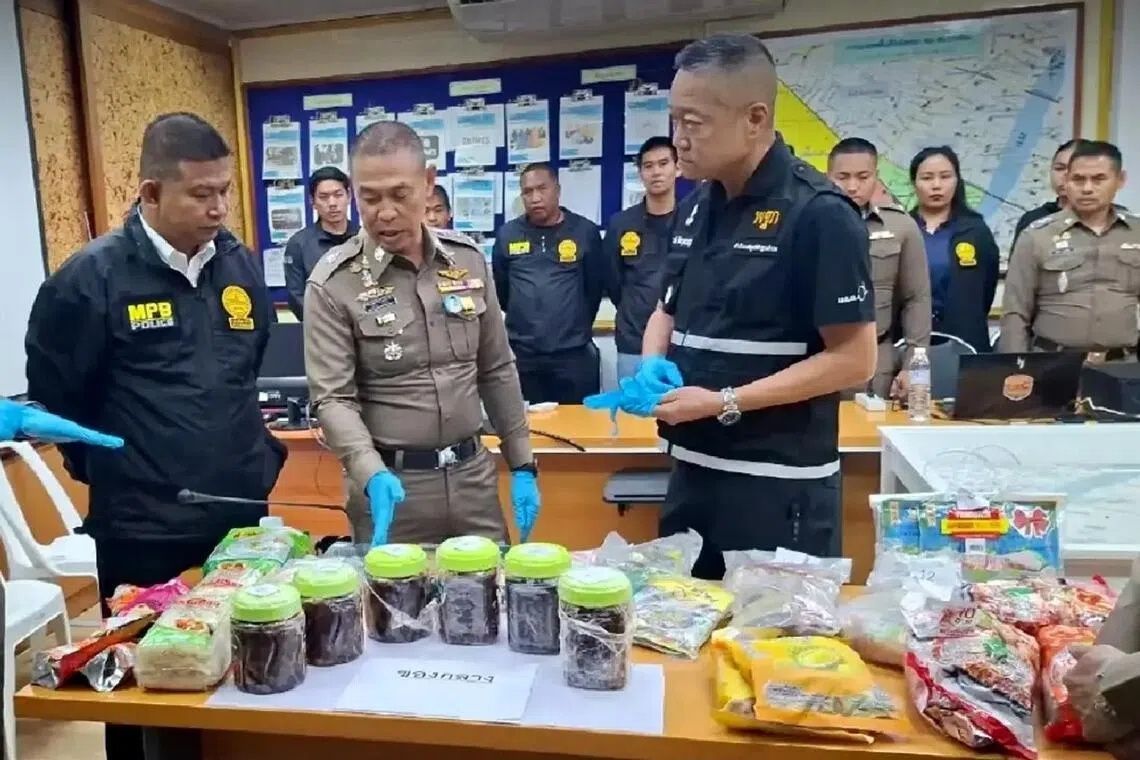
Bangkok's Metropolitan Police Bureau has uncovered an elaborate cross-border narcotics operation orchestrated by Vietnamese nationals, which leveraged Thailand's geographical position as a critical transit corridor to transport crystal methamphetamine into Japan. The revelation, made public on July 17 by Metropolitan Police Bureau commissioner police lieutenant-general Siam Boonsom alongside police major general Chaiya Phetpanya, commander of Metropolitan Police Division 7, and investigators from Bang Yi Khan Police Station, exposes the evolving sophistication of transnational criminal networks operating across Southeast Asia. The discovery carries significant implications for regional law enforcement cooperation and Malaysia's own role in combating similar smuggling corridors.
The investigation commenced after a courier became suspicious of his cargo on July 13. The individual, hired to transport goods internationally, noticed that several jars of tamarind paste destined for Tokyo felt substantially heavier than expected. His decision to report the discrepancy to authorities rather than proceed with delivery proved instrumental in uncovering the broader operation. Upon examination, investigators discovered six foil-wrapped packages concealed within the containers, ultimately yielding more than 2 kilograms of crystal methamphetamine, known colloquially as ice. This particular method of concealment—embedding contraband within legitimate food products—reflects an increasingly common approach among trafficking networks seeking to evade detection at border checkpoints and customs inspections across the region.
What distinguishes this case is its deliberate structural complexity, designed to insulate the operation's architects from direct legal liability. The network operated through multiple discrete layers: senior organisers allegedly positioned in Hanoi issued instructions through untraceable social media channels, recruiting anonymous delivery riders via Facebook to retrieve packages from safe houses occupied by Vietnamese residents throughout Thailand. These intermediaries then transferred the goods to Thai couriers contracted specifically for international transport, creating sufficient separation to complicate law enforcement's ability to establish direct connections between decision-makers and the final shipment. This compartmentalised approach reflects a methodological evolution in transnational drug trafficking, wherein operational security depends upon limiting information access and maintaining plausible deniability throughout the supply chain.
Financial tracking provided crucial investigative leads. Authorities identified that payments and operational expenses flowed through a bank account registered to Sompong, a Thai national arrested in connection with the conspiracy. Vietnamese accomplices systematically withdrew cash in regular increments of between 20,000 and 50,000 baht, typically departing Thailand immediately afterward. This pattern—seemingly designed to avoid triggering financial monitoring thresholds and to distribute withdrawal risk among multiple individuals—demonstrates the syndicate's awareness of banking surveillance protocols. The rotating cast of operatives extracting funds suggests a deliberate strategy to prevent any single individual's pattern from establishing sufficient visibility for authorities to identify the network's operational structure.
Police investigations have now expanded to identify additional conspirators, with arrest warrants issued for Sompong and three Vietnamese nationals implicated in money withdrawal, social media account management, and operational direction. Sompong has categorically denied involvement in the trafficking scheme, though investigators maintain substantial documentary evidence linking him to financial transactions supporting the operation. The inquiry has also extended to Sompong's girlfriend, whom authorities do not yet believe warrants formal charges but suspect possessed knowledge of the arrangement. The reluctance to implicate her immediately suggests investigative caution regarding evidentiary standards, though her potential cooperation could provide insights into the network's domestic Thai operations and recruitment mechanisms.
The operational sophistication evident in this case underscores a troubling reality for Southeast Asian law enforcement: organised drug networks increasingly exploit the region's porous borders, transit infrastructure, and less-regulated financial systems to move contraband between production sources and lucrative consumer markets. Thailand's longstanding role as a transshipment hub for narcotics destined toward Australia, Japan, and other developed economies remains substantial, even as individual operations are disrupted. Vietnamese-led syndicates, in particular, have demonstrated considerable adaptability in establishing supply chains that minimise risk to core decision-makers while maximising operational flexibility through decentralised recruitment and compartmentalised function assignment.
For Malaysia, the revelations carry particular significance. As both a transit corridor and increasingly a market for methamphetamine consumption, Malaysia faces similar vulnerabilities to those exploited in this Bangkok-based operation. Kuala Lumpur and Port Klang represent obvious chokepoints for contraband destined toward Australia and East Asian markets, while domestic consumption patterns suggest expanding demand for crystal methamphetamine among younger demographics. The methodologies employed by Vietnamese networks—obscuring contraband within food products, recruiting unwitting or semi-complicit couriers, leveraging social media for operational communication, and employing rotating financial intermediaries—mirror tactics that Malaysian enforcement agencies have increasingly identified in their own investigations.
International cooperation remains essential to disrupting these networks. The successful identification and tracking of this particular operation required coordination between Thai police, customs authorities, and presumably intelligence agencies monitoring transnational financial flows. Expanding such cooperation into formal bilateral and multilateral frameworks could substantially improve regional capacity to identify trafficking patterns, share suspect databases, and implement coordinated interdiction efforts. ASEAN member states, despite their diversity in enforcement capacity and resources, share common interest in restricting narcotics transit and preventing the consolidation of trafficking infrastructure that might eventually establish permanent operations within their borders.
The tamarind jar methodology, while audacious, reflects pragmatic adaptation to modern customs inspection protocols. Generic food products enjoy presumed legitimacy at borders; packaged tamarind paste from Southeast Asia to Japan represents unremarkable commercial activity, unlikely to trigger heightened scrutiny absent specific intelligence or random inspection. Concealments within legitimate commerce exploit the mathematical reality that most cross-border transactions cannot receive intensive physical examination. As customs agencies increasingly employ advanced scanning and chemical detection technologies, trafficking networks will presumably continue innovating their concealment approaches, initiating an ongoing technological arms race between enforcement and criminal enterprise.
The investigation's conclusion that more than four individuals participated in the operation suggests this represented merely one component of a larger syndicate's activities. Vietnamese-led networks rarely organise single, isolated shipments; instead, successful operations typically maintain multiple concurrent channels to different destinations, utilising different courier services, concealment methods, and financing mechanisms. The disruption of this particular pipeline, while operationally significant, likely represents a temporary interruption rather than a fundamental degradation of the network's capacity. Unless Thai authorities can identify and prosecute the Hanoi-based directors allegedly orchestrating the conspiracy, the organisation may reconstitute operations through alternative couriers and supply routes within weeks.
The case also highlights the vulnerability of couriers recruited through anonymous channels. Many individuals engaged in international transport either possess insufficient resources to refuse potentially lucrative opportunities or maintain such limited awareness of their cargo's true nature that culpability remains ambiguous. This creates a persistent supply of willing transport operatives for trafficking networks, even as enforcement pressure increases. Addressing this vulnerability requires not merely interdiction but broader strategies addressing economic inequality and employment opportunity constraints that render cross-border courier work attractive to vulnerable populations across Southeast Asia.
Moving forward, Bangkok police's determination to pursue leads through financial investigation and social media account analysis suggests an evolving investigative methodology emphasising digital evidence and transaction patterns rather than relying exclusively upon physical interdiction. This approach, if consistently applied across Southeast Asian enforcement agencies, could substantially improve detection rates for trafficking networks employing similar operational models. Regional training initiatives and intelligence-sharing protocols focused upon financial crime investigation and digital forensics could amplify these capabilities, potentially enabling Malaysian and other ASEAN authorities to anticipate rather than merely respond to trafficking activities.

