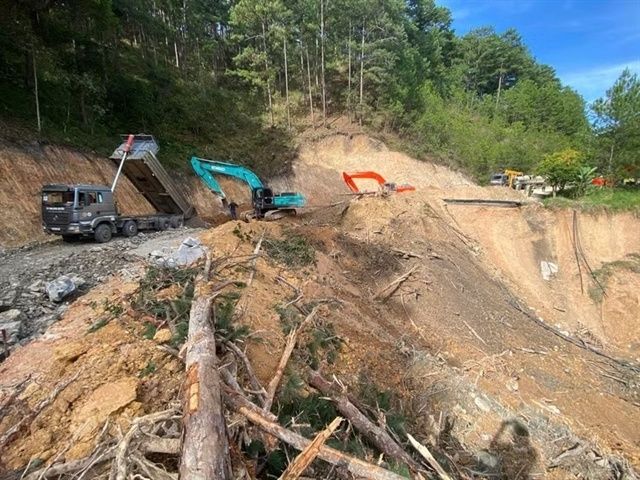
Vietnam's Ministry of Construction has activated an emergency declaration for a critical section of Ho Chi Minh Road cutting through Tuyen Quang Province, following a month of relentless heavy rainfall that has left the vital transport artery severely compromised. The action underscores the escalating vulnerability of Southeast Asia's road infrastructure to extreme weather events, a concern that extends well beyond Vietnam's borders as climate impacts intensify across the region.
The damage centres on a stretch at Km115+000 where Ho Chi Minh Road intersects with National Highway 2C, an area managed by Road Management Zone I. The extended deformation and structural degradation reported at this junction reflects the cumulative toll of multiple heavy rainfall episodes spanning the entire month of June. By declaring an emergency status, the ministry aims to mobilise resources swiftly and bypass normal administrative procedures that would otherwise slow repair efforts, prioritising the safety of the thousands of vehicles and travellers who depend on this route daily.
The decision to invoke emergency protocols was informed by detailed meteorological assessments conducted by both the Tuyen Quang Provincial Hydrometeorological Station and the National Centre for Hydrometeorological Forecasting. These agencies documented the severe and repeated nature of June's precipitation events, establishing a clear link between the extreme weather and the infrastructure damage. Such documentation is essential not only for justifying emergency measures but also for understanding patterns that may repeat as climate variability increases, potentially creating a new baseline for planning and maintenance budgets across Vietnam's sprawling road network.
The Ministry of Construction has tasked the Department for Roads of Việt Nam and Road Management Zone I with leading a comprehensive damage assessment and developing repair strategies. These agencies have been directed to issue an Emergency Construction Order that will enable rapid remediation work while adhering to legal requirements governing disaster response. This bifurcated approach—combining urgency with regulatory compliance—reflects Vietnam's attempt to balance the need for swift action against the imperative of maintaining institutional accountability and transparency in how public resources are deployed following natural disasters.
Beyond the primary emergency zone, authorities have identified an additional flooded section between Km124+600 and Km128 on Ho Chi Minh Road where it overlaps with National Highway 2. Managing congestion and maintaining traffic flow through this waterlogged corridor presents a secondary operational challenge, as vehicles are forced to navigate conditions that compromise both speed and safety. The dual crisis points demonstrate how climate-related damage is rarely confined to a single location but rather cascades across interconnected infrastructure systems, amplifying disruption to supply chains and passenger movements throughout affected regions.
For Malaysia and other Southeast Asian nations, Vietnam's emergency response offers both a cautionary example and a potential template. Roads serving as vital economic arteries—such as the North-South Expressway in Malaysia or major highways throughout Thailand and Cambodia—face comparable threats from increasingly intense monsoon patterns and unexpected precipitation events. Vietnam's decision to implement rapid assessment and emergency repair protocols reflects a recognition that delayed response to infrastructure damage compounds economic losses, disrupts commerce, and strains regional trade networks that depend on cross-border road connectivity.
The accountability mechanisms embedded in Vietnam's response are particularly instructive. Senior officials including the Director General of the Department for Roads of Việt Nam and the Director of Road Management Zone I have been explicitly held responsible for reporting on the damage and overseeing remediation efforts. This personalisation of accountability, while sometimes criticised as excessive, ensures that repair timelines are monitored and that officials cannot indefinitely defer addressing critical infrastructure failures without facing consequences.
The Transport and Road Safety Division of the Ministry of Construction has been designated as the coordinating agency responsible for directing and urging other departments to implement corrective measures. This supervisory role acknowledges that road repair is not solely an engineering task but requires coordination across multiple state agencies managing permitting, traffic, safety protocols, and resource allocation. Fragmented coordination among these bodies is often where emergency responses falter, so establishing clear lines of authority can meaningfully accelerate project timelines.
The broader context matters significantly for understanding why this declaration carries weight. Ho Chi Minh Road is not a secondary route but rather a strategic national corridor linking northern and southern Vietnam. Damage to this artery reverberates throughout the national economy, affecting the movement of goods to and from industrial zones, agricultural regions, and ports. For regional economies integrated through supply chains, disruptions to Vietnam's transport infrastructure translate into delays and cost increases that ultimately affect consumer prices and business competitiveness across Southeast Asia.
The emergency protocol initiated here will likely serve as a reference point for future declarations, establishing precedents for how Vietnam responds to climate-induced infrastructure crises. As rainfall patterns become more erratic and intense events more frequent, Vietnam and its neighbours will need to transition from treating such emergencies as exceptional events toward building them into standard operational planning. This shift from emergency response to adaptive infrastructure management represents one of the defining challenges facing Southeast Asian governments in the coming decades.
Once emergency repairs are completed, the Department for Roads will report back to the ministry, providing the evidentiary foundation for formally concluding the emergency declaration. This formal closure is not merely bureaucratic ritual but signals that critical functionality has been restored and that the crisis phase has passed. However, the underlying vulnerability that permitted such severe damage to accumulate over a single month of rainfall will persist unless longer-term investments in climate-resilient infrastructure design and maintenance are prioritised alongside immediate repairs.

