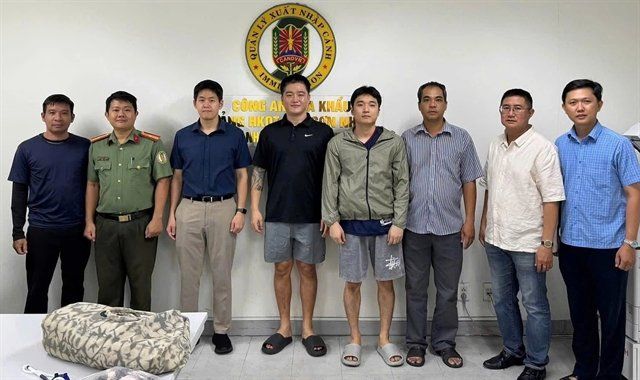
Vietnamese law enforcement has intensified its cooperation with international authorities in combating transnational cybercrime, securing the arrests of four South Korean nationals wanted by Interpol for perpetrating sophisticated online fraud operations. The coordinated effort reflects growing concerns across Southeast Asia about the proliferation of high-tech scams originating from the region and targeting victims internationally.
Police in Ho Chi Minh City arrested three of the suspects—Wang Taesan, Han Joonhee, and Bang Giseong—on August 3, marking a significant breakthrough in a months-long investigation. The Office of the HCM City Police Investigation Agency, working alongside the Ministry of Public Security's Police Investigation Agency and partner units, successfully apprehended the individuals before transferring custody to South Korean authorities at Tan Son Nhat International Airport. The arrests underscore Vietnam's commitment to disrupting criminal networks that exploit digital platforms to victimise citizens across borders.
The investigation revealed an intricate web of deception designed to extract money from unsuspecting victims in South Korea. The criminal syndicate employed multiple manipulation tactics to maximise their reach and success rate. In one particularly cunning scheme, the fraudsters contacted targets claiming to possess compromising intimate videos and threatened public release unless substantial sums were paid immediately. The psychological pressure created by such threats often bypassed victims' rational judgment, compelling quick financial transfers before individuals could verify the claims. Critically, police established that these videos never existed—the threats were entirely fabricated weapons of coercion.
A second operational method involved impersonating legitimate South Korean authority figures, specifically prosecutors and law enforcement officials. The suspects used spoofed phone numbers and sophisticated communication techniques to contact victims, establishing false credibility. They would then transmit links to forged documents, including counterfeit arrest warrants bearing victims' names, creating the illusion of legitimate legal proceedings. These deepfakes and digital forgeries leveraged citizens' natural deference to authority and fear of legal consequences to manipulate behaviour.
Following this psychological groundwork, the perpetrators would claim that victims' bank accounts had become entangled in criminal activities requiring urgent verification. They demanded money transfers to specified accounts, framing these payments as necessary procedural steps to clear their names and avoid prosecution. The veneer of official legitimacy made victims more willing to comply, transforming what was actually theft into what appeared to be compulsory civic cooperation. This hybrid approach combining emotional manipulation with institutional mimicry proved devastatingly effective across their target population.
The fourth arrest, carried out in Hanoi earlier in the year, revealed similar criminal methodology adapted for investment fraud. Lee Sammin, apprehended on December 31 and wanted on an Interpol Red Notice, led a network that posed as legitimate investment professionals and financial experts. Operating through social media platforms and internet channels, the group disseminated misleading information about stocks allegedly poised for imminent public listing. By creating artificial urgency and exclusive opportunities, they enticed victims to transfer funds for investment purposes. Once money entered their accounts, the syndicate simply disappeared with the capital. Investigators ultimately traced approximately US$10,693,343 in fraudulent transfers connected to this operation alone.
These cases illustrate a troubling evolution in transnational organised crime, where Southeast Asian jurisdictions have become both operational bases and transit hubs for sophisticated cybercriminals targeting wealthy regional economies. The advancement of technologies enabling voice spoofing, document forgery, and digital identity manipulation has democratised fraud, allowing relatively small criminal groups to victimise thousands across borders simultaneously. Traditional law enforcement methods struggle to keep pace with the speed and scale of digital attacks, forcing authorities to develop new investigative protocols and international coordination mechanisms.
Vietnam's proactive arrests demonstrate the strategic value of sustained intelligence-sharing between neighbouring countries and Interpol's international network. By rapidly processing extradition requests and transferring custody of suspects, Vietnamese authorities have signalled that the country will not become a safe haven for cybercriminals. This messaging sends important deterrent signals to criminal networks considering whether to establish operations or launder proceeds through Vietnamese financial systems and airports.
For Malaysian readers and businesses, these cases carry significant cautionary lessons. The sophistication and scale of cross-border fraud operations mean that similar schemes targeting Malaysian citizens and companies are almost certainly active within the region. The use of technology to impersonate officials and create false urgency mirrors tactics already documented in Malaysia. Business executives, particularly those involved in investment or high-net-worth transactions, represent prime targets for such operations, as their professional networks and financial assets make them attractive marks.
The regional implications extend beyond law enforcement. These arrest patterns suggest that Southeast Asian countries must substantially upgrade their digital crime investigation capacity, forensic expertise, and cross-border cooperation protocols. Currently, the lag between when crimes occur and when perpetrators face consequences remains dangerously long, allowing criminal networks to operate with relative impunity. Establishing dedicated cybercrime task forces with adequate technology, training, and international liaison capacity has become essential for protecting citizens from increasingly sophisticated international fraud operations emanating from within and beyond the region.

