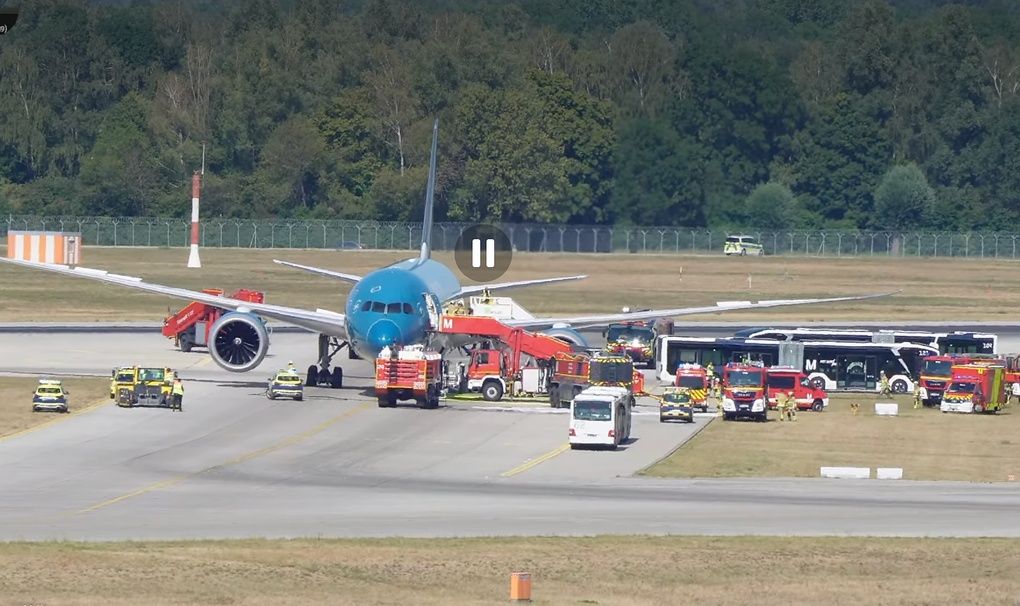
A Vietnam Airlines flight operating between Munich and Hanoi encountered a serious technical incident during takeoff on August 15 when the Boeing 787-9 aircraft experienced a tailstrike and subsequent runway overrun, prompting the crew to execute a diversion back to Munich Airport approximately two hours after departure. The incident, while unsettling for those aboard, was managed without injury to any of the passengers or crew members, with emergency responders maintaining standby readiness throughout the aircraft's return to the Bavarian airport.
According to accounts from aviation monitoring sites including The Aviation Herald and Airlive, the technical problem manifested during the critical rotation phase of takeoff, when the nose of the aircraft was pitched upward to lift off the runway. Witness footage from near the airport captured the Boeing 787 accelerating along the runway and rotating so close to the end of the tarmac that dust clouds were visibly disturbed as the wheels left the ground. The narrow margin between successful rotation and potential disaster underscores the precision required during this high-risk phase of flight operations.
The sequence of events reveals the aircraft achieved rotation and became airborne despite the late timing, but the rear fuselage made contact with the runway surface during this critical manoeuvre—a phenomenon known as a tailstrike in aviation terminology. This contact caused immediate damage to the landing gear tyres, which would subsequently produce smoke during the aircraft's return landing. The tailstrike itself, combined with the runway overrun, represented a compound technical emergency that required immediate and careful management by the flight crew.
Facing this situation, the captain and crew implemented standard emergency procedures with notable composure. Rather than attempting an immediate landing with damaged tyres and potential structural concerns, the aircraft climbed to approximately 9,000 feet and entered a holding pattern—a deliberate circling procedure that allowed multiple critical objectives to be accomplished simultaneously. This tactical decision provided ground engineers and flight operations teams at Munich the necessary time to assess the extent of damage and prepare the airport's emergency infrastructure, whilst the aircraft's continued flight allowed fuel reserves to be managed through consumption rather than through an emergency dump procedure.
The two-hour holding period reflected the methodical approach adopted by both airborne and ground personnel. Emergency services at Munich Airport were placed on full standby, with fire and rescue teams positioned and ready to respond to any potential complications during the landing phase. This precautionary stance proved prudent given the damaged undercarriage and the inherent uncertainties surrounding the aircraft's structural integrity following the runway contact.
When the Boeing 787 eventually returned to Munich, the landing itself generated additional complications. Contact between the damaged tyres and the runway surface upon touchdown produced visible smoke, a phenomenon that would have further alerted emergency responders to the severity of the incident and the need for immediate post-landing assistance. All passengers and crew were safely evacuated from the aircraft and escorted to the terminal building without reported complications.
Vietnam Airlines issued official statements confirming that the crew had adhered strictly to standard operating procedures throughout the emergency, emphasising the safety-first culture that characterises operations at the national carrier. The airline indicated that comprehensive inspections would be necessary before determining the full extent of damage to the Boeing 787 and establishing a timeline for its return to service. Such damage assessments typically require structural engineers to examine not merely the obvious tailstrike zone but also underlying airframe integrity that may have been compromised by the impact and subsequent stress.
The incident carries particular significance given Vietnam Airlines' expanding European operations. The carrier currently maintains direct services linking Hanoi and Ho Chi Minh City with both Munich and Frankfurt, representing critical economic connections between Vietnam and the European Union. These routes are serviced by wide-body aircraft including Boeing 787 Dreamliners and Airbus A350 jets, reflecting the airline's investment in modern, fuel-efficient long-range capacity. A prolonged grounding of even a single aircraft in this fleet can create operational pressure during peak travel seasons.
For affected passengers, Vietnam Airlines moved swiftly to arrange alternative transportation options and support services, acknowledging the significant disruption caused by the unexpected return and extended delay. The airline committed to providing updates once technical inspections were completed and alternative flight arrangements finalised, recognising that passengers on this Munich-Hanoi route typically include business travellers and Vietnamese expatriates for whom scheduling flexibility is often limited.
This incident reflects broader patterns within global aviation, where modern aircraft are engineered with multiple redundant safety systems and where crew training emphasises procedural discipline in managing emergencies. The absence of injuries or fatalities despite the severity of the technical malfunction demonstrates the robustness of contemporary aviation safety protocols. However, the event also underscores the inherent risks present during takeoff and landing phases, which remain the most accident-prone periods of any flight.
Regional aviation authorities, including those in Southeast Asia and Europe, will likely seek detailed reports on the Munich incident as part of their ongoing oversight of flight safety. Such information sharing between regulators helps the broader aviation community identify systemic issues and refine training and maintenance standards. For Malaysian readers following Southeast Asian aviation developments, the Vietnam Airlines incident serves as a reminder of the technical complexities inherent in wide-body jet operations and the critical importance of rigorous safety cultures throughout the region's growing airline industry.

