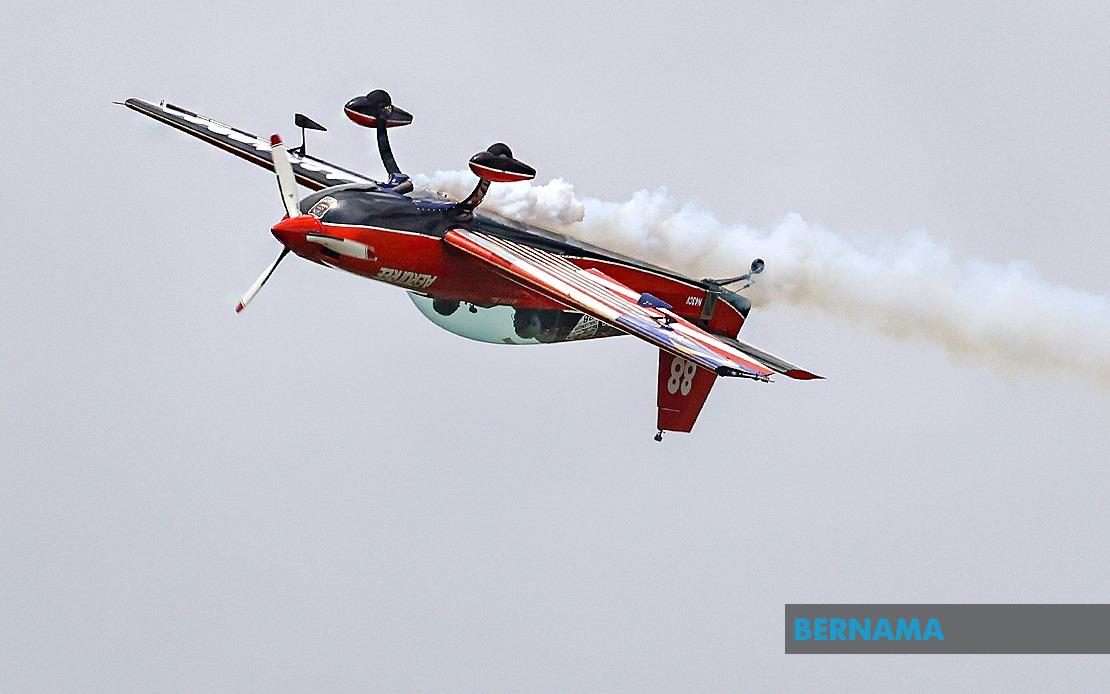
The maiden 'Merdeka Sunset Show: Melukis Senja' marked a significant moment in Malaysia's National Day festivities as retired Royal Malaysian Air Force fighter pilot Major (Rtd) Datuk Halim Othman, 60, took to the skies over Putrajaya for a solo twilight aerobatic performance. Drawing from more than four decades of flying experience, Halim orchestrated a precisely choreographed display that combined high-altitude manoeuvres with pyrotechnics and coloured smoke against the backdrop of the setting sun, creating a spectacle designed specifically to commemorate the nation's 69th year of independence.
Halim's credentials extend far beyond conventional military aviation. As the first Malaysian pilot to qualify for the Red Bull Air Race World Championship, he has competed on a global stage where precision, nerve and intimate aircraft mastery form the core requirements for success. The Red Bull circuit represents one of aviation's most demanding competitive arenas, where pilots navigate low-altitude courses at high speeds through gates marked in three-dimensional space. His progression through this elite competition level underscores the technical proficiency and mental fortitude necessary to execute the aerobatic sequences that defined the sunset show.
The concept underlying the evening's performance draws inspiration from a similar event introduced during the Langkawi International Maritime and Aerospace Exhibition, where 'Melukis Senja' was first unveiled. That successful precedent demonstrated both the technical feasibility and public appeal of combining military-grade aerobatic flying with artistic elements such as smoke trails and coordinated pyrotechnics. The Putrajaya iteration represented an evolution of this model, adapted for a national celebration and designed to resonate with a broader Malaysian audience witnessing their country's aviation capabilities.
Halim's perspective on aerobatic flying challenges common misconceptions about the discipline. In his assessment, executing extreme manoeuvres represents merely the surface dimension of the art form. The deeper foundation rests upon systematic training, rigorous self-discipline and comprehensive understanding of aircraft performance envelopes and structural limitations. This distinction between spectacle and substance becomes critical when considering the safety implications of aerobatic display flying, where miscalculation of aircraft behaviour or environmental conditions can result in catastrophic consequences.
Competing within the Red Bull Air Race circuit meant operating within an environment where most competitors hailed from outside Malaysia and Asia entirely. This geographic and demographic reality created a particular challenge for Halim—the need to demonstrate that Malaysian pilots possessed technical capabilities equivalent to or exceeding those of more established aviation nations. His framing of the sunset performance extends this competitive impulse beyond personal achievement into a broader national project. By executing a complex aerial display on the National Day stage, he positions himself as proof of concept for Malaysian aviation talent and as an inspiration for younger generations contemplating careers in aerospace fields.
Halim's professional journey commenced when he joined the RMAF as a fighter pilot in 1985, eventually earning the designation 'Top Gun' before transitioning into aerobatic specialization and international racing. Throughout his service and subsequent civilian career, he accumulated flight experience across numerous military and civilian platforms, ranging from the high-performance MiG-29N and F/A-18D Hornet to the nimble Extra 300L aerobatic aircraft. This breadth of experience reflects not merely accumulated flight hours but exposure to fundamentally different aircraft philosophies and handling characteristics, essential background for mastering the precise control inputs required in aerobatic competition.
Notable achievements punctuate Halim's competitive record, particularly his Challenger Cup victories achieved simultaneously in Ascot, United Kingdom and Las Vegas, United States during 2014, complemented by a runner-up finish at the Red Bull Ring in Austria. These results position him among a select cohort of successful international racing pilots and provide concrete validation of his technical proficiency at the highest competitive levels. The geographic distribution of these victories—spanning Europe and North America—underscores the truly international scope of his achievements and the absence of home-field advantage in these highly standardized competitions.
Beyond his personal flying accomplishments, Halim has shaped Malaysia's institutional aerobatic capacity through his role in founding Krisakti, the nation's first officially recognized aerobatic display team. The team's inaugural appearance at LIMA 2011 represented a watershed moment for organized Malaysian aerobatic aviation, establishing a platform for coordinated multi-aircraft performances and creating opportunities for emerging aerobatic pilots to develop their skills and gain public visibility. This institutional contribution extends his impact beyond individual performances into the realm of national capability development.
Future iterations of National Day celebrations and LIMA exhibitions will feature an expanded aerobatic team comprising six aircraft equipped with coloured smoke systems, according to Halim's strategic vision. This expansion represents a scaling up of Malaysia's aerobatic display capabilities and signals a commitment to incorporating aerial performances as established components of major national and aerospace industry events. The transition from solo performances to coordinated multi-aircraft displays introduces additional complexity, as pilots must maintain precise formation geometry while executing dynamic manoeuvres—a skill set that demands extensive preparation and coordination.
Halim's framing of the sunset show as part of broader corporate social responsibility objectives reveals the ideological dimensions of his aeronautical activities. Beyond entertainment value or national prestige, he emphasizes the inspirational function that high-performance flying demonstrations serve for younger Malaysians considering aerospace careers. This educational and developmental angle addresses a persistent challenge within Malaysia's aviation sector—cultivating sufficient domestic talent pools and maintaining public enthusiasm for aeronautical pursuits. Public displays of Malaysian pilot expertise, executed at international standards, contribute to normalizing aerospace careers as aspirational professional pathways for younger generations.
The convergence of military experience, international competitive success and institutional aeronautical development work positions Halim as a central figure in contemporary Malaysian aviation culture. His aerobatic performances function simultaneously as entertainment, demonstration of national capability, and explicit mentorship through example for future pilots. The 'Merdeka Sunset Show' crystallizes these multiple dimensions into a single spectacular event, where technical mastery, artistic expression and national pride intersect in the darkening sky above Putrajaya.

