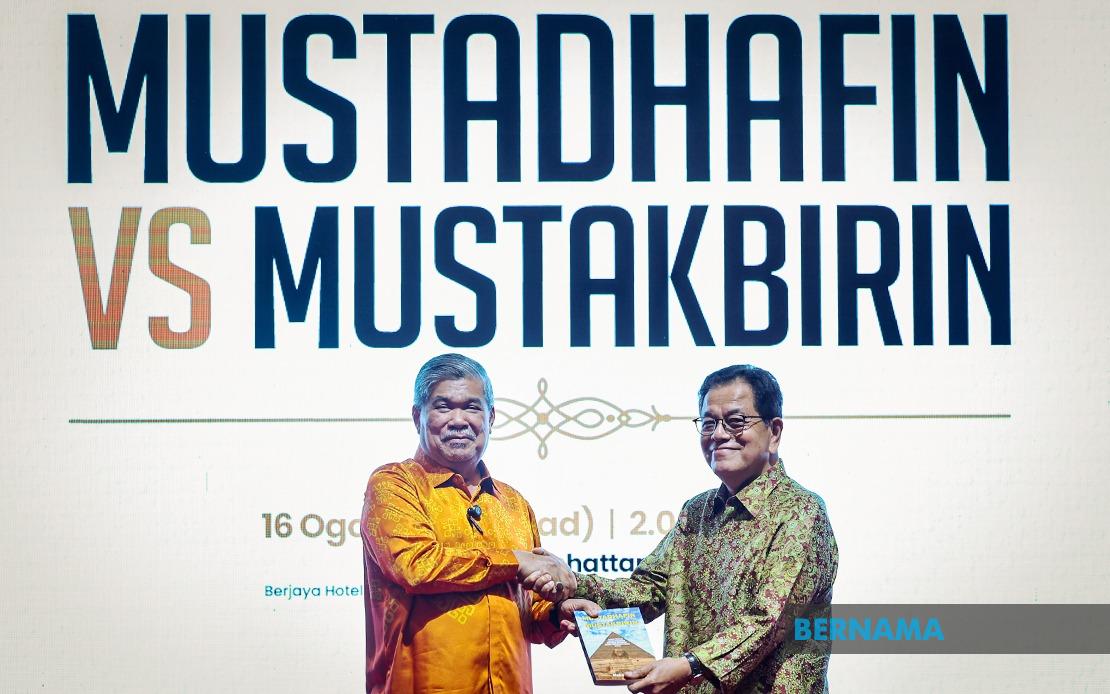
Datuk Seri Mohamad Sabu, the president of Amanah and Minister of Agriculture and Food Security, has issued a pointed reminder to Malaysians to exercise critical judgment when confronted with political accusations and claims. Speaking after launching his book in Kuala Lumpur on August 16, Mohamad cautioned that uncritical acceptance of allegations without scrutiny risks deepening 'asabiyyah'—a concept referring to tribal or group loyalty that blinds adherents to their own group's failings while causing them to dismiss the positive actions of rivals. The warning carries particular resonance in an era when unverified claims can circulate instantly through social media, shaping public opinion before facts have a chance to emerge.
The Amanah leader emphasised that the contemporary political landscape demands a more demanding intellectual approach from citizens. Rather than passively accepting information as it arrives, he urged Malaysians to independently verify claims, examine evidence, and develop a fuller understanding of complex issues before forming political positions. This call for epistemological rigour addresses a fundamental challenge in modern democracies: the tension between the speed at which misinformation travels and the slower, more laborious process of establishing truth. Mohamad's intervention suggests frustration with how Malaysian public discourse has increasingly become vulnerable to rumour and partisan narrative.
Drawing from his own political experience, Mohamad illustrated his argument with a contemporary flashpoint in Malaysian politics: recurring allegations that the Democratic Action Party (DAP) harbours communist sympathies and that any political alignment with the party constitutes collaboration with communism. By questioning the factual basis of such claims—asking whether DAP is genuinely communist—Mohamad highlighted how long-standing accusations can persist in the political ecosystem through repetition rather than substantiation. These allegations, rooted partly in Cold War-era narratives and anti-Chinese sentiment, continue to resurface in Malaysian political discourse, often weaponised by rival coalitions seeking to delegitimise their opponents. The persistence of such claims despite contextual changes in global geopolitics and Malaysian society suggests that emotion and tribal affiliation, rather than evidence, drive their staying power.
A key observation Mohamad offered concerns the asymmetry between facts and accusations in the information environment. Established facts and nuanced understanding require effort to acquire and time to absorb, making them less immediately satisfying to audiences seeking quick explanations. Accusations and suspicions, by contrast, offer immediate closure and emotional gratification, particularly when they align with existing prejudices or group loyalties. Social media platforms amplify this dynamic exponentially, rewarding sensational claims with engagement metrics while relegating careful analysis to quieter corners of the digital landscape. This structural reality has profound implications for Malaysian politics, where digital communication now rivals or exceeds traditional media as a source of political information for urban voters.
The minister's new book, launched by National Journalism Laureate Tan Sri Johan Jaaffar—who also serves as a director of Star Media Group Berhad—functions as a personal testimony to this philosophy. Rather than presenting abstract arguments, the book documents Mohamad's decades of encounters with diverse political actors and movements, grounded in his efforts to comprehend Malaysian and regional issues through direct observation rather than secondhand reportage or ideological templates. This autobiographical approach positions the work as a counter-narrative to the proliferation of untested claims in politics. By reconstructing his intellectual journey from youth through ministerial responsibility, Mohamad models an alternative to passive consumption of political messaging.
From his earliest years, Mohamad explained, he adopted a practice of sceptical inquiry, rejecting the passive reception of information whether delivered as propaganda or news. This habit of verification and independent thought proved formative to his political trajectory, particularly within the Islamic movement where competing ideological claims compete for adherents' allegiance. The habit also resonates with Islamic intellectual traditions emphasizing ijtihad—independent reasoning—rather than uncritical acceptance of handed-down doctrine. By framing his epistemological caution in these terms, Mohamad appeals to religious and cultural values among Malaysian audiences while articulating a secular principle about verification and evidence.
The book extends beyond Malaysian domestic politics to encompass Mohamad's reflections on broader geopolitical shifts and historical patterns. Through discussions of colonialism, Islamic movements, the Palestinian-Israeli conflict, and transformations in global power balances, the work positions Malaysian political questions within larger historical and geographical contexts. This panoramic approach responds to a recognition that contemporary Malaysian politics cannot be understood in isolation; regional dynamics, particularly involving China and the United States, increasingly influence local calculations. For Malaysian readers, this broader framework offers a method for contextualizing domestic disputes within global currents.
The release of this book and Mohamad's attendant warnings about uncritical acceptance of allegations arrive at a moment when Malaysian politics remains fractious and polarised. The failure of previous coalitional experiments, rising communal tensions, and intense competition between Pakatan Harapan and Perikatan Nasional have created conditions where political actors deploy accusations strategically, often abandoning established facts in pursuit of immediate advantage. Mohamad's injunction against 'asabiyyah' directly addresses this tendency, suggesting that tribal political loyalty, while emotionally satisfying and organisationally functional, ultimately corrodes democratic deliberation and national cohesion. His call for verification and independent judgment implicitly critiques the political culture that has normalised such loyalism.
For Southeast Asian observers, Mohamad's intervention reflects broader anxieties across the region about misinformation, digital manipulation, and the erosion of shared factual baselines necessary for democratic functioning. Indonesia, the Philippines, Thailand, and Vietnam have all confronted similar challenges as social media platforms have become primary channels for political communication. The solutions Mohamad proposes—individual scepticism, personal verification, and resistance to tribal impulses—operate at the civic level, emphasising personal responsibility and intellectual practice. Yet implementing such practices at scale requires complementary institutional reforms, including media literacy initiatives, platform accountability mechanisms, and political incentives that reward evidence-based discourse over tribal appeals.
Moving forward, the implications of Mohamad's message extend beyond Amanah's constituency to the broader Malaysian electorate increasingly fatigued by polarisation. Political actors across the spectrum face pressure to engage substantively with facts and evidence rather than relying on customary tropes and inherited suspicions. The book's emphasis on personal experience and direct observation, as opposed to mediated information, offers a template for political leaders seeking to reconnect with voters through authentic engagement. Yet the challenge remains daunting: in an information environment where sensational falsehoods travel faster than careful truths, encouraging the public to pause, verify, and think independently requires not merely exhortation but structural changes in how political information flows through Malaysian society.

