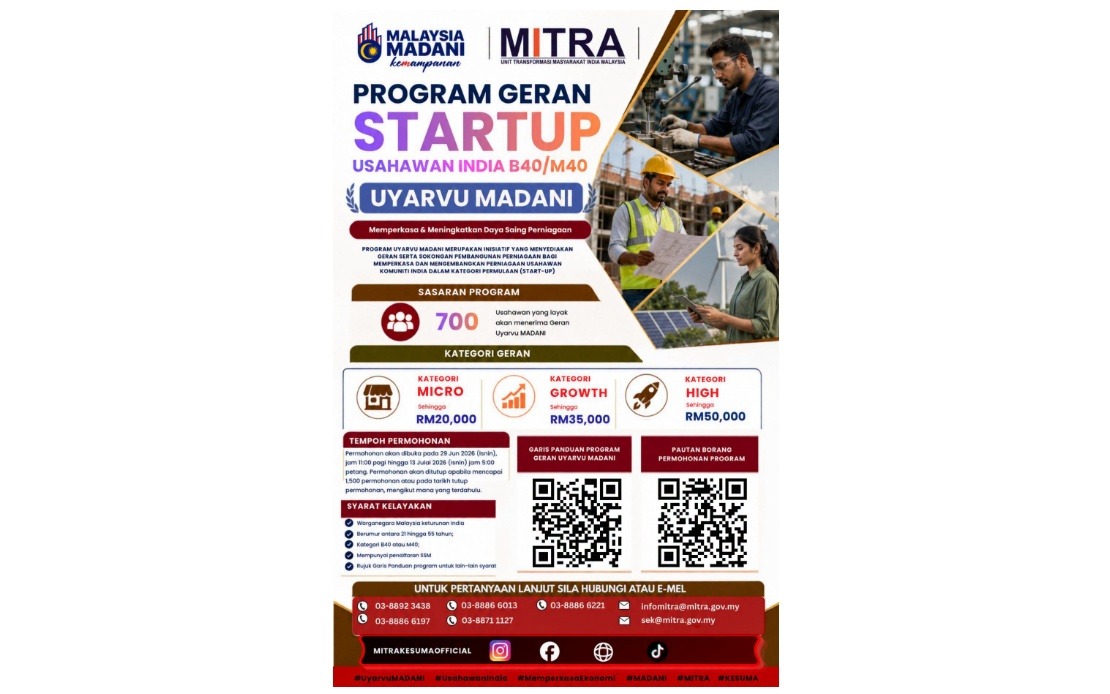
The Malaysian Indian Transformation Unit (MITRA) has launched applications for the Uyarvu MADANI Startup Accelerator Grant Assistance Programme, with the submission window extending from today through 5 pm on July 13. The initiative represents a targeted effort to support aspiring business owners within the Indian community who fall within the B40 and M40 income brackets, providing them with both capital and development resources to establish competitive enterprises.
The grant scheme distributes financial support ranging from RM20,000 to RM50,000 per recipient, amounts specifically calibrated to address the startup capital requirements that often constrain entrepreneurs from lower and middle-income households. By targeting these particular income segments, the programme acknowledges the systemic challenges faced by community members seeking to transition from employment to business ownership, where access to traditional financing remains limited or prohibitively expensive.
MITRA has set an ambitious enrollment target of 700 successful applicants to receive Uyarvu MADANI grants alongside comprehensive business development support services. These ancillary services extend beyond simple capital injection, encompassing mentorship, technical training, and market access initiatives designed to enhance the competitiveness of emerging ventures. The combination of financial and non-financial support reflects a holistic approach to entrepreneurship development, recognising that startup success depends on multiple reinforcing factors beyond initial funding.
The application process will terminate under two possible conditions: either upon reaching 1,500 total submissions or when the July 13 deadline expires, whichever occurs earlier. This dual-closure mechanism suggests confidence in market demand for the programme while simultaneously protecting administrative capacity and ensuring timely processing of applications. Early closure based on application volume would indicate strong uptake among the target demographic.
Uyarvu MADANI comprises one component of a broader six-initiative rollout by MITRA designed for 2026, reflecting an institutional commitment to Indian community development across multiple strategic areas. The collective allocation supporting these initiatives totals RM65.5 million, representing a substantial governmental investment in targeted community support. This funding envelope underscores the priority assigned to addressing economic inclusion gaps within the Indian community at the federal policy level.
For Malaysia's Indian entrepreneurs, this programme addresses a recognisable gap in startup financing ecosystems. While various national entrepreneurship support schemes exist, initiatives specifically designed for particular community segments remain comparatively limited. The Uyarvu MADANI framework acknowledges that entrepreneurial ambition exists across all demographic groups, yet access barriers differ based on community-specific factors including wealth distribution, social networks, and traditional financing sources.
The timing of this programme launch carries significance given ongoing national conversations around inclusive economic growth and wealth distribution. By deploying targeted capital to entrepreneurs from specific income groups within the Indian community, the government signals commitment to narrowing wealth gaps through business ownership pathways rather than solely through employment or social transfers. This entrepreneurship-centric approach assumes that supporting business creation generates sustainable income streams and wealth accumulation beyond what conventional assistance programmes achieve.
Applicants pursuing Uyarvu MADANI funding should recognise that grant receipt likely carries expectations regarding business formalisation, record-keeping, and progress reporting. Government grants typically embed compliance requirements and success metrics that recipients must satisfy. Prospective applicants would benefit from preparing comprehensive business plans, financial projections, and documentation demonstrating both business viability and personal commitment to entrepreneurial success.
The programme also reflects strategic thinking about demographic representation in Malaysia's entrepreneurial ecosystem. Indian Malaysians comprise approximately nine percent of the national population yet often experience lower business ownership rates relative to other communities. Targeted interventions like Uyarvu MADANI attempt to rebalance this representation by reducing capital barriers that disproportionately affect entrepreneurs lacking inherited wealth or established family business networks.
For entrepreneurs in the B40 and M40 categories specifically, the RM20,000 to RM50,000 grant range accommodates diverse business types from service-based enterprises requiring minimal infrastructure to light manufacturing or retail operations. This flexibility allows applicants to propose ventures aligned with their skills, market opportunities, and local contexts rather than forcing conformity to predetermined business models.
The seven-week application window provides adequate time for interested entrepreneurs to compile necessary documentation and submit proposals. Those considering applications should commence preparation immediately, as administrative bottlenecks often emerge as deadlines approach. Contacting MITRA directly for clarification on eligibility criteria and application procedures would be prudent, ensuring submissions meet all technical requirements for processing.
Beyond the immediate financial benefit, successful Uyarvu MADANI recipients gain access to MITRA's broader support ecosystem and potentially to networks connecting multiple government-backed entrepreneurs. These relational benefits often prove as valuable as capital itself, creating information channels, collaboration opportunities, and pathways to government procurement contracts that can substantially accelerate business growth.
The programme's success will be measurable not only through application volumes and grant distribution, but through longitudinal tracking of recipient business survival rates, employment generation, and income progression. These metrics will inform decisions about programme expansion or modification in subsequent years, suggesting that 2026's Uyarvu MADANI iteration represents a pilot that could evolve based on demonstrated outcomes and recipient feedback.

