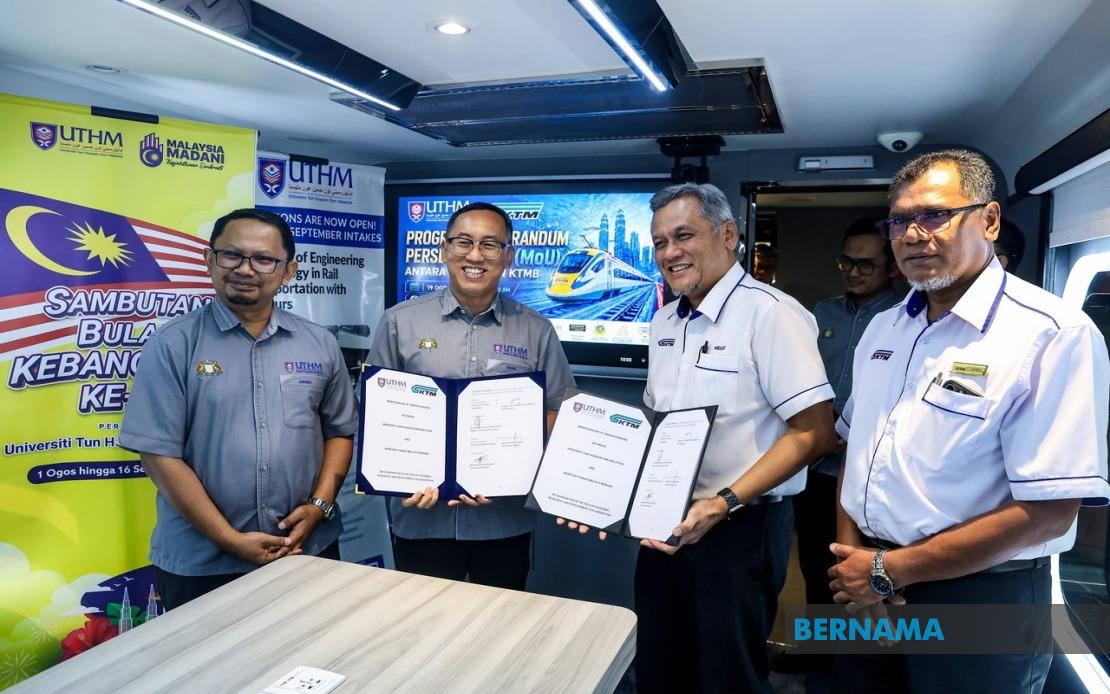
Universiti Tun Hussein Onn Malaysia (UTHM) and Keretapi Tanah Melayu Bhd (KTMB) have formalized an extended partnership spanning three years from October 2026 to July 2029, deepening their commitment to strengthening Malaysia's rail technology sector through coordinated academic and operational collaboration. The renewed agreement builds on a foundation established in 2019, representing a significant milestone in bridging the persistent gap between university research and industry practice within the country's transportation infrastructure domain.
The strategic framework encompasses four complementary pillars: work-based learning opportunities for students, collaborative research initiatives, professional competency development, and systematic knowledge exchange between academic researchers and railway practitioners. By integrating these elements, the partnership aims to create a comprehensive ecosystem where theoretical knowledge generated within university laboratories directly informs practical solutions needed by the nation's largest railway operator. This approach acknowledges a fundamental challenge in Malaysia's skills development landscape—the frequent disconnect between what universities teach and what industries urgently need to solve operational problems.
According to UTHM vice-chancellor Prof Dr Mas Fawzi Mohd Ali, the collaboration directly supports the institution's aspirational vision as a Global Technopreneur University 2030 (GTU2030), which deliberately synthesizes knowledge creation, technological innovation, and entrepreneurial thinking within educational programming. The partnership demonstrates how this ambitious institutional direction translates into concrete action, enabling UTHM to position itself not merely as a repository of technical knowledge but as an active participant in addressing genuine industry challenges that affect millions of Malaysians relying on rail transport daily.
The work-based learning component represents perhaps the most transformative element for participating students. Rather than experiencing the railway sector through textbooks and case studies alone, undergraduates enrolled in UTHM's Bachelor of Rail Transportation Engineering Technology with Honours programme gain direct exposure to real-world operational complexities, technology systems, and the human dimensions of managing a transportation network serving the entire peninsula. This immersive approach has already produced measurable outcomes—nearly 200 graduates from the previous collaboration phase have entered the professional workforce, with some securing positions internationally in Singapore and Saudi Arabia, indicating the caliber of talent the programme develops.
The research and development axis promises equally significant long-term benefits for Malaysia's rail sector. UTHM contributes sophisticated laboratory facilities and theoretical expertise grounded in cutting-edge transportation engineering research, while KTMB provides invaluable operational data, real infrastructure challenges, and institutional knowledge accumulated through decades of managing the country's most extensive rail network. This combination enables collaborative teams to identify genuine technical bottlenecks—whether related to track maintenance, rolling stock optimization, safety systems, or passenger experience—and develop evidence-based solutions rather than importing generic solutions designed for different contexts.
Meanwhile, KTMB's chief corporate officer Megat Khairulazhar Khairodin emphasized that the partnership addresses critical operational needs facing Malaysia's rail operator. By accessing UTHM's specialized technological capabilities and research infrastructure, KTMB gains capacity to tackle persistent technical challenges that might otherwise require expensive external consulting or purchasing proprietary foreign solutions. This orientation toward building domestic expertise represents a strategic imperative for Malaysia, as it reduces dependency on international service providers and gradually builds indigenous capability within the railway sector.
The collaboration explicitly extends into formal academic programming through KTM Academy (MyRA), the railway operator's training and education institution. UTHM will provide academic consultation shaping curricula for diploma, bachelor's, and postgraduate programmes specifically focused on rail transportation engineering technology. This direct curricular involvement ensures that railway operator employees receive training explicitly aligned with company operational standards and future technological directions, reducing the historical friction where academic programmes fail to anticipate industry evolution.
Competency development activities, industry forums, and structured academic visits constitute the third dimension of the partnership. These mechanisms create regular interaction points between university faculty and railway professionals, fostering mutual understanding of respective constraints and opportunities. University researchers gain appreciation for operational realities that constrain implementation of theoretical solutions, while railway practitioners encounter emerging research findings and innovative methodologies that might enhance service delivery. Such regular dialogue prevents the institutional silos that often characterize university-industry relationships in developing economies.
The commitment extends to supporting KTMB personnel pursuing advanced qualifications, with five railway staff members currently enrolled in master's degree programmes at UTHM in rail-related specializations. This investment in upgrading the knowledge profile of railway operators signals confidence that Malaysia's rail sector requires leadership with advanced technical credentials capable of managing increasingly sophisticated transportation networks. As Malaysia's economic development sustains pressure on transportation infrastructure, the availability of locally-educated rail engineers with postgraduate qualifications becomes strategically important for system modernization and innovation.
The partnership renewal comes amid broader regional emphasis on developing technical education capacity aligned with infrastructure development needs. Southeast Asian nations increasingly recognize that sustainable competitiveness requires robust domestic expertise in critical infrastructure sectors. Malaysia's positioning through this UTHM-KTMB collaboration demonstrates institutional awareness that transportation networks—particularly rail systems capable of efficiently moving passengers and freight—represent foundational investments that influence long-term economic development patterns.
The practical outcomes already evident from the previous collaboration phase—including UTHM graduates successfully employed in regional rail sectors—validate the partnership's fundamental approach. By combining academic rigor with operational relevance, and by creating pathways for students to experience industry realities before graduation, the initiative addresses chronic skills gaps that have historically constrained Malaysia's infrastructure development. The extended three-year commitment signals confidence that this collaborative model will continue generating benefits sufficiently valuable to justify sustained institutional investment from both partners.
Looking forward, this partnership model potentially offers a template for other Malaysian universities and infrastructure operators seeking to strengthen technological capacity within critical sectors. The emphasis on work-based learning, joint research, and reciprocal expertise sharing addresses perennial challenges in developing countries where the fastest technological progress often occurs elsewhere, and local institutions struggle to maintain pace. By institutionalizing systematic collaboration between academic research institutions and operational practitioners, Malaysia gradually builds the distributed expertise necessary for managing complex infrastructure systems with increasing autonomy and innovation.

