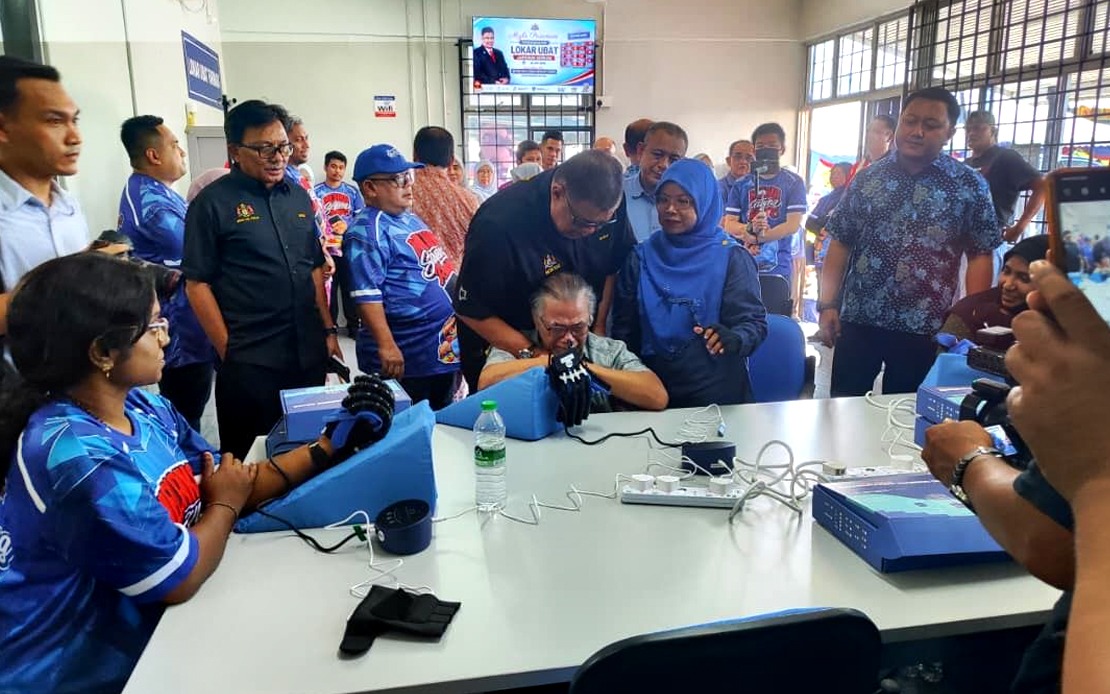
Universiti Teknikal Malaysia Melaka (UTeM) has opened the MADANI Community Rehabilitation Centre and Gymnasium in Serkam, Jasin, signalling a significant step toward bringing advanced medical rehabilitation technology to the wider Melaka community. The facility, officially launched by Chief Minister Datuk Seri Ab Rauf Yusoh, combines university-developed innovations with practical rehabilitation services, aiming to make sophisticated treatment more accessible to patients recovering from stroke, trauma, and mobility limitations.
The initiative emerged from the Finance Ministry's UniMADANI 2024 Grant, a programme designed to foster collaboration between public universities and local communities. Rather than confining research outcomes to laboratory environments, UTeM directed these funds toward establishing a real-world rehabilitation hub that translates years of engineering and biomedical research into tangible patient benefits. This approach addresses a critical gap in Malaysia's healthcare infrastructure, where access to cutting-edge rehabilitation technologies remains concentrated in urban tertiary centres and private facilities beyond the reach of most Malaysians.
At the heart of the centre lie three proprietary technologies developed by UTeM researchers that distinguish it from conventional physiotherapy establishments. The Roboglove system automates and guides hand rehabilitation training, allowing patients to perform repetitive exercises with precise feedback and adjustability. The Assistive Lower Limb Chair (ALLC) delivers automated lower limb exercises tailored to individual patient needs, while an integrated exoskeleton system enhances movement training by providing external support that gradually reduces as patient strength improves. Together, these innovations create a comprehensive rehabilitation environment that combines robotics, artificial assistance, and data-driven monitoring.
The centre's development involved extensive coordination across multiple sectors, reflecting a deliberate institutional strategy to embed university research within government health services and community structures. UTeM partnered with the Serkam State Constituency Development and Coordination Committee, local village development bodies, the Social Welfare Department, and PERKESO—Malaysia's social security organisation. This multi-stakeholder framework ensures that the centre aligns with existing community infrastructure while maintaining clinical standards and accessibility for patients who cannot afford private rehabilitation.
For Malaysian healthcare administrators and policymakers, the Serkam centre represents a replicable model addressing several persistent challenges. Malaysia faces an ageing population increasingly susceptible to stroke, yet physiotherapy capacity struggles to meet demand. The integration of robotic assistance reduces the physiotherapist-to-patient ratio required for effective treatment, potentially allowing limited clinical staff to serve more patients simultaneously. Moreover, the technology-enabled approach generates objective performance metrics that help clinicians track patient progress objectively rather than relying on subjective assessment alone.
Associate Professor Dr Mariam Md Ghazaly led the project's development, drawing on UTeM's engineering expertise and clinical partnerships. Her leadership reflects a broader institutional commitment at UTeM to translational research—converting theoretical advances into deployable solutions. This positioning has become increasingly important as Malaysian universities face expectations to demonstrate community impact beyond traditional academic outputs. By establishing centres like MADANI, UTeM demonstrates that publicly funded research can directly improve health outcomes for ordinary Malaysians.
UTeM Vice-Chancellor Prof Datuk Dr Massila Kamalrudin articulated an ambitious vision for expansion, framing the Serkam centre as a prototype for nationwide replication. Her statement emphasised that rehabilitation innovation need not remain expensive or geographically restricted. The technology-supported model, once refined and optimised at this location, could potentially be adapted for deployment in smaller towns and less-developed regions where conventional rehabilitation services remain inadequate. This scalability ambition resonates with Malaysia's broader digitalisation agenda and efforts to reduce urban-rural healthcare disparities.
The centre's establishment carries particular significance for Jasin district, a semi-rural constituency where residents historically travelled to Melaka city for specialised medical services. By situating the facility locally, UTeM eliminates transport barriers that often deter elderly stroke survivors and economically disadvantaged patients from pursuing rehabilitation. This geographic accessibility, combined with technology-driven efficiency, could substantially improve rehabilitation completion rates and health outcomes for the district's population.
Functionally, the MADANI centre operates as a hybrid facility—simultaneously serving as a community health resource and a testing ground for ongoing technology refinement. Patient data collected during treatment sessions feeds back into UTeM's research pipeline, allowing engineers and clinicians to iteratively improve the Roboglove, ALLC, and exoskeleton systems based on real-world performance. This feedback loop between clinical practice and engineering research represents best-practice translational medicine, ensuring technologies evolve to address genuine patient needs rather than theoretical specifications.
The financing model through UniMADANI 2024 also warrants consideration, as it demonstrates government commitment to university-community engagement beyond traditional funding. Rather than viewing universities primarily as teaching institutions, the Finance Ministry allocated resources specifically to bridge research and public benefit. Such funding mechanisms could accelerate Malaysia's transition toward a knowledge economy where academic institutions contribute directly to social welfare improvements and economic productivity gains.
Looking forward, the centre's success will depend on sustained operational funding, consistent physiotherapist and engineer staffing, and systematic documentation of patient outcomes. Malaysian policymakers observing the Serkam model should recognise that establishing technology-enabled facilities represents merely the initial investment; ensuring long-term viability requires commitment to recurring operational costs and trained personnel. Should these conditions be met, however, UTeM's MADANI centre could catalyse a broader ecosystem where publicly funded rehabilitation technology becomes a cornerstone of Malaysia's health security strategy.
The initiative ultimately reflects a maturing recognition that Malaysia's future healthcare competitiveness depends not solely on curative medicine but on accessible, efficient rehabilitation services that restore patient functionality and reduce long-term disability burden. By combining engineering innovation, clinical expertise, and community-based service delivery, the MADANI centre exemplifies how Malaysian universities can position themselves as drivers of inclusive healthcare transformation.

