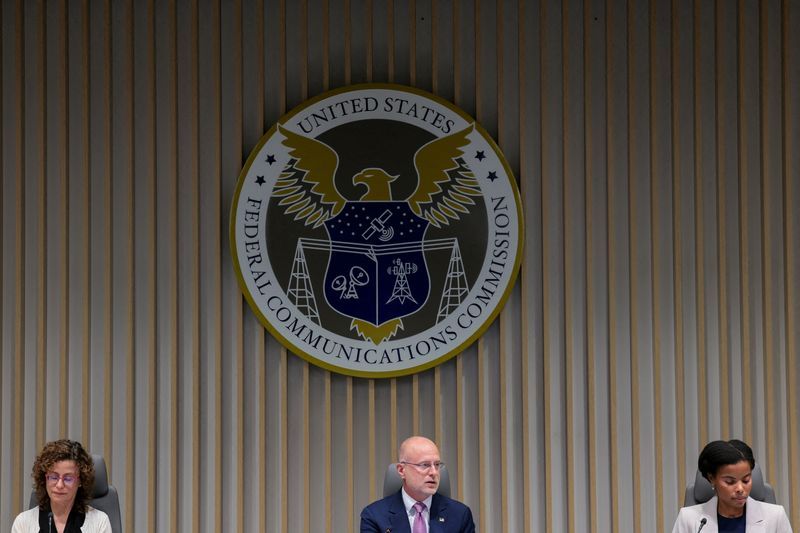
The United States has escalated its technological standoff with China by moving to comprehensively block hardware from Chinese companies classified as national security threats. The Federal Communications Commission voted on Wednesday to prohibit the sale of devices in America that incorporate critical components manufactured by Chinese firms on its restricted list, fundamentally reshaping how technology supply chains operate between the two countries. This action represents a significant expansion of existing restrictions that had allowed certain loopholes to persist in the regulatory framework.
At the centre of this regulatory shift is Huawei, the telecommunications equipment giant that has long been viewed with suspicion by Washington over alleged links to the Chinese government. The FCC maintains a formal blacklist of companies whose complete devices cannot be sold in the United States, with Huawei and ZTE as prominent members alongside other Chinese technology manufacturers. The decision to extend restrictions to component-level imports closes what industry observers had identified as a critical regulatory gap that manufacturers had exploited to maintain market access.
FCC Chair Brendan Carr framed the decision as eliminating what the agency terms the "component part loophole," signalling the regulator's determination to leave no pathway for Chinese technology to enter American infrastructure. Since 2022, while finished devices from blacklisted companies faced outright bans, manufacturers could still secure approval for products incorporating individual hardware components from Huawei and similar firms. This asymmetry allowed for creative workarounds where devices assembled outside China but containing Chinese-made semiconductors or logic boards could still reach American consumers and critical infrastructure.
The new regulatory framework specifically targets what the FCC calls "logic-bearing hardware components," essentially any semiconductor or processing element that contains decision-making capability rather than passive circuitry. This distinction matters considerably because it focuses enforcement on the most sensitive technological elements rather than applying blanket prohibitions that might be easier to circumvent. The specificity suggests regulators have consulted closely with technical experts to identify precisely which components pose the greatest vulnerability to potential compromise or espionage.
Security experts highlight why this technical precision matters. Chris McGuire, who previously served as a national security official in the Biden administration, explained that compromised components—particularly semiconductors and communications devices—could theoretically be weaponised to corrupt entire systems. In an era where computing devices are embedded throughout critical infrastructure from power grids to financial networks, the theoretical risk that a malicious component could serve as an entry point for cyberattacks justifies the regulatory caution. This concern extends beyond immediate military applications to civilian infrastructure that forms the backbone of modern economies.
President Donald Trump's administration has adopted an increasingly assertive approach toward Chinese technology throughout 2024, viewing such restrictions as essential components of broader economic and security strategy. The FCC's Wednesday decision represents just one element of a larger campaign targeting technological dependencies on China across multiple regulatory domains. In the preceding month alone, the commission banned imports of additional equipment from various Chinese manufacturers effective July 16, while simultaneously proposing restrictions on military-grade drone imports from Chinese suppliers.
The scope of restrictions extends well beyond component-level restrictions. Recent months have witnessed FCC prohibitions on new drone and router models from foreign manufacturers, with particular emphasis on Chinese suppliers. The commission has additionally proposed measures that would prevent American telecommunications carriers from establishing interconnections with Chinese telecom firms identified as national security risks, effectively severing communication pathways between networks. These escalating measures suggest a comprehensive strategy to systematically reduce Chinese technological presence across American infrastructure.
Looking forward, the FCC is contemplating even more consequential restrictions targeting the operational capacity of Chinese telecommunications companies within United States borders. Under consideration are measures that would prohibit Chinese telecom firms from operating data centres or maintaining Points of Presence—specialised facilities positioned at major internet exchange points where data traffic flows between networks. Implementing such restrictions would essentially force Chinese telecommunications companies to cease their American operations entirely, eliminating a physical foothold that has existed for decades and representing an unprecedented intervention in the structure of global communications infrastructure.
For regional technology companies and governments, these American actions carry significant implications. Southeast Asian nations including Malaysia have grown increasingly integrated into global technology supply chains, and American restrictions on certain components may create secondary effects as manufacturers seek alternative sourcing or relocate operations. The precedent of component-level restrictions could inspire similar measures in allied countries, potentially fragmenting global technology markets along geopolitical lines. Malaysian technology sectors dependent on Chinese components or serving Chinese technology companies may face disruption as supply chains reconfigure in response to American policy.
The absence of an immediate response from Huawei underscores the company's constrained position. With already limited access to American markets, further restrictions carry more symbolic than immediate commercial weight for the company itself. However, the regulatory action signals to other potential suppliers and manufacturers that American authorities intend to systematically eliminate grey areas and creative compliance strategies. The message extends to companies globally that producing technology for American markets increasingly requires certified non-Chinese component sourcing, raising manufacturing costs and potentially limiting competition in technology sectors.
These measures reflect deeper anxieties within American policymaking circles about technological sovereignty and supply chain vulnerability. The restrictions assume that Chinese government authorities could theoretically compel companies to embed surveillance or sabotage capabilities into exported components, though no public evidence of such practices exists. Whether or not such risks materialise, the perception of vulnerability has become sufficient to justify comprehensive restructuring of how American technology procurement operates. This approach represents a fundamental shift from decades of globalised supply chain integration toward technological compartmentalisation along national lines.
The longer-term trajectory suggests continued expansion of restrictions rather than convergence toward negotiated settlements. As American policy entrenches around technological decoupling from China, Chinese policymakers face incentives to accelerate domestic technology development and seek alternative markets less aligned with American interests. For Malaysian policymakers and business leaders, navigating this environment requires careful calibration between commercial relationships with Chinese technology partners and alignment with American security preferences—a challenge that will define technology sector dynamics across Southeast Asia for years to come.

