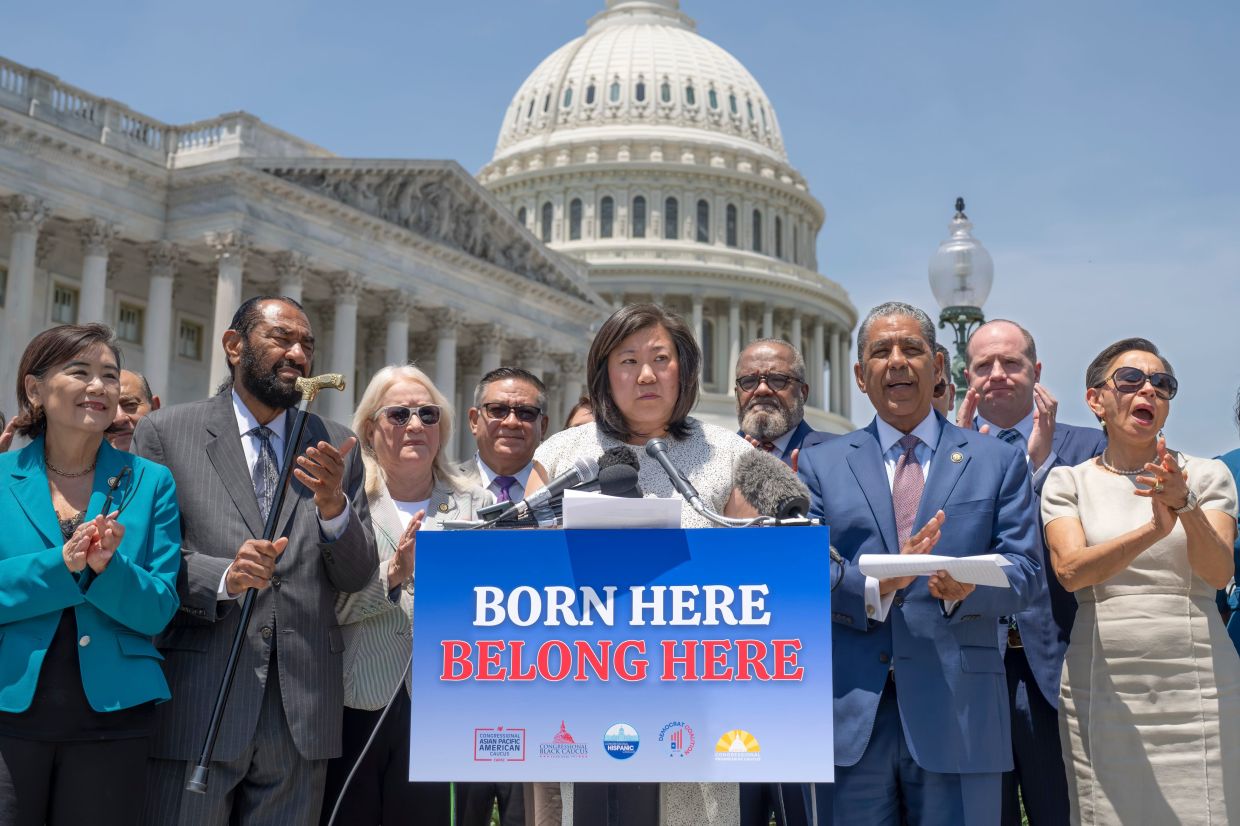
The United States Supreme Court has dealt a significant blow to a cornerstone of President Donald Trump's second-term immigration agenda by rejecting his attempt to strip citizenship rights from children born to undocumented parents or those on temporary visas. The 6-3 decision in Trump vs Barbara upheld the constitutional guarantee of birthright citizenship, a principle embedded in the 14th Amendment since the post-Civil War era. The ruling strikes down an executive order signed by Trump in early 2025, which had been scheduled to take effect the following month but was blocked before implementation.
The case centred on the interpretation of the 14th Amendment's Citizenship Clause, which the court's majority determined continues to grant citizenship to nearly all children born on American soil regardless of their parents' immigration status. Chief Justice John Roberts, writing for the majority, grounded the decision in historical principle: "Citizenship, then and now, was the right to have rights – to freely participate in our political community. The Framers of the Fourteenth Amendment extended that promise to 'every free-born person in this land'. We keep that promise today." This constitutional protection, originally enacted in 1866 and ratified in 1868 to safeguard the rights of former enslaved people and minorities following the Civil War, remains the bedrock of American citizenship law.
What distinguishes this case from previous citizenship debates is the breadth of Trump's executive order, which extended far beyond the undocumented immigration typically at the centre of the birthright citizenship controversy. The order would have affected children of individuals lawfully present in the United States on temporary status, including holders of highly skilled work visas such as H-1B and L-1 categories, as well as those on dependent visas, student visas, temporary labour visas, and achievement visas. All of these categories fall under the legal designation of "lawful but temporary" according to the US Citizenship and Immigration Services. The scope of the order revealed that arguments about immigration control masked a broader attempt to reshape citizenship access for millions of lawfully resident foreigners. The single exception would have been children with at least one citizen parent, who would have retained birthright citizenship under the proposed policy.
The Supreme Court's decision draws considerable symbolic weight from Wong Kim Ark, the landmark 1898 case that established the modern framework for birthright citizenship in America. Wong, a cook of Chinese descent, had been denied re-entry to the United States following a trip to China when officials argued he was not a citizen under the Chinese Exclusion Act based on his parents' immigration status. That Supreme Court decision determined that nearly all persons born on US soil acquire citizenship, irrespective of their parents' nationality or legal status. More than a century later, Wong's descendants have publicly reflected on the continuing relevance of his case. Norman Wong, his great-grandson, stated that his ancestor "was one man, only a cook, and yet he stood up for what was right," adding that the contemporary ruling demonstrates that "his victory remains as important now as it was in 1898."
The invocation of Wong's legacy carries particular resonance for Asian-American communities and others advocating for inclusive citizenship policies. Advocates note that birthright citizenship has survived previous existential threats, from the Chinese Exclusion Act through the Jim Crow era, and now an executive order that one civil rights organisation characterised as effectively turning "the maternity ward into a customs checkpoint." Stop AAPI Hate, an organisation tracking anti-Asian discrimination, emphasised that the ruling holds special significance for Asian-American communities, stating that "because of this right, the Asian-American community and other communities of colour have been able to grow in size and political power – and that is precisely why the Trump administration attempted to end it." The decision thus becomes a safeguard not only for immigrant families but for the demographic and political development of minority communities.
Trump's response to the decision has been characteristically defiant and creative in suggesting alternative paths forward. In social media posts, he called the Supreme Court's ruling "too bad" for the country while strategically congratulating China on a perceived "massive Birthright Citizenship WIN," apparently referencing so-called birth tourism allegations centred on Chinese nationals. He dismissed the need for a constitutional amendment, arguing instead that "no long and unwieldy Constitutional Amendment is necessary" and that Congress could easily remedy the situation through ordinary legislation. Trump has called upon Congress to "start TODAY" on ending birthright citizenship, pledging his "Complete and Total Support" for legislative efforts. This pivot toward legislative remedies rather than constitutional change reflects the political reality that amendment requires supermajority support from both chambers and state ratification.
Birth tourism has increasingly featured in the birthright citizenship debate, with the Trump administration and its legal representatives arguing that the practice constitutes an abuse of American citizenship. During oral arguments presented in April, Solicitor General D. John Sauer, Trump's top litigator, claimed that birthright citizenship "has spawned a sprawling industry of birth tourism" with "uncounted thousands of foreigners from potentially hostile nations" seeking to give birth in the United States. The Justice Department subsequently reinforced this focus by directing federal prosecutors through a memo to prioritise investigations of alleged birth tourism schemes. The memo referenced a 2024 prosecution in which a husband and wife, Michael Wei Yueh Liu and Jing Dong, received 41-month prison sentences for operating a birth tourism enterprise that charged Chinese clients tens of thousands of dollars to facilitate births on American soil.
For Southeast Asian readers, this Supreme Court decision carries broader implications regarding American immigration policy and the protection of citizenship rights across diverse populations. Malaysia, like many countries in the region, sends significant numbers of skilled workers, students, and professionals to the United States. The Supreme Court's ruling ensures that their children born in America retain automatic citizenship regardless of the parents' visa category or immigration status. This protection extends not merely to undocumented migrants but to the vast majority of lawfully present foreigners, providing stability and security for families engaged in temporary work or education arrangements. The decision also establishes a legal precedent that resists narrowing citizenship rights through executive action alone, requiring instead the more cumbersome process of congressional legislation or constitutional amendment.
The broader political and constitutional significance extends to questions of executive power and the separation of powers. Trump's attempt to use executive authority to reshape citizenship law represents an extraordinary expansion of presidential prerogative, effectively reinterpreting a constitutional amendment through administrative action. The Supreme Court's rejection of this approach reaffirms that fundamental questions of citizenship status cannot be resolved unilaterally by the executive branch, regardless of political conviction or policy preference. This principle gains relevance not merely within the United States but as a global example of constitutional limits on executive authority. The decision establishes that even a president commanding substantial electoral support and significant political resources cannot bypass constitutional protections through executive order when the judiciary remains independent and willing to enforce constitutional boundaries.
Looking forward, the Trump administration's apparent intention to pursue legislative remedies suggests that the birthright citizenship debate will intensify within Congress rather than the courts. The practical reality of achieving legislative change presents formidable obstacles, requiring support from the House of Representatives, the Senate, and the subsequent concurrence of state legislatures through ratification. The Supreme Court's 6-3 majority suggests deep ideological conviction regarding citizenship rights that transcends simple partisan calculations. The decision also reflects the continued relevance of 19th-century constitutional promises to American jurisprudence, even as immigration pressures and changing global patterns raise novel policy questions. For immigrant communities, particularly those from Asia and Latin America, the ruling provides confidence that constitutional protections will constrain even aggressive executive efforts to restrict membership in the American polity.
The symbolic dimensions of the decision merit consideration alongside its legal and policy implications. The invocation of Wong Kim Ark grounds contemporary protection of immigrant families in a historical narrative of American constitutional struggle, linking 21st-century immigration to the arc of civil rights development that followed slavery and racial exclusion. This narrative suggests that birthright citizenship represents not merely a technical legal rule but a foundational commitment to human dignity and political belonging. Whether Congress will successfully alter this constitutional guarantee through legislation remains uncertain, but the Supreme Court's decision has temporarily foreclosed the executive route and signalled that citizenship rights enjoy substantial constitutional protection. For policymakers throughout Southeast Asia observing American immigration debates, the ruling offers evidence that constitutional frameworks can constrain even determined presidential efforts to reshape fundamental political status.
The months ahead will reveal whether the Trump administration and its allies in Congress can muster sufficient political support for legislative change or whether the Supreme Court's decision will settle the matter definitively. Advocacy organisations representing immigrant communities have mobilised to defend birthright citizenship as fundamental to American identity and democratic values. Business interests dependent on skilled temporary workers may provide countervailing pressure against restrictions that would affect H-1B visa holders and their families. The intersection of constitutional principle, political calculation, and practical policy consequences will continue to shape this debate as it moves from the courts into the legislative arena and the broader public square.

