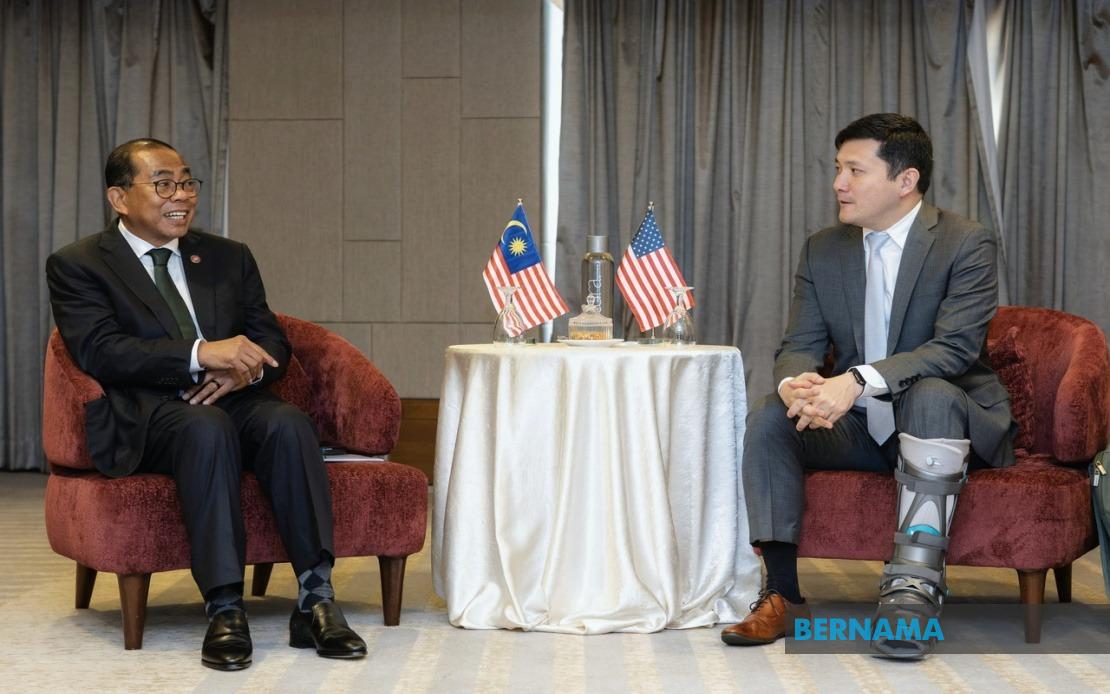
Defence Minister Datuk Seri Mohamed Khaled Nordin confirmed on August 3 that the United States remains committed to advancing its strategic partnership with Malaysia, particularly in the defence realm. The assurance came during a courtesy call from Kevin Kim, the US Ambassador to ASEAN, who visited Malaysia in connection with the 37th Annual Military Law and Operations Conference (MILOPS) being hosted in Kuala Lumpur. Mohamed Khaled emphasized that the American side has demonstrated consistent interest in nurturing the bilateral relationship and expanding cooperation across military and security dimensions.
The discussions between Mohamed Khaled and Ambassador Kim centred on consolidating existing collaborative frameworks rather than addressing contentious policy disagreements. This diplomatic approach reflects the pragmatic nature of contemporary US-Malaysia relations, where both nations appear focused on broadening institutional ties and identifying complementary interests. The visit itself carries symbolic importance, signalling Washington's continued engagement with the region at a time when great power competition and shifting geopolitical dynamics have heightened the significance of partnerships with key Southeast Asian nations.
Beyond the American engagement, Mohamed Khaled received separate courtesy calls from two other high-ranking officials, underscoring Malaysia's prominent role in regional security dialogues. ASEAN Secretary-General Dr Kao Kim Hourn used the occasion to discuss the multifaceted challenges confronting the regional bloc, with particular emphasis on how the defence sector can reinforce ASEAN Centrality—the foundational principle that the association should remain the driving force in regional architecture and dialogue mechanisms. Both officials acknowledged that military and defence institutions possess considerable leverage in advancing the bloc's collective agenda of maintaining peace, stability, and inclusive prosperity across Southeast Asia.
The defence sector's role in supporting ASEAN's broader objectives extends beyond traditional security concerns. Mohamed Khaled and Kao recognised that cooperation among defence establishments can facilitate trust-building, enhance interoperability, and create platforms for addressing transnational threats that transcend conventional borders. These might include maritime security challenges, disaster response coordination, counterterrorism operations, and cybersecurity threats—issues that demand sustained military-to-military dialogue and institutional collaboration across member states.
Singapore's newly appointed Permanent Secretary for the Ministry of Defence, Joseph Leong, also met with the Malaysian Defence Minister, bringing fresh impetus to bilateral cooperation frameworks that extend beyond bilateral channels. Joseph expressed Singapore's unwavering commitment to strengthening defence partnerships with Malaysia, a pledge that carries particular weight given the two neighbours' historical security relationship and mutual strategic interests. The cooperation architecture encompasses not only direct bilateral initiatives but also encompasses the broader ASEAN framework and the Five Power Defence Arrangements (FPDA), a long-standing multilateral security mechanism involving Malaysia, Singapore, Australia, New Zealand, and the United Kingdom.
The FPDA represents a distinctive model of regional security cooperation, blending bilateral commitments with multilateral coordination to address shared security challenges. By involving both bilateral and FPDA-level engagement, Singapore's defence establishment signals its intention to deepen ties with Malaysia across multiple institutional layers. This multi-level approach allows for flexible cooperation tailored to specific contexts while maintaining broader strategic coherence across the Indo-Pacific region.
The 37th MILOPS Annual Conference provides the backdrop for these high-level engagements and demonstrates Malaysia's status as a convening power in regional security affairs. Held from August 3 to August 6, the conference brings together government officials and military representatives from over 30 countries to deliberate on contemporary regional security challenges. The gathering facilitates direct dialogue among defence practitioners and policymakers, enabling the exchange of perspectives on emerging threats, operational doctrines, and legal frameworks governing military conduct in an increasingly complex security environment.
The conference's focus on legal aspects and military operations reflects growing international recognition that modern defence cooperation must rest on robust institutional foundations and shared understanding of international legal norms. As regional tensions occasionally flare and technological advancements blur traditional distinctions between military and civilian domains, forums like MILOPS provide essential spaces for establishing common ground on principles governing military operations and conflict prevention.
For Malaysia specifically, hosting this conference and attracting high-level delegations from the US, Singapore, and ASEAN leadership reinforces its position as a key node in regional security networks. The country occupies a strategically significant location along vital sea lanes and maintains substantial defence capabilities relative to its neighbours. As competition between major powers intensifies—particularly involving the United States and China—Malaysia's capacity to maintain balanced relationships and provide neutral ground for regional dialogue assumes heightened importance.
The emphasis on ASEAN Centrality in these discussions carries particular resonance given ongoing debates about the association's relevance and influence in shaping regional outcomes. By positioning defence cooperation as a vehicle for reinforcing ASEAN principles, officials are attempting to ensure that military-to-military engagement supports rather than undermines the bloc's collective agency. This approach allows ASEAN member states to pursue security partnerships with external powers while maintaining the association's coherence and voice in regional affairs.
Looking forward, the convergence of American commitment, Singapore's renewed focus under Joseph Leong's stewardship, and ASEAN's institutional priorities suggests a period of intensified defence diplomacy in Southeast Asia. Malaysia stands to benefit from this heightened engagement, potentially accessing advanced training opportunities, defence technology partnerships, and strengthened intelligence-sharing arrangements. Simultaneously, the country must carefully calibrate its multiple security partnerships to avoid perceptions of alignment that could undermine its non-aligned credentials or complicate relationships with other regional and global actors.
The outcomes of these meetings and the broader MILOPS conference will likely shape defence cooperation trajectories across Southeast Asia in coming months. With regional security challenges ranging from maritime disputes to transnational terrorism, the institutional relationships forged and commitments reaffirmed during such gatherings carry practical implications for how effectively the region responds to shared threats. Malaysia's role as host and active participant in these dialogues positions it advantageously to shape the terms of future regional security cooperation.

