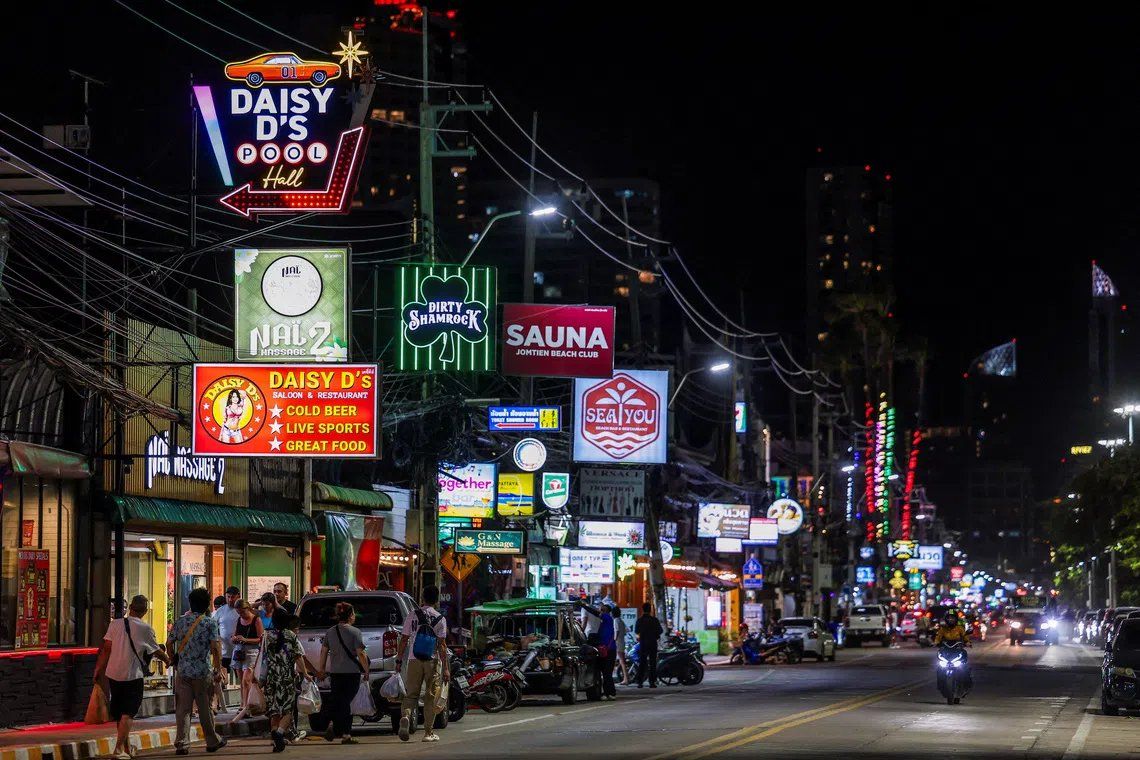
The USS Abraham Lincoln aircraft carrier is set to arrive in Thailand's Pattaya this week following an extended deployment spanning over 200 days, bringing nearly 5,000 sailors and Marines seeking respite after months at sea in the Middle East. The vessel and its two accompanying Navy ships will dock at nearby Laem Chabang, with the extended time away having redirected the carrier from its home port in San Diego to support military operations connected to the U.S.-Israeli conflict with Iran, according to Thai officials and Democratic lawmakers who have noted this represents a modern-day record for consecutive days deployed.
Pattaya, a coastal resort destination roughly two hours south of Bangkok, stands to receive a substantial economic injection from the visiting personnel. Mayor Poramase Ngampiches estimates that individual sailors and Marines could spend between 1,000 and 3,000 baht—approximately $30 to $91—per day during their shore leave, depending on accommodation choices and length of stay. The staggered nature of typical military leave means spending will be distributed across several days rather than concentrated in a single period. Local business leaders, struggling through what many describe as an exceptionally difficult tourism year, welcome the influx with considerable optimism, viewing the arrival as a potential lifeline for the region's hospitality and entertainment sectors.
Yet behind this optimism lies a more troubling reality that authorities are scrambling to manage. Pattaya's transformation from a fishing village into a major tourism hub was catalysed by American servicemen during the Vietnam War era, creating an infrastructure where the sex industry became deeply embedded. Despite Thailand's laws explicitly prohibiting prostitution, the industry operates with considerable visibility throughout major tourism zones. The FBI characterized Pattaya a decade ago as one of the world's leading sex tourism destinations, a designation that remains relevant today. Weekend raids preceding the carrier's arrival resulted in 40 to 50 detentions related to suspected prostitution, signalling the scale of police enforcement efforts.
The police response reflects the challenge authorities face in managing illicit activities across Pattaya's sprawling nightlife district. Pattaya police chief Anek Srathongyoo acknowledged on Monday that despite enhanced patrols around the beachfront and entertainment zones, enforcement remains fundamentally difficult. Sex workers can solicit clients in public spaces while evading detection, creating a cat-and-mouse dynamic that police resources struggle to contain. The arrival of thousands of foreign military personnel, many of whom may be unfamiliar with Thai laws and cultural norms, is expected to intensify this challenge substantially.
Academic and public health experts warn that the economic benefits must be weighed against documented harms. Pipatpong Fakfare, associate professor at Bangkok University's School of Humanities and Tourism Management, highlights risks including increased sexual exploitation and elevated transmission rates of sexually transmitted diseases as customer volumes surge. The influx of demand typically exerts downward pressure on worker safety standards and working conditions, with vulnerable individuals—including trafficked persons—disproportionately affected by rapid commercialization. These concerns reflect longstanding patterns observed across multiple Southeast Asian destinations where military port visits coincide with observable spikes in exploitation indicators.
The mental health dimension adds further complexity to this calculus. Reports from military-focused outlets this month have documented suicide attempts and declining morale among Abraham Lincoln personnel, reflecting the psychological toll of the extended deployment. Shore leave is intended partly to alleviate such stress through rest and recreation, yet research suggests that sailors experiencing mental health challenges may engage in riskier behaviour while ashore. This intersection of vulnerable military personnel and vulnerable exploited populations creates a nexus that compounds both groups' exposure to harm.
The economic distribution across Pattaya and surrounding regions remains uncertain, creating divergent fortunes within the tourism ecosystem. Thanet Supornsahasrungsi, president of the Association of Chonburi Tourism Federation, notes that overall commercial impact depends substantially on where personnel choose to spend leisure time, with some potentially travelling to Bangkok's broader attractions. Hotels, restaurants, and general retail will benefit more reliably than establishments concentrated in the nightlife and entertainment sectors. Lisa Hamilton, president of the Pattaya Nightlife Business Association, emphasised the acute desperation businesses feel after experiencing what she characterised as an unprecedentedly slow tourism year—a sentiment reflecting broader post-pandemic disruptions affecting Thailand's tourism-dependent economy.
Pattaya's tourism infrastructure, encompassing over 300,000 rooms, has substantial capacity to absorb the visiting personnel without reaching maximum occupancy. However, this physical capacity masks underlying structural vulnerabilities within the destination's business model. Heavy reliance on entertainment and nightlife activities leaves the local economy susceptible to external shocks and vulnerable to moral hazard, whereby economic incentives may inadvertently encourage rather than discourage illicit activities. The police crackdowns preceding the carrier arrival represent efforts to maintain a facade of regulatory compliance, yet observers familiar with Pattaya's dynamics recognise that enforcement typically diminishes once initial restrictions ease.
For Malaysia and other Southeast Asian nations observing these developments, the Pattaya situation illustrates persistent tensions within regional tourism policy. Economic necessity often overwhelms social and regulatory concerns, particularly in communities where tourism represents a primary income source. The Abraham Lincoln visit encapsulates this dilemma: legitimate economic stimulus intertwined with elevated risks of worker exploitation and social harms. Southeast Asian governments increasingly face pressure to reconcile tourism growth with labour protections and anti-trafficking commitments, yet enforcement capacity and political will remain inconsistent across the region.
The carrier's arrival also reflects broader geopolitical positioning, with Thailand's continued military cooperation with the United States reflected in port access and logistical support. This strategic relationship underpins Thailand's regional importance and carries economic benefits beyond immediate spending, yet it simultaneously embeds Thailand within frameworks where military presence and sex tourism have become historically intertwined. Breaking these patterns requires addressing not merely the symptoms—visible through police raids and regulatory efforts—but the underlying economic structures that make sex tourism persistently attractive to operators and customers alike.
As the Abraham Lincoln prepares to dock, Pattaya authorities face a genuine policy challenge without easy resolution. Enhanced policing offers political cover and may reduce visible solicitation temporarily, yet evidence from comparable military port visits suggests that clandestine operations intensify when enforcement becomes overt. Sustainable solutions would require addressing Pattaya's tourism economy more comprehensively, developing alternative employment pathways and business models less reliant on the nightlife sector. The five-figure injection of foreign spending represents genuine economic relief for struggling businesses, yet it perpetuates a development model whose human costs remain poorly accounted for in tourism statistics and business forecasts.

