The Upper Rajang Development Agency (URDA) is pivoting toward a fundamentally different model of rural economic development, one grounded in innovation and market-driven value creation rather than the traditional reliance on extracting and selling raw materials. Speaking in Sibu on July 16, URDA chairman Datuk Seri Alexander Nanta Linggi outlined an ambitious vision in which partnerships with universities, government agencies, and grassroots communities would collectively drive sustainable income growth across the Upper Rajang region of Sarawak.
The shift in strategy reflects a recognition that commodity-dependent rural economies remain vulnerable to price volatility and global market dynamics beyond local control. Instead, Nanta emphasised that communities must be equipped to process, refine, and market finished products, capturing larger profit margins within integrated value chains. This approach requires simultaneous investment in research capacity, technical training, and market access—elements that Nanta identified as the core pillars of modern rural development.
Evidence for this approach comes from the performance of the High Impact Community Projects (HICP) initiative, which has demonstrably lifted household incomes. Participating communities have seen average earnings rise by more than 25 per cent, a meaningful gain that validates the underlying theory: when research institutions collaborate with implementing agencies and government to solve real community problems, the outcomes extend beyond academic publications to create tangible livelihood improvements. The results suggest that the gap between research and practice need not be insurmountable if institutional frameworks are designed to bridge it deliberately.
Universities feature prominently in URDA's reconceived strategy, though Nanta reframed their role beyond traditional research production. He characterised universities as "strategic partners" whose strength lies not merely in generating knowledge but in aligning that knowledge with community priorities and ensuring it reaches practitioners who can commercialise it. This positioning reflects growing recognition across Southeast Asia that research institutions must be more deliberately embedded in regional economic ecosystems if research investments are to translate into widespread prosperity.
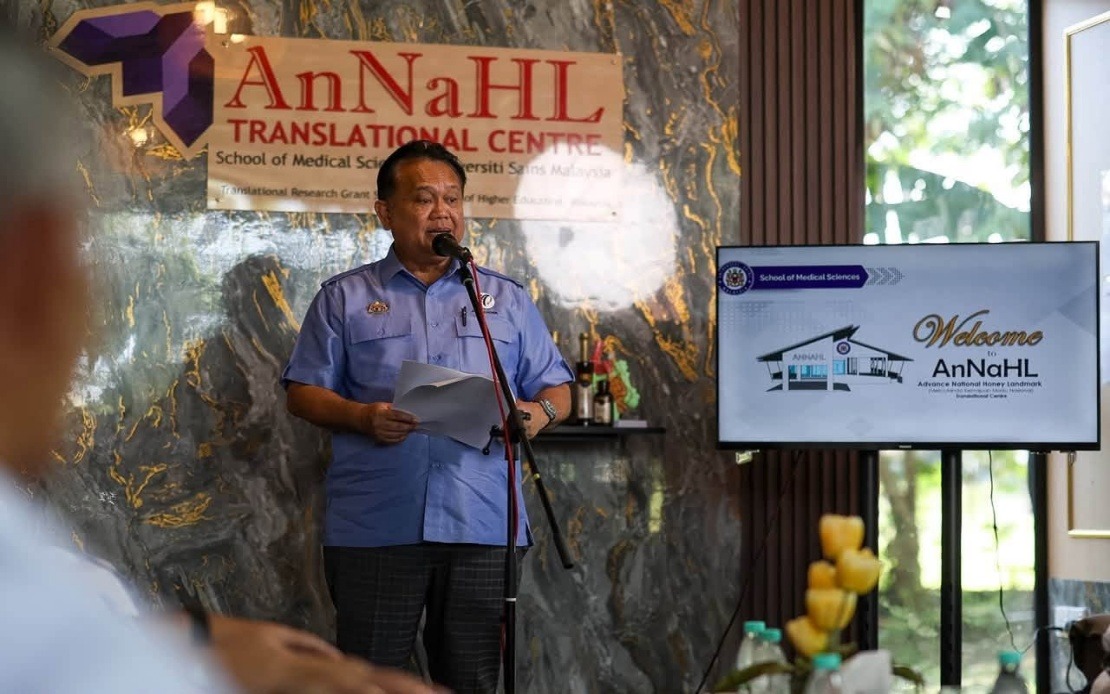
The URDA-RECODA delegation's visit to the Advanced National Honey Landmark (AnNaHL) Translational Centre at Universiti Sains Malaysia's Health Campus in Kubang Kerian, Kelantan, exemplifies this institutional partnership model in action. The centre functions as a bridge between laboratory science and marketplace reality, offering processing facilities, marketing support, training programmes, and product development services. For a developing rural region, such infrastructure dramatically reduces the barriers facing small-scale producers seeking to move beyond primary production into value-added processing and branding.
Within the Kapit parliamentary constituency, which Nanta represents, several locations have been earmarked for high-impact community projects. Stingless bee farming has emerged as a particular focus, reflecting regional ecological advantages and growing domestic and export demand for honey and related bee products. Stingless bees thrive in tropical environments and produce honey with distinctive therapeutic properties increasingly sought by health-conscious consumers in Malaysia and across Asia. The species thus offers rural communities a genuine market opportunity, provided they can overcome technical and commercial hurdles.
The deliberate linking of Kapit's development agenda to research capacity at established universities signals confidence that rural development need not remain isolated from cutting-edge knowledge. By positioning university research facilities as accessible resources for local entrepreneurs and farming communities, development agencies create pathways for technological leapfrogging. A farmer experimenting with stingless bee cultivation can access scientific guidance on hive management, pest control, and product quality assurance without relocating or abandoning agricultural pursuits.
Market access emerged as equally critical to technological upgrading in Nanta's framing. Rural producers often lack the networks, branding capacity, and distribution channels necessary to move products beyond local or regional markets. By establishing centres such as AnNaHL that offer processing and marketing support, agencies address a structural constraint that has historically confined rural producers to commodity-like roles, accepting whatever prices intermediaries offer. Processing facilities, cold-chain infrastructure, and professional packaging transform raw products into shelf-stable branded goods commanding premium prices.
The emphasis on community capacity building reflects an understanding that technological tools and market access matter little if communities lack the skills and knowledge to deploy them effectively. URDA's strategy thus prioritises training and knowledge transfer alongside infrastructure investment. This multi-dimensional approach—combining technology, market linkages, and human capital development—represents an evolution beyond earlier rural development models that often focused narrowly on infrastructure or credit provision without attending to capability constraints.
For Malaysian policymakers and Southeast Asian counterparts, URDA's trajectory offers instructive lessons about scaling prosperity beyond coastal urban centres. The framework suggests that rural economic transformation requires deliberate institutional coordination, sustained investment in research-community linkages, and patient capital willing to support entrepreneurs through the risky early stages of adopting new products and processes. It also suggests that universities, far from being tangential to development agendas, function as essential infrastructure when their research is deliberately oriented toward regional economic challenges.
The stingless bee initiative and broader HICP successes demonstrate that rural communities possess latent productive capacity awaiting activation through appropriate knowledge, technology, and market connections. Rather than accepting that rural economies must forever depend on selling unprocessed commodities or remain repositories of urban unemployment, Nanta's vision imagines rural areas as sites of deliberate, innovation-driven enterprise. Realising that vision at scale will require sustained political will, adequate budgeting, and continued institutional collaboration across universities, development agencies, and local stakeholders throughout Sarawak and beyond.

