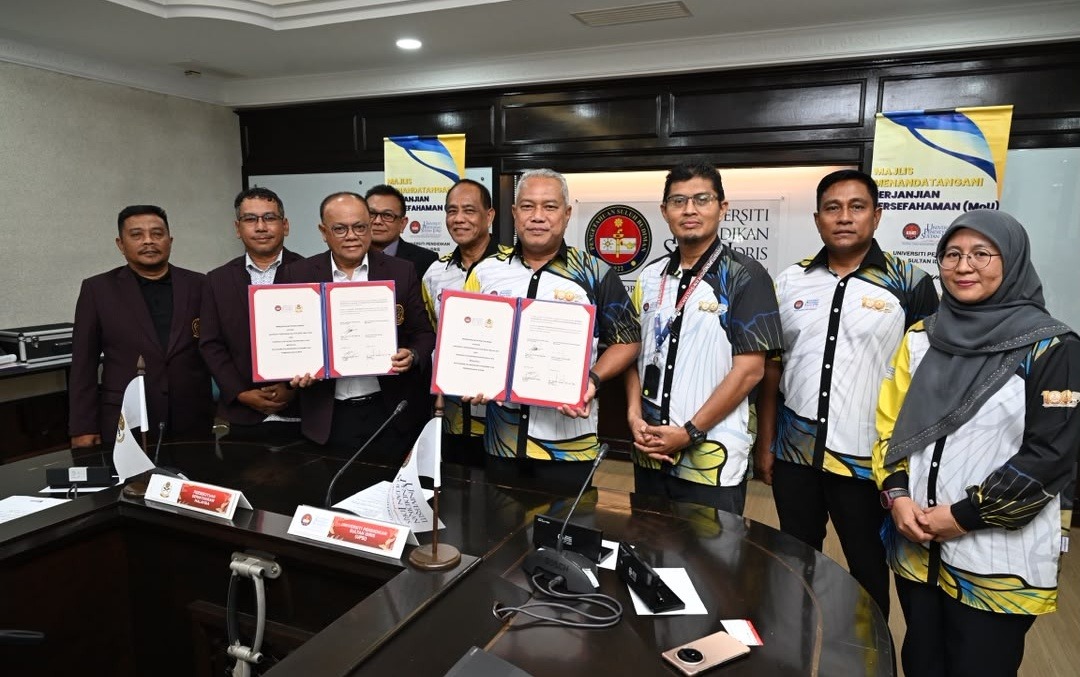
A significant collaboration between Malaysia's leading teacher-training institution and the country's governing body for sepak takraw took shape in Ipoh this month, signalling renewed institutional investment in one of Southeast Asia's most culturally distinctive sports. Universiti Pendidikan Sultan Idris (UPSI) and the Malaysian Sepaktakraw Federation (PSM) have inked a Memorandum of Understanding designed to integrate elite athletic development with rigorous academic preparation, addressing a persistent challenge in Malaysian sports: enabling talented competitors to complete their education without sacrificing their competitive prospects.
The three-year accord, signed at UPSI's Tanjong Malim campus, represents more than bureaucratic formality. According to UPSI Vice-Chancellor Prof Datuk Dr Md Amin Md Taff, the arrangement commits the university to admitting PSM-affiliated athletes at all degree levels, provided they meet academic entry standards, while offering modified timetables that accommodate intensive training schedules and national competition calendars. Such flexibility has proven essential in countries where athletes typically face a false choice between education and elite sport, often abandoning university studies when competition demands intensify during their peak performance years.
Central to the partnership is UPSI's commitment to place its accumulated expertise in sports science, coaching methodology, officiating standards and sports technology at the federation's disposal. The university has signalled willingness to share laboratory facilities, analytical resources and academic staff knowledge that could improve technical coaching, athlete conditioning, and the overall professionalization of Malaysia's sepak takraw ecosystem. This capacity-sharing model creates advantages for both parties: PSM gains access to scientific rigour that can accelerate athlete development, while UPSI's sports science faculty gains a living laboratory for applied research and student projects grounded in real competitive environments.
The agreement explicitly addresses talent identification and pathway development, areas where Malaysian sports has historically struggled with coherence and coordination. By formalizing links between UPSI and PSM, the MoU creates a clearer trajectory for promising players emerging from Malaysian Sports Schools and State Sports Schools—institutions that feed talent into competitive age-group and senior categories. Athletes demonstrating both academic capability and elite-level potential now have a designated institutional home where they can develop simultaneously as scholars and competitors, rather than being forced into informal, ad-hoc arrangements that often leave them isolated from peer support or vulnerable to exploitation.
Perhaps most ambitiously, the accord contemplates establishing a dedicated national training centre for sepak takraw, though the operational details of this facility remain to be negotiated in a more detailed Memorandum of Agreement anticipated in the coming months. Such a centre could serve as Southeast Asia's premier research and development hub for the sport, hosting coaches' education programmes, athlete testing and monitoring, and collaborative initiatives with regional federations and universities. For Malaysia, which has historically punched above its weight in sepak takraw internationally despite limited institutional infrastructure, this facility could represent a pivotal competitive advantage in a region where Thailand, Indonesia, and Vietnam are investing substantially in their own athlete development systems.
Tengku Zaihan Che Ku Abdul Rahman, PSM Vice-President, framed the collaboration as a validation of integrated athletic-academic development, noting that the union of UPSI's sports science capabilities with PSM's technical expertise creates conditions for accelerating the pipeline of accomplished players, qualified coaches, and certified technical officials. This emphasis on systemic development—not just producing winning athletes but building an entire ecosystem of qualified personnel—reflects mature thinking about sports sustainability. Too often, national sports bodies invest exclusively in current competitors while neglecting coach education, officiating standards, and administrative capacity, creating recurring crises when a generation of athletes retires.
The agreement also carries implications extending beyond sepak takraw itself. Tengku Zaihan suggested that this model could serve as a template for how other national sports bodies might forge strategic partnerships with universities, potentially reshaping how Malaysia approaches elite athlete support across multiple disciplines. This aspiration is significant in a Southeast Asian context where few countries have successfully scaled coordinated university-federation partnerships across multiple sports. Should the UPSI-PSM model prove operationally successful and produce measurable improvements in athlete development outcomes, other federations—in badminton, shooting, cycling, weightlifting and other disciplines—may pursue similar arrangements, fundamentally altering the institutional landscape of Malaysian sports.
The three-year initial period allows both institutions to test operational modalities, identify friction points, and refine procedures before potential extension. This measured approach acknowledges that institutional partnerships, particularly between academia and sports bodies with different governance cultures and incentive structures, require time to mature. UPSI's sports science faculty will need to coordinate with PSM coaching staff and athletes to ensure research agendas align with competitive priorities. PSM will need to ensure that its athletes honour their academic commitments, preventing the partnership from devolving into mere credential-granting without genuine educational engagement.
For Malaysian athletes in sepak takraw, the arrangement offers tangible practical benefits. Flexible scheduling eliminates the artificial crisis point where 18- to 22-year-old competitors must choose between national team selection and university enrolment. Financial support through UPSI scholarships can reduce the precarity that often forces talented athletes into early retirement or into semi-professional arrangements that distract from their sport. Access to university sports science resources—biomechanical analysis, sports psychology support, nutrition counselling, injury prevention protocols—can narrow the technical and physiological gaps that have historically separated Malaysian athletes from their Vietnamese and Thai counterparts.
The deeper significance lies in what this partnership reveals about changing attitudes toward athlete welfare within Malaysian sports governance. Previous generations of sports policy often treated athletes as disposable commodities, extracting maximum performance output during peak years before abandoning them to uncertain civilian employment prospects. The UPSI-PSM accord implicitly rejects this extractive model in favour of an approach that views athlete development as concurrent with personal development. An athlete completing a university degree while competing nationally emerges with qualification-backed employment prospects, civic knowledge, and social capital that extend far beyond their athletic career lifespan.
Looking toward the detailed Memorandum of Agreement and the potential national training centre, stakeholders will scrutinize whether institutional commitment translates into operational effectiveness. Successful implementation will depend on regular coordination meetings, transparent budget allocation, measurable performance indicators, and genuine buy-in from coaches, athletes, and academic staff who must navigate the practical realities of integrating two distinct institutional cultures. Malaysian sports has occasionally suffered from agreements that generate headlines but stall during implementation due to unclear responsibilities or resource constraints. The UPSI-PSM partnership's credibility will ultimately hinge on whether it avoids this pattern.

