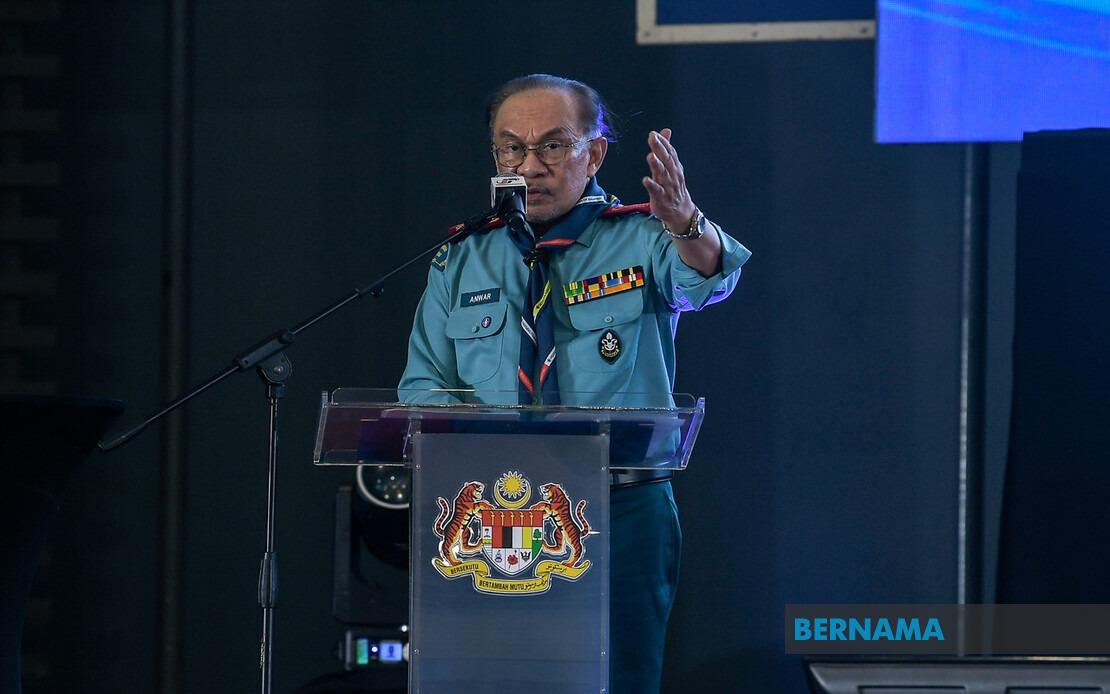
Prime Minister Datuk Seri Anwar Ibrahim has reframed the national conversation around language policy, arguing that elevating Malay's status as the country's official language should not be construed as a threat to other languages spoken across the nation. Speaking at the Ambang Merdeka Sahabat MADANI 2026 programme at Universiti Teknologi MARA (UiTM) Permatang Pauh on Thursday, Anwar stressed that linguistic priorities are not mutually exclusive, addressing what has become an increasingly sensitive topic in Malaysian public discourse.
The Prime Minister's position reflects a pragmatic approach to a nation deeply divided along linguistic and cultural lines. Malaysia's demographic complexity—with Malay being the constitutional official language while English, Mandarin, and Tamil remain integral to communities and commerce—has historically created tension between aspirations for cultural preservation and economic necessity. By framing language acquisition as complementary rather than competitive, Anwar seeks to defuse anxiety among those who fear that prioritising Malay diminishes opportunities for minority language speakers.
Anwar articulated a vision where every Malaysian citizen, regardless of ethnic background, develops strong proficiency in the national language as a unifying foundation. This emphasis on linguistic unity serves a practical purpose: Malay functions as the common tongue binding together a multicultural society, and its mastery by all citizens strengthens social cohesion and administrative efficiency. Yet simultaneously, he acknowledged that such advancement need not come at the expense of other languages that have deep historical roots and ongoing utility within their respective communities.
The international dimension of language policy featured prominently in Anwar's remarks. English, he noted, has evolved into an indispensable global medium of communication and commerce, making proficiency in the language an economic imperative for Malaysian youth seeking international opportunities. Rather than viewing English as a competing force against Malay, Anwar positioned it as a complementary tool that expands rather than restricts possibilities. This reflects Malaysia's position as a trading nation heavily dependent on cross-border commercial relationships and foreign investment.
Mandarin Chinese received particular attention in Anwar's analysis, a recognition that reflects Southeast Asia's economic realities. As China's economic influence and trade relationships continue reshaping the regional landscape, proficiency in Mandarin has become increasingly valuable for Malaysian businesses and professionals. Anwar's explicit encouragement for children to master Chinese—provided their Malay foundation remains solid—signals official endorsement for this linguistic shift driven by market forces. This stance acknowledges that Malaysia cannot insulate itself from regional economic currents and must position its citizens to compete effectively.
Tamil, representing Malaysia's substantial Indian community, also featured in the Prime Minister's multilingual framework. By including Tamil among the languages worthy of cultivation, Anwar addressed concerns from minority communities that language policy discussions might inadvertently marginalise their cultural heritage. This inclusive framing allows the government to advance Malay-centric policies while simultaneously demonstrating commitment to communal pluralism, a delicate balance crucial for maintaining social stability.
Central to Anwar's argument is his rejection of what he termed a "zero-sum game" mentality regarding language competency. This phrasing carries significant weight in Malaysian politics, where educational policy often becomes a proxy for broader questions about national identity and communal rights. By explicitly stating that learning regional languages does not disadvantage speakers, he attempts to neutralise opposition from those who fear that multilingual education diverts resources from Malay instruction. The framing suggests that linguistic competency is not a finite resource to be rationed but rather an expandable capacity that benefits individuals and society.
The economic imperative Anwar emphasised extends beyond commercial advantage. In an increasingly integrated regional economy and interconnected global marketplace, multilingual capabilities become essential professional credentials. Malaysian workers competing for positions in multinational corporations, international organisations, and regional enterprises require fluency across multiple languages. Anwar's position thus aligns personal economic advancement with national competitiveness, suggesting that individual language acquisition serves collective national interests.
Beyond linguistic specifics, Anwar's broader message addressed social cohesion and national unity. He cautioned against actions that might "sow seeds of hostility among the races," contextualising language policy within the framework of interethnic relations. This connection recognises that in Malaysia's plural society, language debates carry meanings extending far beyond education and commerce—they signal whose identities and cultures the state values and privileges. By emphasising shared benefit and complementarity, Anwar attempts to defuse tensions that language discussions can generate.
The Prime Minister called for citizens to cultivate a "spirit of sharing, caring and helping one another," framing linguistic diversity as an expression of Malaysian multiculturalism rather than a threat to national identity. This appeal to collective values seeks to transform potential points of conflict into opportunities for demonstrating unity in diversity. The underlying assumption is that Malaysians of different backgrounds will accept Malay strengthening policies more readily if they simultaneously perceive commitment to preserving their own linguistic and cultural spaces.
Anwar's remarks also implicitly challenge assumptions about the relationship between language policy and national loyalty. By suggesting that fluency in multiple languages represents economic pragmatism rather than cultural betrayal, he reframes the debate away from nationalist concerns toward practical competitiveness. This repositioning may help ease tensions that have periodically erupted around education policy, particularly regarding the role of vernacular schools and the appropriate balance between Malay and English instruction in schools.
The timing of these comments during the Ambang Merdeka MADANI 2026 programme underscores their connection to government messaging about national development and inclusive growth. The MADANI framework emphasises prosperity, integrity, and technology as pillars of the government's agenda, and Anwar's language position fits within this vision of a Malaysia that embraces global economic integration while maintaining cultural foundations.
Moving forward, the challenge for policymakers will be translating Anwar's philosophical framework into concrete educational and cultural policies that satisfy communities with competing linguistic priorities. Whether educational resource allocation and curriculum design can genuinely reflect the balanced approach he articulated remains a practical question that will determine whether his vision of complementary multilingualism becomes operational reality or remains aspirational rhetoric.

