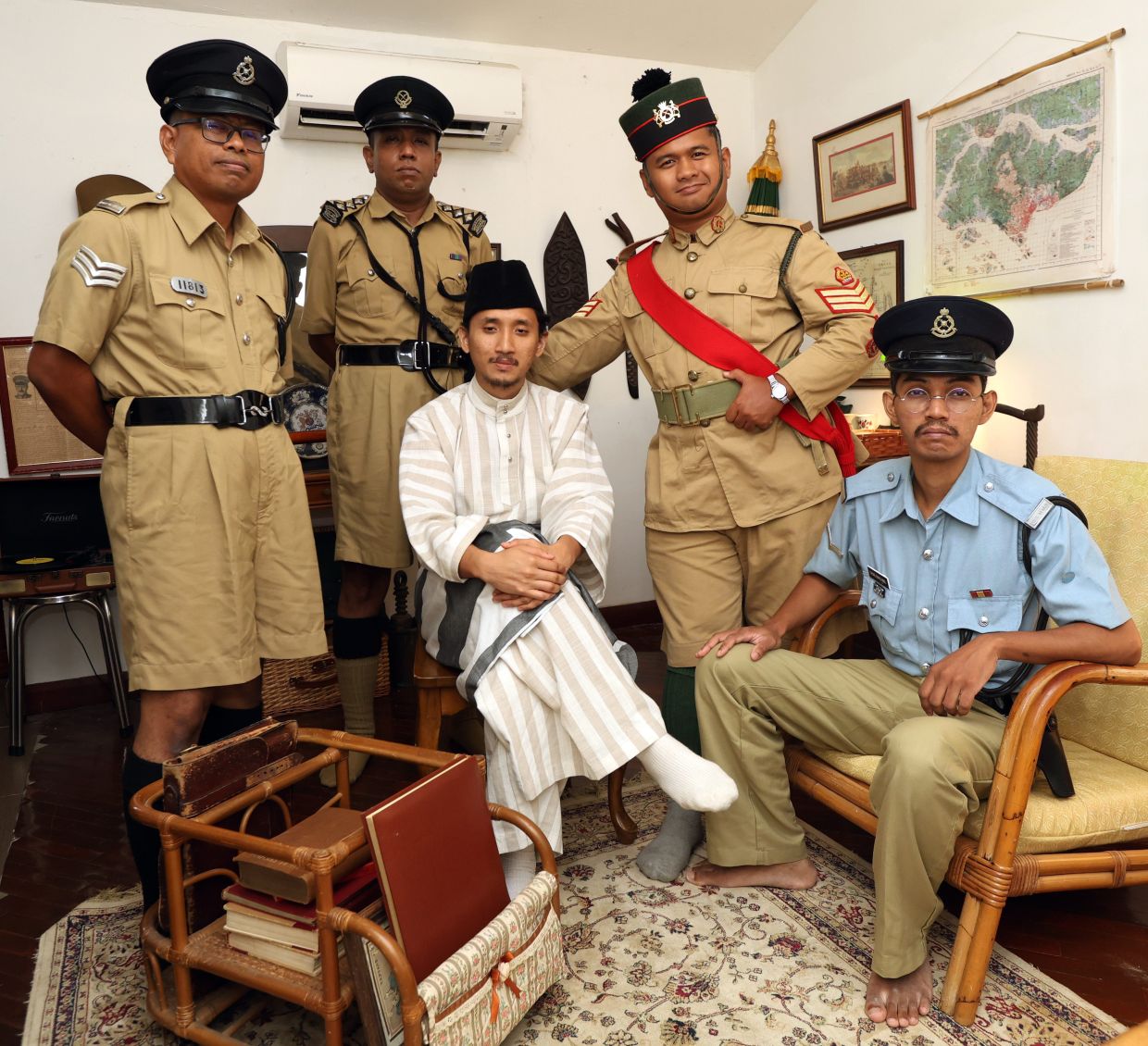
On weekend afternoons, members of Persatuan Reka Ulang Sejarah (PRUS) gather in carefully curated historical military uniforms, settling around a coffee table for discussions that transport conversations across decades. What began as casual hobby meetings has matured into a sophisticated educational initiative, with PRUS now operating as a formally registered society committed to making Malaysia's historical narrative tangible and engaging. The group's emergence represents a broader recognition that historical understanding extends far beyond classroom lectures and textbook pages—it demands visualization, embodiment, and the kind of immersive engagement that breathes life into dated black-and-white photographs.
The origins of PRUS trace back to the early 2010s, when a loose coalition of vintage military uniform enthusiasts first converged at an event hosted by the Port Dickson Army Museum at the now-defunct Royal Malaysian Air Force Base in Sungai Besi, Kuala Lumpur. These collectors, bound by shared fascination with historical military attire and regalia, eventually formalized their gatherings under the banner "We Are Re-enactors" before taking the significant step of official registration as PRUS in 2023. This transition from informal assembly to institutional entity reflects the group's maturation and its expanded vision of historical outreach. By securing legal status as a society, PRUS gained the capacity to systematically organize exhibitions, school programmes, and public demonstrations—moving beyond private enthusiast circles into formal educational channels.
Chairman Abdul Hakim Abdul Rani articulates the driving philosophy behind PRUS's establishment. He observed persistent confusion and misunderstanding regarding historical military uniforms, particularly from the pre-Independence era when photographic documentation relied on black-and-white imagery and where different military branches appeared visually indistinguishable to untrained eyes. This knowledge gap motivated him and fellow members to transform their accumulated expertise into a public resource. By obtaining official registration, PRUS could legitimize its educational mission and gain institutional access to schools, museums, and cultural organizations—platforms essential for reaching audiences beyond the enthusiast community. The group's fundamental conviction rests on the premise that historical accuracy matters profoundly, not merely as academic pursuit but as a foundational element of cultural education and national consciousness.
What distinguishes PRUS from casual costume enthusiasts lies in the scholarly rigor underlying every presentation. Members recognize that historical authenticity encompasses far more than donning the correct uniform. Each era carried distinct protocols regarding etiquette, body language, marching styles, and vocal patterns—subtle dimensions that collectively constitute the embodied experience of living within a particular historical moment. This commitment to granular accuracy reflects Abdul Hakim's perspective that historical re-enactment functions principally as educational medium rather than entertainment vehicle. When PRUS members don uniforms and assume historical roles, they undertake deliberate acts of historical translation, attempting to bridge the temporal gap between contemporary observers and the lived experiences of their predecessors.
The depth of PRUS's commitment manifested visibly during a two-day, one-night re-enactment jamboree held in July, where members underwent structured training in marching formations, map reading, navigation protocols, and basic combat manoeuvres drawn directly from original pre-Independence military manuals. Abdul Hakim, leveraging his background in the Territorial Army (Askar Wataniah), led these sessions with authoritative expertise grounded in practical military experience. Significantly, the jamboree transcended nostalgic recreation; its explicit purpose involved understanding the operational methodologies and tactical thinking of soldiers from that historical period. Even the weapons used for combat re-enactments were substituted with wooden sticks to maintain compliance with contemporary safety regulations—a practical compromise that preserves educational value while acknowledging present-day legal frameworks.
Beyond educational exhibitions and public demonstrations, PRUS has cultivated partnerships with Malaysia's film and television industry, serving as historical consultants and appearing as extras in period productions. Vice chairman Mohd Fadzreeq Mokti emphasizes that this collaborative work transcends ordinary acting; PRUS members function as living archives, ensuring visual and behavioral fidelity to specified historical periods. Their involvement in film projects represents an indirect but significant avenue for disseminating historical knowledge to mass audiences who encounter historical content through entertainment media rather than formal educational settings. This intersection of entertainment and education reflects contemporary trends in how historical narratives reach and influence public consciousness, particularly among younger demographics who absorb information through visual media.
The timing of PRUS's programming reveals strategic consideration regarding national consciousness and cultural commemoration. The group intensifies its activities during August and September, when Malaysia's National Month celebrations and Malaysia Day observances dominate the cultural calendar. During these periods, PRUS brings its collections to exhibitions and public events, deliberately positioning historical artifacts and embodied demonstrations within moments of heightened national reflection. This scheduling strategy acknowledges that educational receptivity peaks during periods when audiences are psychologically primed for historical engagement. By presenting authentic historical materials during these ceremonial moments, PRUS capitalizes on existing cultural momentum to embed historical awareness within broader national celebrations.
Schools represent a particular focus of PRUS's outreach strategy, and the group has identified concerning gaps in younger generations' familiarity with fundamental historical figures and events. Abdul Hakim views this knowledge deficit with genuine concern, recognizing that historical consciousness constitutes a prerequisite for informed citizenship and national identity formation. Schools offer the most systematic pathway for addressing this deficiency, particularly when historical content can be presented through experiential rather than purely textual means. The accessibility barrier extends beyond mere motivation; many students lack opportunities to visit museums or handle historical artifacts directly. This spatial and material inequality in access to historical experience creates a disparity that PRUS attempts to address through direct school engagement, bringing historical demonstrations into educational spaces.
Mohd Fadzreeq, who works as a school teacher and also serves as PRUS vice chairman, has witnessed firsthand the transformative impact of embodied historical presentation. When he appears at his school in full historical uniform—a practice authorized by his headmaster—student engagement reaches notably elevated levels. Children consistently inquire when he will next don these garments, indicating profound curiosity that textbooks alone struggle to ignite. Fadzreeq's observation that young learners respond most effectively to hands-on, visual, and interactive educational modalities aligns with contemporary pedagogical research emphasizing multisensory engagement in learning processes. The physical presence of historical uniforms, worn by recognizable authority figures within the school environment, creates psychological and emotional proximity to history that removes temporal and abstract barriers separating students from historical content.
The concept of PRUS members functioning as "walking museums" captures an essential dimension of their broader social role. These individuals transform themselves into mobile historical repositories, carrying accumulated knowledge and material authenticity into public spaces where spontaneous conversations generate educational opportunities. When community members encounter PRUS members in full regalia, curiosity typically prompts questions, initiating organic educational dialogues. This informal pedagogical approach operates according to different principles than structured classroom instruction. Members invest substantial personal time studying historical texts, military manuals, and archival materials to prepare for these spontaneous encounters, demonstrating commitment that extends far beyond surface-level costume performances. The depth of their preparation ensures that responses to public inquiries reflect informed understanding rather than superficial knowledge.
The broader significance of PRUS's work extends beyond individual historical education to encompass questions about how contemporary Malaysia engages with and interprets its own recent past. The transition from colonial administration to independence represents a foundational rupture requiring ongoing interpretive work to remain culturally comprehensible across generations. By rendering this history visible, tangible, and emotionally resonant through authentic material culture and embodied performance, PRUS participates in the essential cultural labor of historical meaning-making. Their activities acknowledge that history cannot remain confined to archives and academic publications if it is to maintain relevance and influence within living societies. Rather, history requires continuous reinterpretation and re-presentation to successive generations, a responsibility that PRUS has undertaken with remarkable dedication and scholarly seriousness.
As Malaysia continues to navigate questions about national identity, historical consciousness, and collective memory, organizations like PRUS occupy increasingly important positions within the cultural ecosystem. The group's evolution from amateur hobby community to formally recognized historical society reflects growing recognition that preserving national heritage demands active, sustained engagement beyond passive consumption of textual historical accounts. Their commitment to meticulous accuracy, educational accessibility, and public outreach offers a model for how passionate communities can effectively contribute to broader national conversations about historical understanding. By making Malaysia's military heritage visible and comprehensible to contemporary audiences, particularly younger citizens, PRUS helps ensure that the past remains alive as active reference point rather than fading into abstract irrelevance. This work ultimately serves the practical purpose of fostering informed citizenship grounded in genuine historical understanding rather than received mythology or popular misrepresentation.

