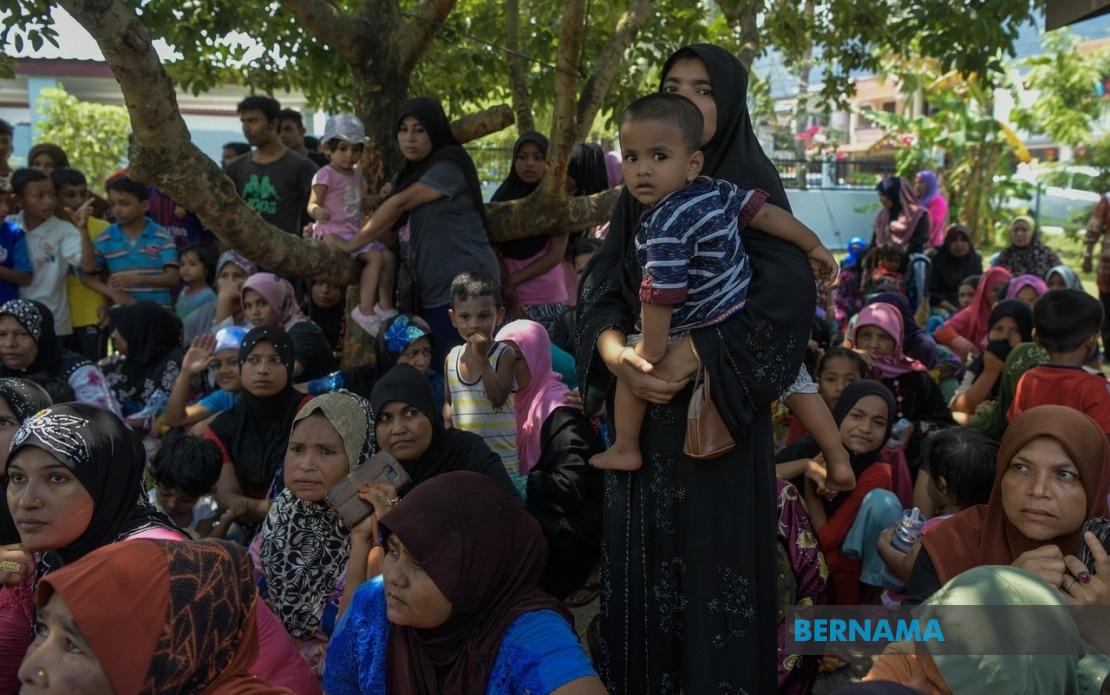
The Malaysian government has moved to dispel public misconceptions surrounding refugee documentation, with Economy Minister Datuk Akmal Nasrullah Mohd Nasir explicitly stating that UNHCR cards confer no special legal status or protection from domestic prosecution. His statement, delivered during the Global Supply Crisis Briefing on July 13, addresses mounting public anxiety over how asylum seekers and refugees are managed within Malaysian territory and the potential security implications for local communities.
Akmal Nasrullah's clarification comes at a sensitive moment for Malaysia, where public discourse around refugee populations has intensified following concerns about human trafficking networks, documentation fraud, and unauthorised border crossings. The minister was direct in his message: possession of a UNHCR card identifies an individual as a refugee under international protocols but does nothing to shield that person from investigation, arrest, or prosecution should they breach Malaysian criminal or civil law. This distinction carries real significance for both policymakers and the general public seeking to understand the legal framework governing the country's refugee population.
The issue gained prominence at the National Economic Action Council meeting chaired by Prime Minister Datuk Seri Anwar Ibrahim at Parliament, where the Home Ministry presented a comprehensive update on refugee management challenges. The discussion reflected broader government concern that misinformation about refugee rights has created a perception of legal ambiguity, potentially undermining public confidence in law enforcement institutions. By having a senior economic minister publicly reaffirm Malaysia's commitment to universal legal standards, the government signalled that refugee status is a humanitarian designation rather than a legal exemption.
The Home Ministry's presentation outlined the Refugee Registration Document programme, which Malaysia is progressively implementing to establish clearer oversight of displaced populations. This biometric-based system combines registration, security screening, and continuous monitoring, designed to create a transparent database that distinguishes between legitimate asylum seekers and individuals who pose security risks. The approach reflects international best practices in refugee management while addressing specific Malaysian concerns about irregular migration and criminal networks exploiting refugee populations for trafficking purposes.
Beyond documentation, authorities are intensifying integrated enforcement operations that target the syndicates profiting from human smuggling, forged documents, and illegal border incursions. These operations represent a shift toward intelligence-led policing, with the government employing data analytics and monitoring technology to identify patterns that suggest trafficking activity or security threats. The strategy acknowledges that effective refugee management requires not merely processing paperwork but actively disrupting criminal enterprises that exploit vulnerable migrants.
The government's commitment to enhanced border security underpins these initiatives. Malaysia has allocated RM1.2 billion across multiple agencies for border control infrastructure and operations, reflecting the scale of investment deemed necessary to manage maritime and land frontiers effectively. This funding expansion supports the accelerated rollout of the Malaysian Border Control and Protection Agency, which aims to streamline coordination between immigration, police, and customs authorities at key crossing points. Enhanced operational capacity at borders theoretically reduces opportunities for irregular entry while maintaining legitimate humanitarian access for asylum seekers following proper procedures.
The timing of this official clarification reveals underlying political considerations within Malaysia's approach to refugee policy. Public confidence in the government's ability to manage border security and internal security has become a political issue, particularly as communities surrounding refugee settlement areas express concerns about crime, employment competition, and social cohesion. By publicly reinforcing that UNHCR status does not confer legal immunity, the government attempts to reassure citizens that refugees remain subject to the same legal accountability as any other residents or visitors.
This stance also reflects Malaysia's balancing act between international humanitarian obligations and domestic political pressures. As a signatory to regional agreements on refugee movement and a de facto gateway for displaced populations from Myanmar, Afghanistan, and the Rohingya crisis, Malaysia hosts one of the world's largest refugee populations outside formal camps. Yet rapid population growth in urban centres like Kuala Lumpur has sparked friction between refugee communities and Malaysian citizens competing for informal employment and housing. The government's emphasis on legal equality serves both functions: demonstrating commitment to international norms while assuring domestic constituencies that refugee presence does not create legal grey zones.
The broader context of this clarification extends to concerns about criminal networks exploiting refugee populations. Human trafficking syndicates have historically moved migrants through Malaysia as a transit point, with some individuals coerced into illegal work or exploited through debt bondage. Law enforcement agencies have identified instances where refugee documentation has been misused or forged, creating security vulnerabilities. By emphasising that UNHCR cards do not provide legal protection for offences, authorities signal their intent to prosecute traffickers and those engaged in documentation fraud with the full force of Malaysian criminal law.
The government's integrated approach also encompasses food security and manufacturing resilience, areas highlighted as priority concerns during the National Economic Action Council meeting. While seemingly tangential to refugee policy, these discussions reflect how migration and labour-market issues intersect with broader economic management. Malaysia's agricultural and manufacturing sectors rely partly on migrant labour, creating complex interactions between refugee populations, legal migrant workers, and domestic employment. Effective governance of these intersecting challenges requires clarity on legal frameworks and enforcement capacity.
For Southeast Asian context, Malaysia's position carries regional implications. Neighbouring countries facing similar refugee management challenges look to Malaysian policy as a reference point, particularly regarding how governments can maintain humanitarian obligations while addressing domestic security and social concerns. The clarity provided by Akmal Nasrullah's statement potentially influences how other ASEAN members approach refugee documentation and legal frameworks governing asylum seekers within their territories.
Moving forward, the success of Malaysia's enhanced refugee management framework will depend on consistent implementation of these principles across all enforcement agencies. Public messaging from senior officials like the Economy Minister must translate into actual practice at borders, in police stations, and within immigration detention facilities. Any perception that UNHCR cards are de facto immunity documents—regardless of official statements—would undermine both the government's credibility and the legitimacy of international refugee protection systems operating within Malaysia.

