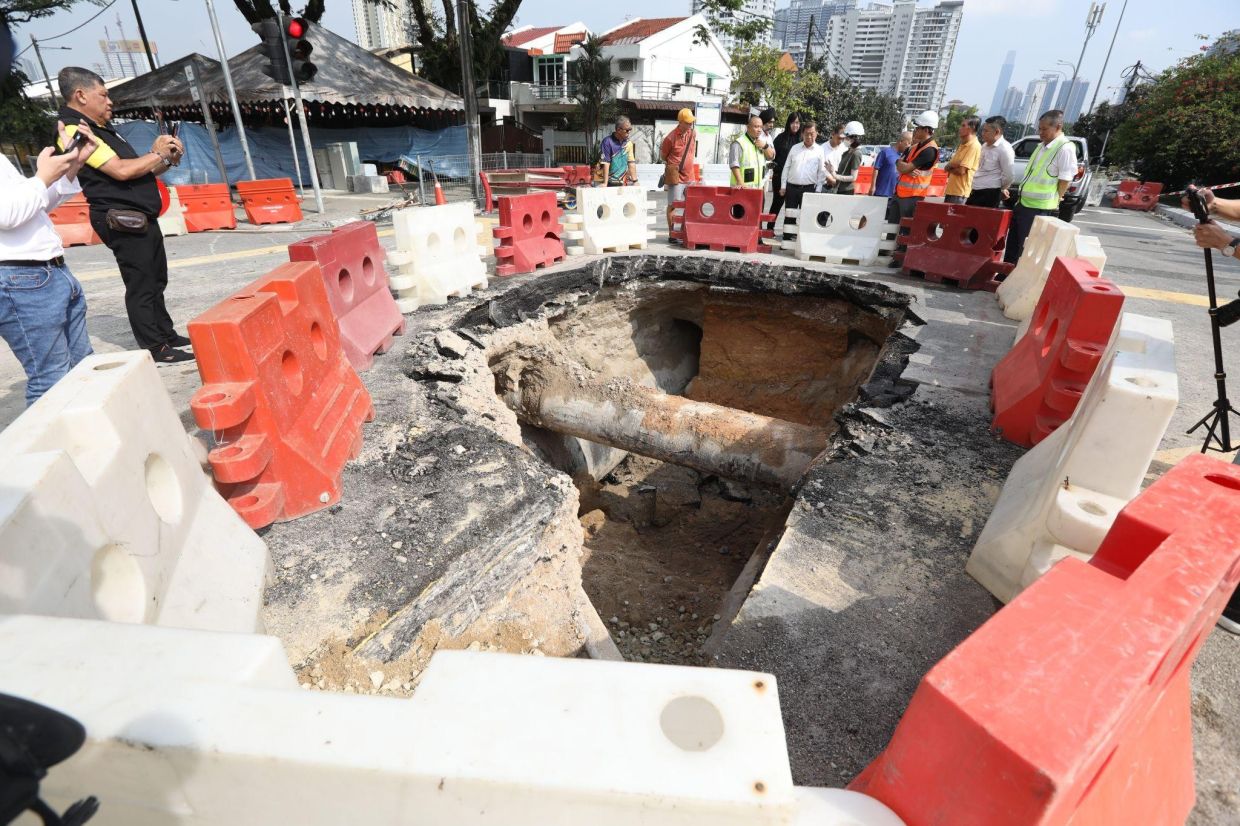
Malaysia's intensifying rainfall patterns are surfacing a critical vulnerability beneath urban streets: the growing threat of sinkholes linked to failing underground sewerage systems. As weather becomes increasingly unpredictable and extreme precipitation events multiply, the nation's subsurface infrastructure—often invisible to the public but essential to daily life—faces unprecedented stress. This growing phenomenon has prompted Indah Water Konsortium (IWK), the statutory authority responsible for sewerage management, to fundamentally rethink how the country prepares for the infrastructure challenges that climate volatility now demands.
Sinkholes result from a convergence of circumstances rather than any single cause. While natural geological formations and groundwater movement create baseline vulnerability, the interaction between heavy rainfall, ageing pipes, construction activities and inadequate maintenance can trigger catastrophic subsurface collapse. Each incident carries its own unique combination of contributing factors, making diagnosis complex and requiring detailed forensic investigation before remedial work can begin. Understanding this complexity is essential for developing prevention strategies that address root causes rather than merely treating symptoms.
The mechanics of sinkhole formation during extreme weather illustrate why Malaysia's sewerage infrastructure now demands urgent attention. When intense rainfall saturates soil, the ground loses its structural integrity and begins shifting. This movement can displace or misalign buried sewer pipes, creating blockages and fractures. Simultaneously, the surge in water volume dramatically increases pressure within sewer lines, causing pipes to crack or rupture. Where pipes fail, surrounding soil washes away into underground voids, gradually enlarging hollow pockets beneath the surface. When these cavities become sufficiently large, the ground above suddenly collapses, forming a sinkhole that endangers lives and destroys roads and property. This cascading mechanism transforms weather events into infrastructure emergencies within hours.
IWK's operational challenge is formidable in scale. The organisation manages approximately 22,500 kilometres of public sewer pipelines distributed across Malaysia, representing one of Southeast Asia's most extensive sewerage networks. Within this vast system, particular vulnerability concentrates in the large trunk sewers—reinforced concrete pipelines measuring 600 millimetres in diameter and above—that form the network's backbone. These critical arteries typically operate at or near full capacity, experiencing high flow velocities and prolonged exposure to hydrogen sulphide gas. Over time, this corrosive environment attacks concrete, accelerating structural deterioration and elevating failure risk significantly beyond that of smaller pipes.
Confronting this challenge requires technology that can see beyond surface appearances. IWK now employs a sophisticated suite of inspection technologies to diagnose underground conditions with precision. Ground Penetrating Radar sends electromagnetic waves into the earth to detect subsurface anomalies, while closed-circuit television crawler inspections provide visual documentation of pipe interiors. Push rod cameras and pole cameras supplement these systems, adapting to varying site accessibility and operational constraints. This multi-layered inspection approach enables IWK to identify deterioration before catastrophic failure occurs, shifting the management paradigm from reactive emergency response toward proactive risk mitigation. The data gathered through these inspections directly informs decisions about which sections require rehabilitation or replacement.
When inspections reveal problems, IWK pursues several remediation pathways. Trenchless sewer lining technology allows pipes to be rehabilitated without extensive excavation, minimising surface disruption while restoring structural integrity. For severely compromised sections, complete pipeline replacement becomes necessary. Both approaches aim to eliminate the weak points that convert rainfall events into sinkhole disasters. By restoring pipe strength and watertightness, these interventions reduce the cascading failure mechanisms that extreme weather now routinely triggers.
According to IWK Chief Executive Officer Narendran Maniam, the relationship between climatic extremes and subsurface infrastructure failure has become impossible to ignore. As Malaysia enters an era of genuinely unpredictable weather patterns, understanding how rainfall translates into underground stress represents a fundamental necessity for infrastructure management. Heavy precipitation does more than simply add water to sewer systems; it destabilises soil, increases pressure beyond design tolerances, and creates conditions where ageing pipes cannot survive. When saturated ground loses strength and water pressure mounts, older pipes shift, crack and deteriorate. The failure of these pipes unleashes a destructive sequence: soil washes into the created void, the underground cavity expands, and ultimately the surface collapses without warning.
The secondary complications of extreme weather compound these primary risks. Large volumes of stormwater infiltrate sewer networks through cracks, broken joints and poorly sealed manholes, forcing aged systems to handle flows they were never designed to carry. This hydraulic overload particularly endangers older infrastructure, which deteriorates progressively under pressure. Pipe segments begin shifting and cracking, each failure widening pathways for soil washout. The accumulation of these failures beneath populated areas creates dangerous instability, where ordinary daily activities proceed unaware above increasingly fragile ground.
Maintaining and upgrading sewerage infrastructure under these pressures demands more than technical capability; it requires organisational readiness to respond rapidly when emergencies do occur. IWK recently conducted a comprehensive Crisis Simulation Exercise at its Asian Sewerage Training, Research & Innovation Centre of Excellence (ASTRICE), specifically designed to test institutional capacity under sinkhole emergency conditions. The simulation modelled a major sinkhole event involving multiple casualties and suspected damage to large sewer infrastructure, requiring coordination across multiple government agencies including the Fire and Rescue Department and Royal Malaysia Police. This exercise moved beyond theoretical planning to practical stress-testing of response procedures, command structures, communication protocols and inter-agency coordination.
The simulation's primary value lay in exposing weaknesses within the existing response architecture. By running through crisis procedures in a controlled environment, IWK's operational teams identified communication gaps, clarified role assignments and discovered coordination challenges between departments. Narendran noted that the exercise validated certain procedures while revealing areas requiring enhancement, allowing IWK to strengthen its crisis management standard operating procedures and ensure employees understand their specific responsibilities during actual emergencies. The intensive training reinforced that successful crisis response depends not on equipment alone but on teams that have practiced together and understand how decisions flow during high-pressure situations.
For Malaysian citizens and businesses, this infrastructure preparation translates into practical resilience against climate volatility. A sinkhole that opens beneath a major road creates not merely property damage but disrupts commerce, delays emergency services and threatens lives. By investing in advanced inspection technology, systematic rehabilitation programmes and comprehensive emergency preparedness, IWK reduces the probability of such catastrophic failures. However, the scale of the challenge remains daunting: 22,500 kilometres of pipeline cannot be upgraded overnight, and climate impacts are accelerating faster than infrastructure investment historically proceeds.
The broader implication extends beyond Malaysia's borders. As Southeast Asian nations confront intensifying extreme weather, many face similar infrastructure vulnerabilities rooted in systems designed for historical rather than projected climate conditions. IWK's approach—combining technological assessment, systematic rehabilitation and emergency readiness—offers a replicable framework for the region. The emphasis on proactive maintenance rather than reactive crisis management represents a paradigm shift essential for infrastructure resilience in an era of unpredictable weather.
Looking forward, IWK's commitment to continuous planning, training enhancement and agency collaboration reflects recognition that infrastructure protection demands perpetual adaptation. Extreme weather events will continue multiplying; the sewerage systems carrying Malaysia's residential and commercial waste cannot simultaneously fail without cascading consequences across urban environments. By building institutional capacity now and investing in preventive infrastructure work, IWK positions Malaysia to absorb climate impacts that, left unaddressed, would devastate communities far beyond the immediate sinkhole site. The work proceeds largely unseen, underground and unglamorous, yet it represents among the most consequential infrastructure challenges facing the nation as weather patterns shift beyond historical parameters.

