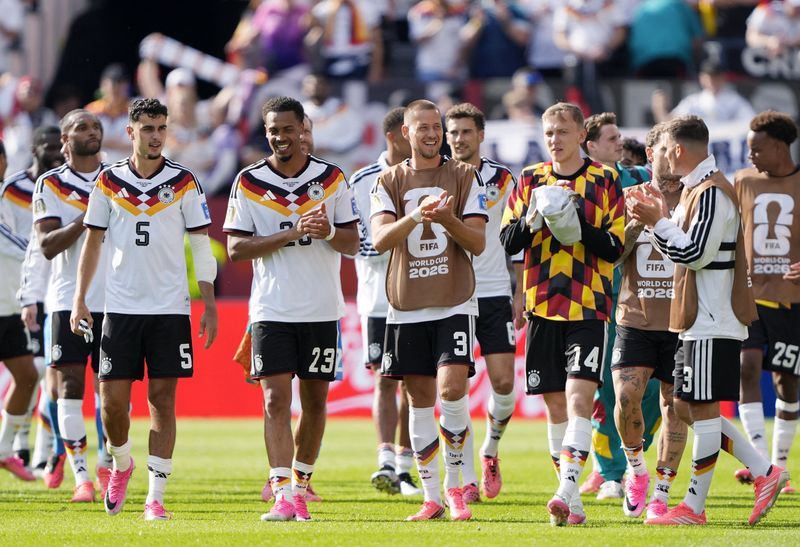
Germany have secured their passage to the World Cup knockout stage for the first time since claiming the trophy in 2014, after substitute Deniz Undav delivered a match-winning double in a pulsating Group E encounter against Ivory Coast that ended 2-1 in Toronto on Saturday. The turnaround came after the West Africans had taken the lead in the first half, and the Germans had seen two perfectly good goals ruled out by the referee before Undav's introduction shifted the momentum entirely in their favour.
The opening phase belonged firmly to Ivory Coast, who struck first when Franck Kessie finished a rebound after Amad Diallo's attempt had come from a left-flank cross delivered by Yan Diomande. This breakthrough capped a period of aggressive, direct attacking play from the Ivorians, whose free-flowing style posed considerable problems for a German side that appeared blunt in their approach despite dominating possession. The West African nation's ability to transition swiftly from defence to attack kept Julian Nagelsmann's men on edge throughout the first half, and their momentum seemed entirely theirs at the interval.
Germany's frustration stemmed not from a lack of creation but from a series of refereeing decisions that denied them clear opportunities to level the match. When Aleksandar Pavlovic rose to meet a short corner kick in the 25th minute, the officials judged him to have fouled goalkeeper Yahia Fofana in the process, a controversial decision that left the midfielder with hands clasped to his head in exasperation while the partisan German crowd in Toronto—bolstered by more than 100,000 residents of German heritage—voiced their anger at the officiating. The frustration deepened moments later when Jamal Musiala's finish was chalked off following an alleged infringement by the winger on Odilon Kossounou during the build-up, leaving Germany to retreat to the dressing room with nothing to show for eight shots on target.
The numerical advantage in possession and chances created should ordinarily have favoured Germany, yet the structure of Nagelsmann's setup appeared to lack the incisiveness required to unlock the Ivorian defence in the opening period. Despite Germany's reputation for technical proficiency and intricate passing combinations, they found the West Africans' compact defending and rapid counter-attacks difficult to navigate. The halftime break, however, provided the opportunity for tactical adjustment and fresh impetus.
Undav emerged as the catalyst for Germany's transformation after the interval, providing the clinical finishing that had eluded his teammates in the first period. His equaliser arrived in the 68th minute when he collected a loose ball and dispatched a controlled volley past Fofana, breathing life into a German performance that had threatened to become mired in frustration. The momentum shifted decisively thereafter, and Undav's second goal came from a demonstration of composure and technical excellence—receiving a pass on the turn before swivelling and rifling a shot beyond the goalkeeper's reach with authority.
Undav's two-goal performance extended a remarkable recent run of form for the striker, who has now accumulated nine goals across his last eight matches, establishing himself as a devastating late-game option for the German national team. His impact from the bench underscored the depth of quality available to Nagelsmann and suggested that tactical flexibility—particularly the introduction of attacking reinforcements—could prove decisive in knockout competition. The significance of his contribution cannot be overstated, transforming what appeared to be a potentially damaging group-stage stumble into a position of considerable strength.
Ivory Coast, despite their first-half dominance and Kessie's clinical finishing, found themselves unable to withstand the German resurgence and were ultimately undone by lapses in concentration during the second period. Simon Adingra fashioned a late opportunity that might have restored parity, but he failed to execute the chance in the penalty area when a clear sight of goal presented itself. By that juncture, Germany had seized control of the contest entirely, and Adingra's misfortune effectively sealed the outcome. Nathaniel Brown's subsequent effort was blocked by Fofana, but by then the momentum had become irreversible.
With this victory, Germany moved to the summit of Group E with six points from two matches, securing automatic qualification for the last-32 stage. Ivory Coast remain on three points after two fixtures, leaving their knockout hopes dependent on outcomes in their forthcoming matches. The disparity in points reflects the quality differential that emerged over the course of ninety minutes, though it must be noted that the Ivorians' seven-match scoring streak at the tournament represents the longest such sequence in their World Cup history, highlighting their attacking prowess even in defeat.
The implications of this result extend beyond the immediate group standings. Germany's comeback performance suggests that their technical quality and tactical sophistication will prove formidable in the knockout stages, despite what appeared to be an uncharacteristically rusty showing in the opening period. For other Group E contenders, Ecuador and Curacao—who meet in Kansas City later on Saturday—the equation becomes considerably more complex, as Germany's commanding position and demonstrated ability to respond to adversity indicate they will be exceptionally difficult opponents in the final matchday.
Germany will conclude their group engagement against Ecuador in New Jersey on Thursday, while Ivory Coast travel to Philadelphia to face Curacao. The Germans' next task represents an opportunity to secure top spot and potentially favourable knockout positioning, though their recovery from adversity against the West Africans will have undoubtedly provided considerable confidence heading into the knockout phase. For Southeast Asian football enthusiasts and analysts observing the tournament, Germany's demonstration of attacking depth and tactical adjustment offers instructive lessons in how established footballing nations maintain their competitive edge through the adaptation and utilisation of squad resources.