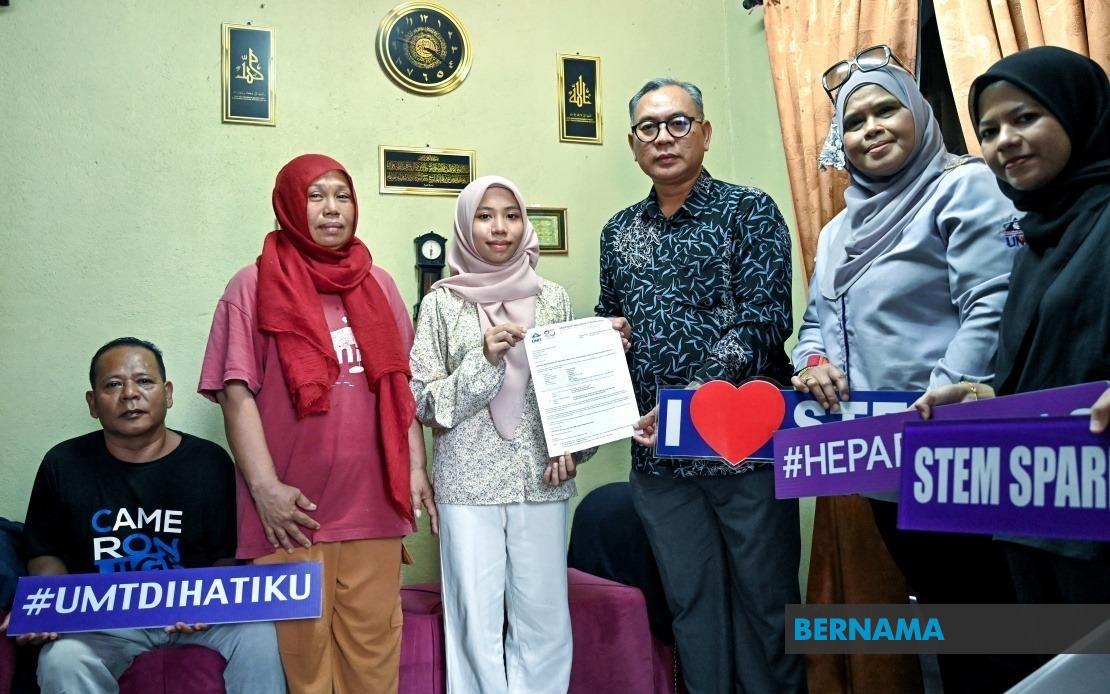
An 18-year-old student from Parit Jawa in Bagan Serai faced abandoning her university aspirations after receiving an offer to study at Universiti Malaysia Terengganu (UMT), only because her family lacked the means to pay registration and tuition costs. The intervention by UMT's leadership has transformed Nurul Amira Abdul Hamid's educational trajectory, allowing her to enrol in the foundation programme and ultimately pursue a Bachelor's degree in Science specialising in Nautical Science and Maritime Transportation.
Nurul Amira's circumstances reflect a reality facing many Malaysian families navigating the financial demands of tertiary education. Her father, Abdul Hamid Othman, aged 58, contends with persistent health complications that have strained the household budget, whilst her mother, Asmah Che Ros, aged 53, maintains the home as a full-time housewife with no independent income. As the youngest of three siblings, Nurul Amira made the pragmatic decision following her Sijil Pelajaran Malaysia examination to enter the workforce, securing employment at a retail store with a monthly wage of RM1,300 to supplement family finances.
Despite achieving three As in her SPM examination—a credible academic achievement—Nurul Amira initially resolved to decline the university offer, viewing it as an unaffordable luxury given her household's precarious economic position. Rather than passively accept this outcome, she approached the university directly to explain her circumstances and candidly discuss the financial obstacles preventing her from enrolling. This proactive communication with UMT's administration proved instrumental in identifying available support mechanisms.
The university responded by securing the Al-Ikhlas Scholarship worth RM500 for Nurul Amira, supplemented by additional financial assistance that substantially reduced her immediate fee obligations. The institution has also contributed RM400 towards her related fees, meaningfully easing the registration burden. Beyond these direct financial contributions, UMT committed to providing living support throughout her study period, recognising that accommodation and subsistence costs represent significant barriers for economically vulnerable students attempting to concentrate fully on academic pursuits.
Nurul Amira's case represents part of a broader institutional commitment at UMT to ensure educational access regardless of socioeconomic background. The university's vice-chancellor, Prof Dr Mohd Zamri Ibrahim, articulated an institutional philosophy centred on proactive engagement with struggling students and their families. Rather than maintaining bureaucratic distance, UMT leadership has adopted direct outreach approaches, personally meeting with households facing financial hardship to identify tailored assistance pathways.
Prof Dr Mohd Zamri Ibrahim emphasised that UMT views financial barriers as institutional challenges rather than individual failures, advocating for prospective and current students encountering fee difficulties to approach the university without hesitation. His statements suggest that the institution possesses diverse assistance mechanisms beyond singular scholarship programmes, offering flexibility to accommodate varying circumstances and financial needs. This approach contrasts with institutional models that require complete advance payment or deny admission pending full fee settlement.
The scale of UMT's support extends beyond individual cases. During the current academic year, the institution has provided financial assistance to more than ten students originating from underprivileged family backgrounds, indicating a systematic rather than ad-hoc approach to addressing educational access. This figures suggests the university has established institutional infrastructure and dedicated resources specifically targeting economically disadvantaged students, moving beyond sporadic charitable interventions towards embedded support systems.
The maritime and nautical science sector represents a strategically important field for Malaysian economic development, given the nation's extensive coastlines and maritime trade significance. Nurturing talent in this specialisation through inclusive admission policies ensures that capable students from all socioeconomic strata can contribute to sectors critical for national development. Nurul Amira's pursuit of a degree in Nautical Science and Maritime Transportation potentially positions her for career advancement in shipping, ports management, or related maritime industries that drive Southeast Asian economic activity.
UMT's intervention also illustrates the practical reality that merit-based admission systems fail without accompanying financial support mechanisms. Academic qualifications alone—such as Nurul Amira's three As—remain meaningless if institutional structures prevent capable students from accessing programmes. Universities functioning as genuine engines of social mobility require deliberate policies and resource allocation directed towards removing financial obstacles rather than assuming family responsibility for all costs.
The broader implications for Malaysian higher education policy merit consideration. As tertiary education becomes increasingly essential for competitive employment, institutional capacity to support economically marginal students directly impacts social mobility and educational equity. UMT's model of proactive student engagement, diverse financial assistance packages, and living cost support offers a replicable framework that other institutions could adapt. Such approaches acknowledge that financial barriers often reflect circumstantial disadvantage rather than academic insufficiency.
For prospective students across Malaysia and the region facing similar circumstances, Nurul Amira's experience demonstrates that direct communication with universities can unlock previously invisible support pathways. The reluctance to inquire about assistance opportunities may itself constitute a significant barrier, with capable students prematurely withdrawing from educational aspirations without exploring available institutional assistance. UMT's public commitment to supporting struggling students potentially encourages wider awareness of such opportunities among economically vulnerable families.
Moving forward, Nurul Amira's case exemplifies how targeted institutional support transforms individual educational outcomes whilst simultaneously strengthening institutional capacity by enrolling talented students who might otherwise remain economically excluded from higher education. As she progresses through her foundation programme towards a bachelor's degree in maritime science, her trajectory will ultimately demonstrate the productive return on UMT's investment in removing financial barriers to educational access.

