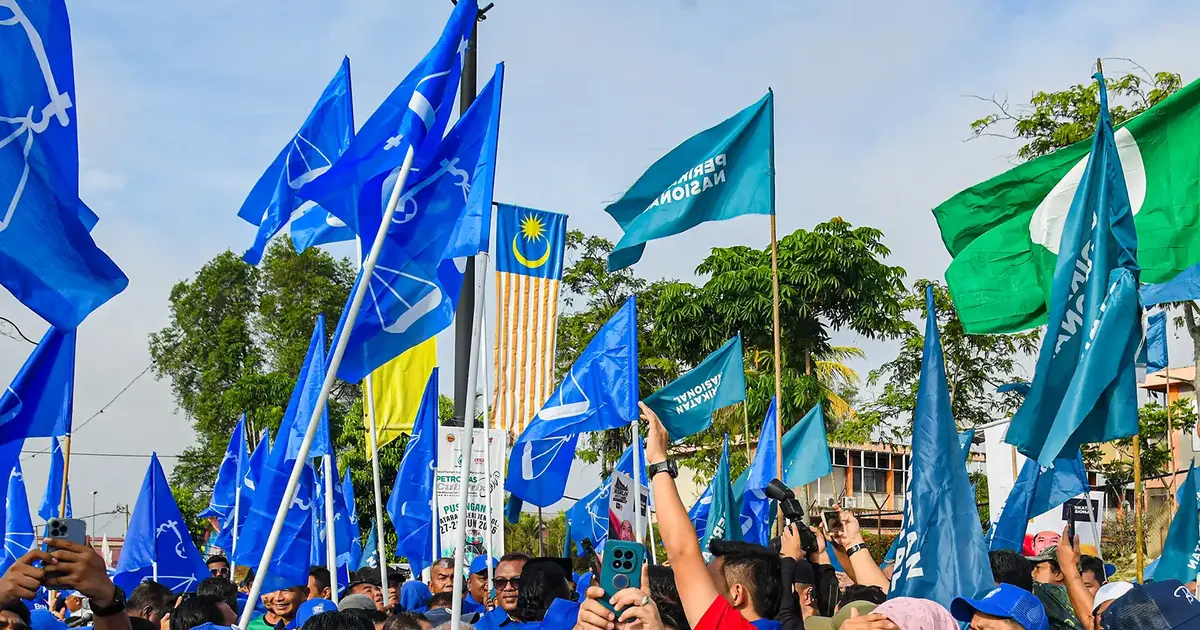
The tension between Umno's desire to reassert itself as Malaysia's dominant political force and the coalition arrangement it has forged with Perikatan Nasional is emerging as a significant fault line that could reshape the country's political landscape in coming years, according to analysts tracking the movements of both blocs.
Umno's recent repositioning reflects its determination to claw back the electoral ground it lost during the last two general elections, when internal fractures and public dissatisfaction saw the party's parliamentary representation shrink dramatically. The party has begun signalling its intent to contest more seats and claim greater prominence within the Barisan Nasional framework, a posture that sits uncomfortably with Perikatan Nasional's own appetite for electoral gains and territorial expansion.
The collision of these ambitions appears most acute in states where the two coalitions have overlapping bases or competing claims. In Terengganu, Kedah and Perlis, Perikatan Nasional holds significant organisational presence and electoral strength, yet Umno harbours aspirations to revive its influence in territories where it currently holds no parliamentary representation. This fundamental mismatch between what each party seeks and what each party controls creates fertile ground for intra-coalition friction that could potentially rupture the power-sharing arrangement.
Analysts emphasise that Perikatan Nasional is unlikely to gracefully surrender territory it has cultivated and consolidated. The pan-Malaysian bloc has invested considerable political capital in building grassroots networks and establishing itself as a credible alternative in these states. Yielding seats to accommodate Umno's comeback narrative would undermine that investment and signal weakness to party members and supporters who have rallied behind Perikatan Nasional precisely because it offered a different political vehicle. Such a surrender would be internally demoralising and strategically counterproductive for the bloc's own growth trajectory.
The situation in Kelantan presents a somewhat different but equally complex challenge. Umno currently holds just two parliamentary seats in the state, a devastating decline from its historical dominance during the pre-2018 era. The party sees recapturing lost ground in Kelantan as symbolically and strategically vital to its rehabilitation project. However, Perikatan Nasional's foothold in Kelantan, derived largely from its Pan-Malaysian Islamic Party component, represents a hard-won achievement that the bloc has no incentive to relinquish, particularly as it seeks to prove itself a serious long-term force in Malaysian politics rather than a temporary insurgent force.
Beyond the specific state-level disputes, the broader question animating political observers concerns whether the BN-PN pact possesses sufficient institutional mechanisms and shared ideological grounding to manage these territorial conflicts amicably. Unlike traditional coalition arrangements rooted in ideological affinity or long-standing organisational networks, the BN-PN relationship emerged pragmatically from the ashes of the 2022 political earthquake. It was constructed as a government-formation necessity rather than as an expression of deep political kinship, leaving it vulnerable to fracture when immediate survival pressures ease.
The coalition's architecture also lacks a clear dispute-resolution mechanism that commands equal respect from both Umno and Perikatan Nasional. Umno, as the elder party and former hegemonic force, may assume it should occupy a privileged position within discussions about seat allocation and state-level strategy. Perikatan Nasional, by contrast, views itself as a relative newcomer with legitimate claims to proportional representation and organisational autonomy. This asymmetry in perceived entitlement and legitimacy creates perpetual negotiating friction.
For Malaysian politics more broadly, the implications of a BN-PN rupture would be significant. The coalition's ability to govern effectively, pass legislation, and maintain parliamentary stability depends on maintaining sufficient unity to sustain a working majority. A fundamental split between the two blocs would introduce unpredictability into the political system at precisely the moment when Malaysia's economic challenges and demographic shifts demand sustained governance competence. The opposition benches would gain leverage from any signs of government coalition instability, potentially emboldening alternative political players.
Malaysian voters, increasingly sophisticated in their political preferences and tactical voting behaviour, are also monitoring these tensions closely. The electorate that produced the volatile results of 2018 and 2022 has demonstrated its willingness to punish coalitions perceived as internally fractious or focused on elite power consolidation rather than substantive governance. Any visible deterioration in BN-PN unity would almost certainly be punished at the ballot box, creating electoral incentives for both blocs to paper over their differences, at least publicly, until the next general election cycle approaches.
The way Umno and Perikatan Nasional resolve their competing territorial ambitions will ultimately reveal whether their coalition is a durable political arrangement capable of evolving beyond its immediate circumstances, or whether it remains a temporary marriage of convenience destined to dissolve when external pressures diminish. The coming months will be telling, as both parties begin finalising campaign strategies and seat allocation agreements ahead of what analysts expect will be crucial electoral contests that could reshape the balance of power between these two coalitional heavyweights.

