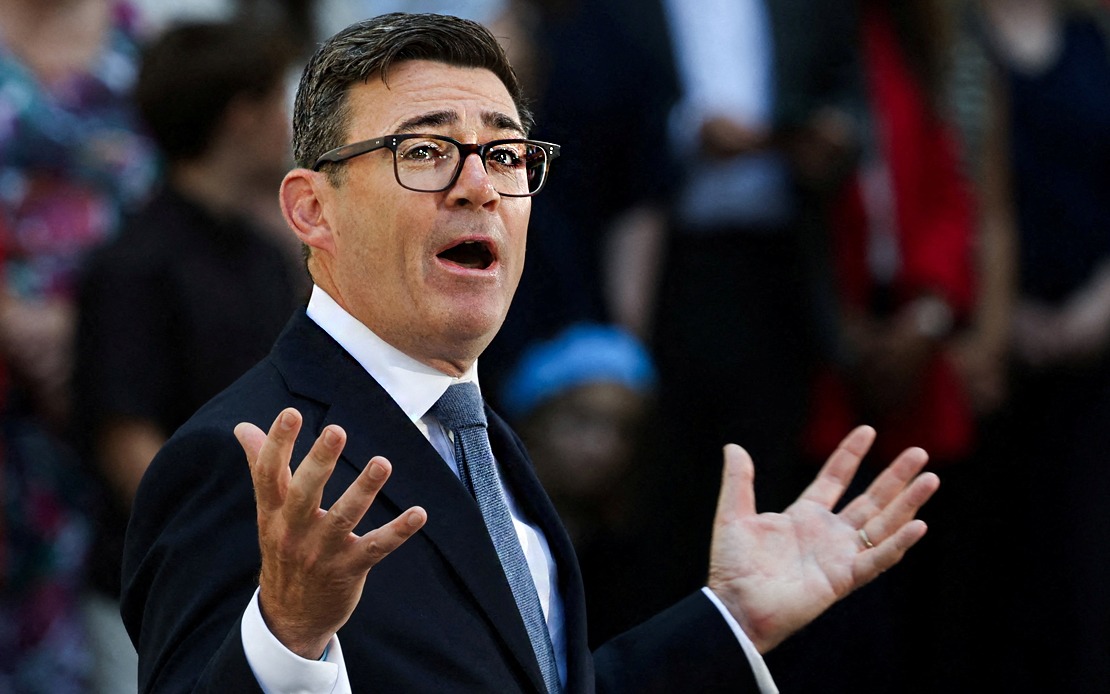
Andy Burnham has taken office as Prime Minister of the United Kingdom following King Charles III's acceptance of Keir Starmer's resignation on Monday. In his inaugural address from outside Number 10 Downing Street, the new leader committed to orchestrating the most substantial changes to British governance and economic policy in four decades, signalling an ambitious agenda aimed at reversing decades of regional stagnation and political dysfunction.
Burnham's opening statement focused heavily on repositioning the UK's political and economic structures. He framed his administration as a decisive turning point, using the phrase "circuit breaker" to describe the transformative impact he intends to deliver. This language reflects an intention to fundamentally interrupt existing patterns of governance and policy-making that have, in his assessment, served the nation poorly. The emphasis on introducing "a new political model and a new economic model" suggests systemic rather than incremental reform, indicating potential restructuring of how power flows within Westminster and how wealth is generated and distributed across the country.
The incoming Prime Minister drew particular attention to the economic and political legacies of the 1980s, a period that remains deeply contentious in British politics. He identified a critical policy divergence during that era: the centralisation of political authority coupled simultaneously with the privatisation of economic assets. This combination, Burnham argued, created winners and losers distributed geographically rather than equitably, leaving substantial portions of the nation economically weakened and politically disempowered. His diagnosis directly challenges the ideological foundations of that decade's governance model, suggesting a recalibration in how public and private sectors interact.
The regional dimension of Burnham's critique carries particular weight for understanding contemporary British politics. His reference to deindustrialised communities that "still haven't recovered" acknowledges the persistent consequences of manufacturing collapse across former industrial heartlands in northern England, Wales, Scotland, and parts of the Midlands. These areas, which once formed the backbone of British economic power, have experienced generations of disinvestment and declining opportunity. Residents' sense of abandonment and powerlessness, which Burnham explicitly named, has fuelled political volatility, including the surge in populist voting and erosion of traditional party allegiances that characterised recent electoral cycles.
Beyond diagnosis, Burnham outlined a philosophical reorientation toward collaborative governance. His pledge to remake UK politics into something "more collaborative, more about problem solving than point scoring" signals an intended departure from the adversarial Westminster culture that has dominated recent decades. This approach echoes critiques from observers across the political spectrum regarding parliamentary dysfunction, gridlock, and the prioritisation of partisan advantage over substantive policymaking. The invocation of problem-solving as a governing principle suggests potential integration of regional input into policy development and possibly a willingness to work across traditional party lines on issues of national consequence.
For Malaysian and Southeast Asian observers, Burnham's elevation and initial policy signals carry several implications. The UK remains an important partner in regional security architecture, trade relationships, and diplomatic coordination, particularly through frameworks such as the Five Power Defence Arrangements. Changes to British governance and economic orientation could reshape how the UK engages with Asian partners and international institutions. Additionally, Burnham's emphasis on addressing regional inequality and deindustrialisation may resonate with policymakers in the region who confront similar challenges of uneven development and the need to transition away from commodity dependence or outdated industrial models.
The constitutional process surrounding Burnham's appointment proceeded swiftly. King Charles III's formal acceptance of Keir Starmer's resignation represents the culmination of a political realignment within Westminster, though the specific circumstances prompting Starmer's departure remain contextualised within broader shifts in British political dynamics. The monarch's subsequent request that Burnham form a government represents the formal constitutional step required before a new administration can assume executive authority and begin implementing legislative priorities.
Burnham's legislative agenda, though not yet detailed in comprehensive form, appears oriented toward decentralisation and regional empowerment. His implicit critique of 1980s centralisation suggests potential devolution of powers to local and regional authorities, possibly mirroring or expanding the devolution settlements already in place for Scotland, Wales, and Northern Ireland. Such restructuring could have profound implications for how policy is formulated and implemented across diverse communities with distinct economic profiles and social needs.
The timing of these transformative commitments acquires significance within the current global context. The UK faces simultaneous pressures including managing post-Brexit economic adjustments, addressing persistent inflation and cost-of-living challenges, competing with other Western economies for investment and talent, and navigating shifting geopolitical alignments. Burnham's framing of his government as a corrective force suggests that his administration views these challenges not as disconnected crises but as interconnected consequences of policy choices made across the preceding four decades. Whether his proposed structural reforms can meaningfully address these multifaceted pressures will substantially determine his administration's success and influence broader Western political trajectories.

