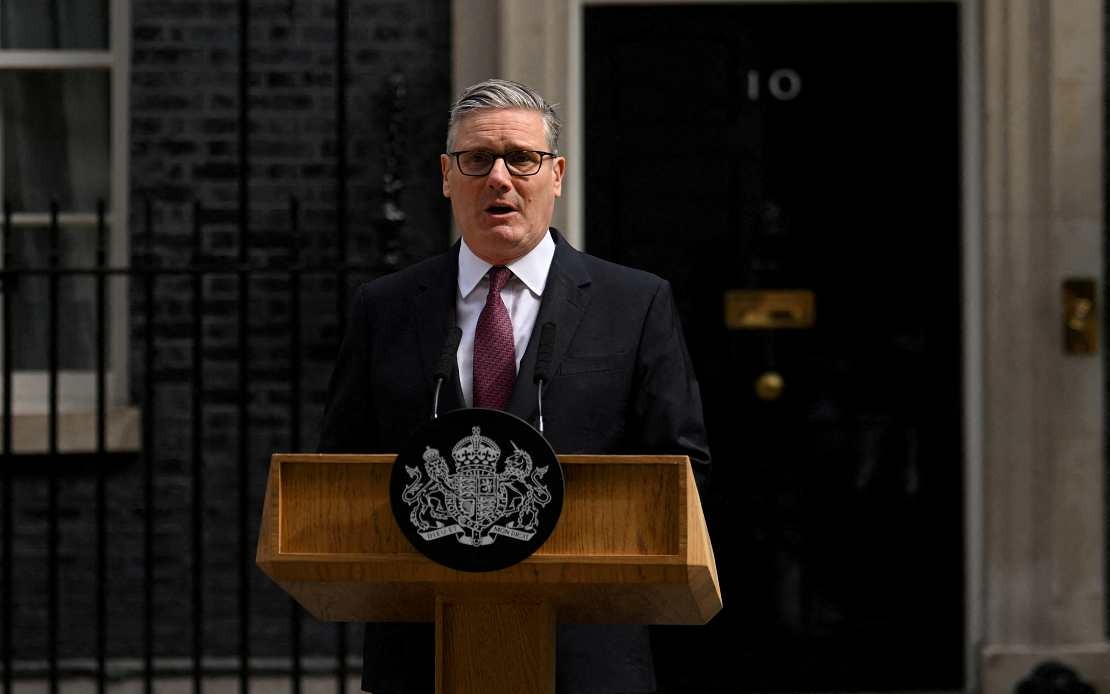
British Prime Minister Keir Starmer has moved to escalate diplomatic pressure on both Washington and Tehran, calling for an urgent restoration of ceasefire discussions as tensions in the Persian Gulf threaten one of the world's most strategically vital shipping corridors. Speaking at a joint news conference in Paris alongside leaders from France, Germany, and Ukraine following a "coalition of the willing" meeting, Starmer emphasised the gravity of the deteriorating security situation and the need for immediate de-escalation.
The British leader delivered a pointed rebuke of Iranian actions, directly condemning what he characterised as attacks on commercial shipping and allied Gulf nations. Starmer's language reflected heightened concern about the risks posed to international maritime commerce and regional stability. He demanded an immediate cessation of such strikes, signalling that London views Iran's recent military actions as unacceptable breaches of acceptable international conduct.
Starmer positioned Britain as a constructive partner willing to facilitate resolution, pledging that the United Kingdom stands ready to deploy military and naval assets to restore safe passage for merchant vessels traversing the contentious waterway. This commitment carries substantial weight, given the Royal Navy's historical presence and ongoing operations in the region. The offer of British resources underscores Western determination to maintain freedom of navigation, a principle central to global maritime commerce.
The broader diplomatic framework that Starmer outlined emphasises three interconnected priorities: immediate cessation of hostilities, renewed negotiations addressing outstanding disputes between Washington and Tehran, and guaranteed unrestricted access through the Strait of Hormuz. This tripartite approach suggests that London views the current impasse as addressable through sustained diplomatic engagement rather than military confrontation alone.
The escalation trace back to recent tit-for-tat military exchanges between American and Iranian forces that unfolded over the weekend preceding Starmer's statement. President Donald Trump announced that the United States would reinstate comprehensive economic sanctions on Iran whilst simultaneously establishing a paid shipping protection system through the strategically critical waterway. Trump's announcement essentially formalised American enforcement of chokepoint control over one of global commerce's most indispensable passages.
For Malaysian readers and broader Southeast Asian observers, these developments carry substantial implications. The Strait of Hormuz represents a chokepoint through which approximately one-third of globally traded oil transits daily. Any sustained disruption threatens energy security across Asia-Pacific nations, including Malaysia, which remains a net energy importer. Rising insurance premiums, extended shipping times, and potential supply shocks could ripple through regional economies and impact consumer prices.
The current crisis traces its origins to a conflict that commenced in late February involving Israeli military operations and Iranian-backed forces, though the precise triggers and full scope of that broader conflict remain contested among international observers. Despite expectations that a memorandum of understanding signed in June would normalise conditions and restore Iran's openness to international navigation through the Strait, practical implementation has instead stalled amidst mutual recriminations and renewed hostilities.
Iran's effective closure of the waterway during peak conflict phases represented an extraordinary assertion of control over infrastructure deemed crucial to international commerce. The expectation that a June agreement would swiftly reverse this situation has proven naive, exposing deep structural mistrust between protagonists. Starmer's intervention acknowledges that technical agreements prove insufficient without parallel de-escalation in military posturing and threat perception.
The convening of a "coalition of the willing" in Paris, bringing together European nations and Ukraine alongside British leadership, signals Western determination to preserve established international norms governing maritime freedom. However, the conspicuous absence of direct representation from major Asian trading partners—including China, India, and Southeast Asian states most exposed to supply disruptions—suggests potential limitations in coalition cohesiveness and enforcement capacity.
Trump's announcement of a fee-based shipping protection scheme represents a novel assertion of hegemonic control that challenges conventional interpretations of international maritime law. Rather than relying on existing frameworks, the proposed system would essentially privatise security provision whilst concentrating decision-making authority with Washington. This approach may prove strategically counterintuitive if it further alienates Iran or incentivises alternative regional arrangements that marginalise Western participation.
For Malaysia and comparable regional economies, the unfolding crisis presents twin challenges. First, immediate commercial exposure through heightened transportation costs and potential supply disruptions warrant contingency planning across energy, manufacturing, and trade sectors. Second, the precedent of great power assertion over critical chokepoints threatens the principle of rules-based international commerce that underpins regional prosperity.
Starmer's diplomatic intervention, whilst constructive in tone, operates within constraints imposed by the current administration in Washington and the entrenched positions of both American and Iranian leaderships. Without parallel signals from Tehran indicating willingness to resume negotiations, British exhortations alone may prove insufficient to arrest the trajectory toward sustained confrontation that threatens global commerce.

