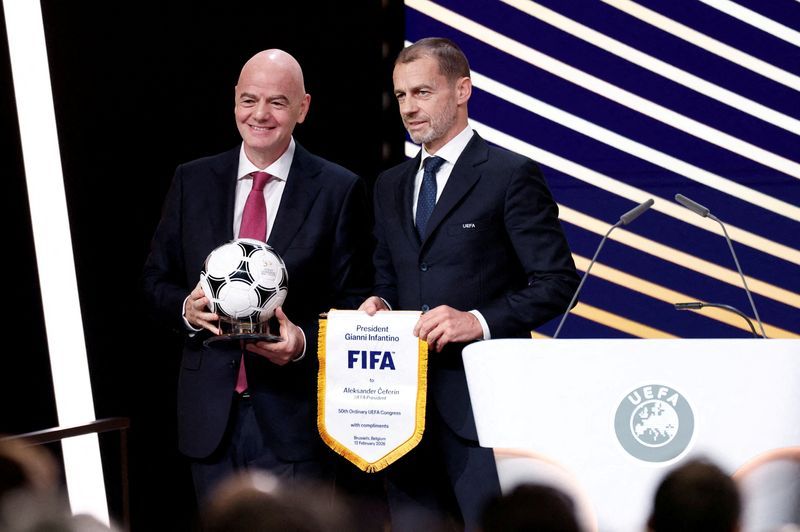
European soccer's governing body UEFA has escalated its confrontation with FIFA President Gianni Infantino by requesting access to confidential FIFA documents held in Florida, according to court filings made in the United States. The move signals that UEFA intends to pursue formal criminal charges in Switzerland against Infantino and potentially other FIFA officials for their roles in developing and advancing a controversial commercial scheme that sparked an unprecedented international crisis within world football this summer.
The scheme in question, called FIFA Forward Enterprise, would have transferred the commercial rights to men's and women's World Cups and the Club World Cup into a newly created subsidiary controlled partly by outside investors. UEFA alleges that Infantino conceived this proposal in secrecy alongside a small group of advisers and investors, deliberately circumventing FIFA's established governance frameworks and decision-making processes. The confederation contends that neither FIFA's Council, regional football confederations, nor the organisation's 211 member associations were consulted before the plan was publicly unveiled on 28 July.
Under Swiss Criminal Code Article 158, UEFA and other interested parties are preparing claims alleging criminal mismanagement. The legal filing specifically requests that a U.S. federal court authorise the discovery of testimony and documents from FIFA (AMERICAS), Inc. and FWC2026 US, Inc., two Florida-registered subsidiaries of FIFA. UEFA maintains that these entities likely possess critical documentation and witness testimony regarding how the FFE transaction was conceived, structured, valued, and ultimately approved by FIFA leadership.
According to UEFA's account, the proposal remained hidden from FIFA's broader membership for more than a year before its announcement. The confederation emphasises that FIFA's own statutes grant the Council exclusive authority to determine how FIFA's commercial rights are managed and promoted, suggesting that Infantino's unilateral advancement of the FFE plan represented a fundamental breach of FIFA's constitutional framework. The proposal designated Thrive Eternal, an investment vehicle controlled by Joshua Kushner and affiliated with Thrive Capital, as the lead investor in the consortium, which would have acquired a permanent financial stake in FIFA's commercial operations.
What made the proposal particularly contentious was its valuation structure. According to UEFA's legal filing, the investor group agreed to pay approximately 4.2 billion USD for their stake, valuing the entire FIFA Forward Enterprise at roughly 20 billion USD. UEFA contends this valuation dramatically undervalued FIFA's actual commercial rights and that the transaction bypassed standard procedures including open auctions and independent third-party valuations. Given that FIFA currently maintains billions of dollars in reserves—funds that UEFA notes legally belong to member associations—the federation questioned why Infantino believed external investment capital was necessary to expand football development funding.
The crisis reached its peak when UEFA's 55 member associations unanimously agreed at an emergency meeting on 30 July to withdraw European teams from all FIFA competitions, including the World Cup, unless the proposal was immediately terminated. This represented an extraordinary challenge to FIFA's authority, as the World Cup generates the vast majority of FIFA's revenue. Faced with this existential threat, FIFA formally abandoned the FFE proposal on 31 July. When announcing the withdrawal, Infantino characterised the scheme as well-intentioned but acknowledged it had created divisions incompatible with football's broader interests.
However, UEFA's provisional agreement to suspend its threatened competition boycott came with significant conditions and caveats. The confederation received written assurances that the FFE project had been "irrevocably and permanently withdrawn," which prompted the decision to allow European teams to participate in upcoming tournaments, including the Under-20 Women's World Cup scheduled for Poland in September. Yet UEFA's statement made clear this represented only a temporary pause rather than any resolution. The confederation's member associations unanimously mandated UEFA to pursue "every available institutional, political and legal avenue" to secure structural reforms and impose meaningful restrictions on presidential authority within FIFA.
UEFA further demanded an independent external review of how the FIFA Forward Enterprise proposal had been developed and advanced. The confederation explicitly rejected FIFA's ability to investigate itself, stating that the football community should not be expected to accept conclusions from any internally conducted inquiry. This demand reflects the depth of distrust that has emerged between Europe's football leadership and FIFA's executive apparatus, with UEFA suggesting that FIFA possesses neither the objectivity nor the credibility to examine what happened.
Internal complaints within FIFA itself have added further weight to UEFA's allegations. Staff members reportedly told UEFA they felt "deceived" by the process, and FIFA Secretary General Mattias Grafstrom was apparently excluded from the proposal's development despite his statutory role in FIFA governance. These accounts suggest that even FIFA's permanent bureaucracy was sidelined in favour of a tight circle of advisers and investors loyal to Infantino personally.
For Southeast Asian football stakeholders, this crisis carries significant implications. FIFA's governance structures directly affect how international football is administered regionally, and the outcome will determine whether member associations retain meaningful influence over decisions affecting their sport. The proposed centralisation of commercial rights under investor control would have concentrated financial power in ways that could disadvantage smaller federations and developing football nations that rely on FIFA revenue-sharing arrangements.
Infantino, who announced his intention to seek a fourth term in March 2027, has retained backing from the African and South American confederations, as well as the Saudi Arabian Football Federation. The geographic split in support reflects broader tensions within world football, with European confederations increasingly challenging FIFA's administrative structure while other regions have maintained alignment with the current president. As the criminal proceedings advance and UEFA continues its political campaign, the leadership contest scheduled for 2027 will likely become a referendum on FIFA's governance direction.
The outcome of UEFA's criminal complaint in Switzerland remains uncertain, but the court proceedings will provide a public forum for examining how FIFA's highest authority has wielded presidential power. Whether Swiss prosecutors take action and what reforms FIFA ultimately adopts will shape the governance environment for all member associations, with particular consequences for regional confederations in Asia seeking to protect their interests within FIFA's increasingly contested institutional framework.

