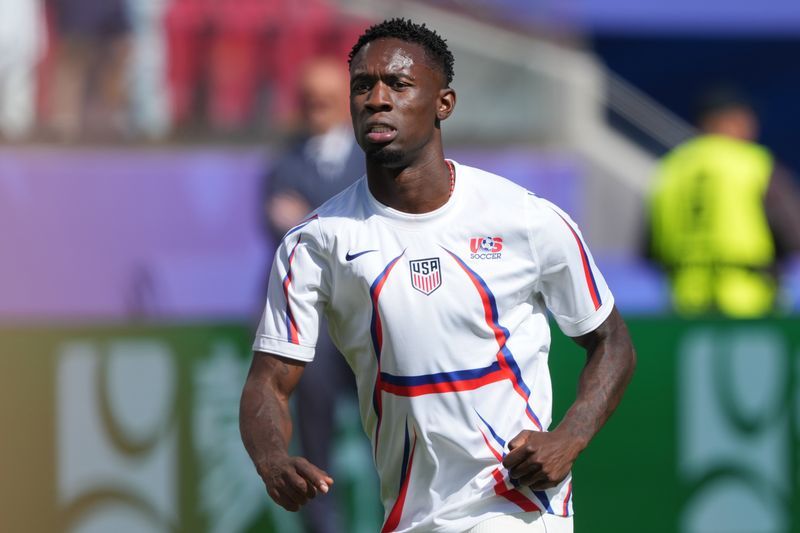
European soccer's governing body has launched a scathing attack on FIFA's handling of US striker Folarin Balogun's disciplinary case, accusing the world governing body of undermining the fundamental integrity of the sport. The furore erupted after FIFA suspended the implementation of Balogun's red-card ban—a decision that came shortly after US President Donald Trump contacted FIFA president Gianni Infantino requesting a review of the dismissal. UEFA's response on Monday was unsparing, describing the move as "unprecedented, incomprehensible and unjustifiable" and warning that when the certainty of regulations can no longer be relied upon by those entrusted to enforce them, the credibility of international competition hangs in the balance.
The incident at the heart of this controversy occurred during the United States' group-stage victory over Bosnia, when Balogun was sent off following a VAR review for dragging his cleats down the back of opponent Tarik Muharemovic's leg and onto his foot. The American striker, who had already notched three goals in the tournament, faced an automatic suspension that would have rendered him unavailable for Monday's knockout round encounter against Belgium. That potential absence, given Balogun's contribution to the team's attacking prowess, gave the red card particular significance beyond routine discipline. However, FIFA's subsequent manoeuvre—suspending the ban's implementation while retaining the red card itself, ostensibly on a probationary basis lasting one year—has reframed what might have been a straightforward disciplinary matter into a broader question about whether political pressure can influence sporting decisions.
The decision to suspend rather than overturn the ban represents a peculiar middle ground that has satisfied neither those opposing the original dismissal nor those defending the integrity of the sport's regulatory framework. By leaving the red card on record while suspending its consequences, FIFA appears to have attempted a compromise that instead invites accusations of inconsistency and arbitrary decision-making. UEFA's statement penetrates to the heart of this contradiction, emphasizing that the rule of law in sport depends not merely on the existence of rules but on the unwavering application of those rules by those responsible for their enforcement. When exceptions emerge as a result of political intervention, the entire system of regulation becomes compromised in the eyes of competitors and observers alike.
The intervention by Trump fundamentally altered the trajectory of what was hitherto a standard post-match disciplinary process. By directly appealing to FIFA's president to reconsider the card, the US leader transformed a soccer matter into a diplomatic one, creating expectations that his request would carry weight disproportionate to sporting merit. This represents a departure from convention in international sports governance, where decisions are typically rendered by appointed officials and panels insulated from direct political pressure. The fact that FIFA subsequently altered its position—not overturning the decision outright, which might have appeared too blatant, but implementing a suspension that achieves a similar practical outcome—suggests the organization recognized the political sensitivity whilst attempting to preserve a veneer of consistency.
Belgium's football federation responded with palpable frustration, expressing bewilderment at FIFA's move and signalling its intention to file an appeal challenging the suspension. The Royal Belgian Football Association's decision to escalate the matter through formal channels underscores how the Balogun case has expanded beyond a single disciplinary decision to implicate the broader framework of international soccer governance. Belgium, as the disadvantaged party facing an opponent that would otherwise have been weakened by the absence of a key attacking player, has every incentive to contest a process that appears influenced by extraneous political factors rather than principled sporting judgment.
This episode arrives at a moment when FIFA's credibility has already weathered considerable strain from various controversies. The organization faces recurring questions about the consistency and transparency of its decision-making processes, and the Balogun case provides fresh ammunition to critics who contend that FIFA's governance structures lack sufficient independence from external pressures. The suspension of the ban, rather than resolving the matter, has instead magnified doubts about whether FIFA operates according to published standards or whether those standards remain flexible when powerful actors intervene.
For Malaysian and Southeast Asian readers, this controversy carries significance beyond its immediate soccer context. It illustrates how international sporting governance remains vulnerable to political influence, particularly when powerful states flex diplomatic muscle on behalf of their athletes. In regional competitions involving nations of varying political standing and influence, such precedents could reshape expectations about what outcomes are achievable through political channels rather than regulatory procedure. The case suggests that the boundary separating sports from politics remains porous in global institutions.
The question of whether FIFA will ultimately uphold, modify, or overturn its decision on the suspension remains unresolved as the matter proceeds through additional channels. FIFA has not yet issued a substantive public response to UEFA's condemnation or Belgium's appeal, leaving ambiguity about the organization's reasoning for its unprecedented action. This silence itself communicates something troubling about FIFA's willingness to justify decisions that diverge from established norms, further corroding institutional legitimacy. Whether subsequent review processes will restore consistency to FIFA's disciplinary framework or entrench the perception that rules bend under political weight will substantially influence international soccer's competitive integrity in tournaments to come.
The deeper implication of this affair extends to how international sporting bodies balance deference to member nations—particularly powerful ones—against their institutional duty to enforce uniform standards. FIFA's suspension of the ban, whatever its precise motivation, has supplied apparent confirmation that sufficiently forceful advocacy through diplomatic channels can alter sporting outcomes in ways that equal application of the rules would not permit. That lesson, once learned and absorbed by other national associations and political leaders, may reshape future interactions with FIFA and other governing bodies, potentially cascading into broader erosion of rule-based governance in international sport. The Balogun case therefore signals deeper structural vulnerabilities in how global sports organizations maintain independence from political interference.

