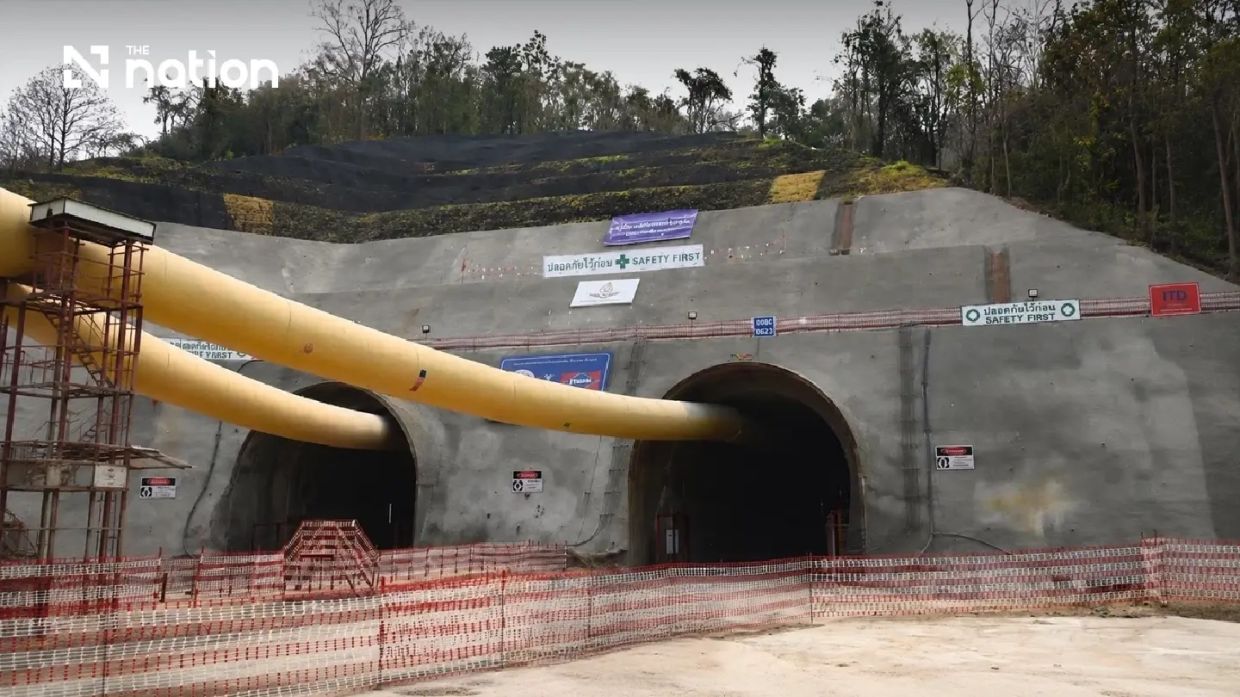
Two construction workers were killed and seven more sustained injuries when scaffolding gave way inside the Doi Luang railway tunnel near Chiang Rai on Saturday evening. The accident struck during ongoing development of the Den Chai-Chiang Rai-Chiang Khong railway line, a signature infrastructure initiative managed by the State Railway of Thailand. The incident underscores persistent safety challenges in Thailand's ambitious rail expansion programmes, which have repeatedly encountered operational difficulties across multiple projects in recent years.
Deputy Transport Minister Siripong Angkasakulkiat revealed that preliminary assessments pointed to falling rock from the tunnel wall as the likely trigger for the collapse. Workers were actively engaged in installing waterproofing systems when the incident occurred at approximately 8:35 pm. Earlier accounts had suggested the problem originated within the shotcrete application zone, though officials cautioned that comprehensive investigation was necessary before drawing firm conclusions about the precise chain of events. The ministry indicated that detailed forensic analysis would proceed to establish definitive causation and prevent recurrence.
The human cost of the collapse reflected the severity of the structural failure. Two workers lost their lives in the accident, while the remainder of the injured cohort experienced varying degrees of trauma. Medical personnel documented three cases classified as serious and four as minor injuries. All affected individuals received prompt hospital treatment following emergency response protocols activated immediately after the collapse was reported. The swift evacuation and medical intervention likely prevented the casualty toll from rising further.
Siripong stated that control of the accident scene had shifted to the project's safety unit, which implemented containment measures to prevent additional incidents. The tunnel area was sealed off following standard emergency procedures. The State Railway's Special Projects and Construction Department mobilised inspection teams to examine the site and gather evidence relating to the structural failure. These parallel investigations would feed into the transport ministry's comprehensive analysis aimed at identifying systemic deficiencies in current safety management practices.
The Doi Luang tunnel itself represents a substantial engineering undertaking within the broader rail development scheme. Located in Chiang Saen district, the 3.4-kilometre subterranean passage has been successfully bored through, positioning it for completion of internal finishing work—a phase where the collapse occurred. The tunnel forms part of Contract 3 of the Chiang Rai-Chiang Khong segment, valued at THB19.385 billion. This contract extends across approximately 87 kilometres of track construction, encompassing three fully fledged stations and three additional halts, alongside the tunnel itself, plus integrated signalling and telecommunications infrastructure.
The joint venture executing these works comprises three major construction entities: CH. Karnchang Public Company Limited, Sino-Thai Engineering & Construction Public Company Limited, and Chiangmai Construction Co., Ltd. operating collectively as CKST-DC3. The consortium's coordination across such a large, complex contract raises questions about oversight mechanisms and safety culture implementation across subcontractor operations. The incident suggests potential gaps in communication chains or consistency in applying international best practices across the joint venture's multiple work areas.
Thailand's railway modernisation agenda has become increasingly prominent within broader Southeast Asian infrastructure development. The Den Chai-Chiang Rai-Chiang Khong route represents a critical northern corridor that promises to enhance regional connectivity and economic integration. However, the project has encountered multiple delays and complications since inception, with safety incidents representing only one category of challenge. The tunnel collapse carries implications extending beyond immediate victim compensation to encompass reputational questions about project management competency and worker protection standards.
For Malaysian stakeholders, the incident warrants close attention given parallels with similar infrastructure undertakings across the region. Malaysian construction companies frequently participate in cross-border projects, and the safety standards demonstrated in Thai-managed contracts reflect broader sector norms that could influence bidding and operational approaches. The experience also informs Malaysian regulatory bodies considering how to strengthen oversight of domestic rail projects and establish appropriate contractual safeguards regarding safety performance.
The transport ministry indicated that further updates would be released as investigations progressed. The pending comprehensive analysis would presumably address whether safety protocols were properly documented, whether worker training proved adequate for the specific hazards encountered, and whether supervision intensity matched the risks inherent in underground tunnel finishing operations. These findings could influence future tendering processes for comparable regional projects and may prompt reassessment of contractor selection criteria across Southeast Asian transport infrastructure programmes.

%22%2F%3E%3C%2Fpattern%3E%3C%2Fdefs%3E%3Crect%20width%3D%22100%25%22%20height%3D%22100%25%22%20fill%3D%22url(%23ph3ns52g)%22%2F%3E%3Crect%20width%3D%22100%25%22%20height%3D%22100%25%22%20fill%3D%22url(%23ph3ns52p)%22%2F%3E%3Ctext%20x%3D%2250%25%22%20y%3D%2250%25%22%20text-anchor%3D%22middle%22%20dominant-baseline%3D%22central%22%20fill%3D%22rgba(255%2C255%2C255%2C0.95)%22%20font-family%3D%22Georgia%2C%20'Times%20New%20Roman'%2C%20serif%22%20font-weight%3D%22700%22%20font-size%3D%22226%22%20letter-spacing%3D%22-0.02em%22%3EPenang%3C%2Ftext%3E%3C%2Fsvg%3E)