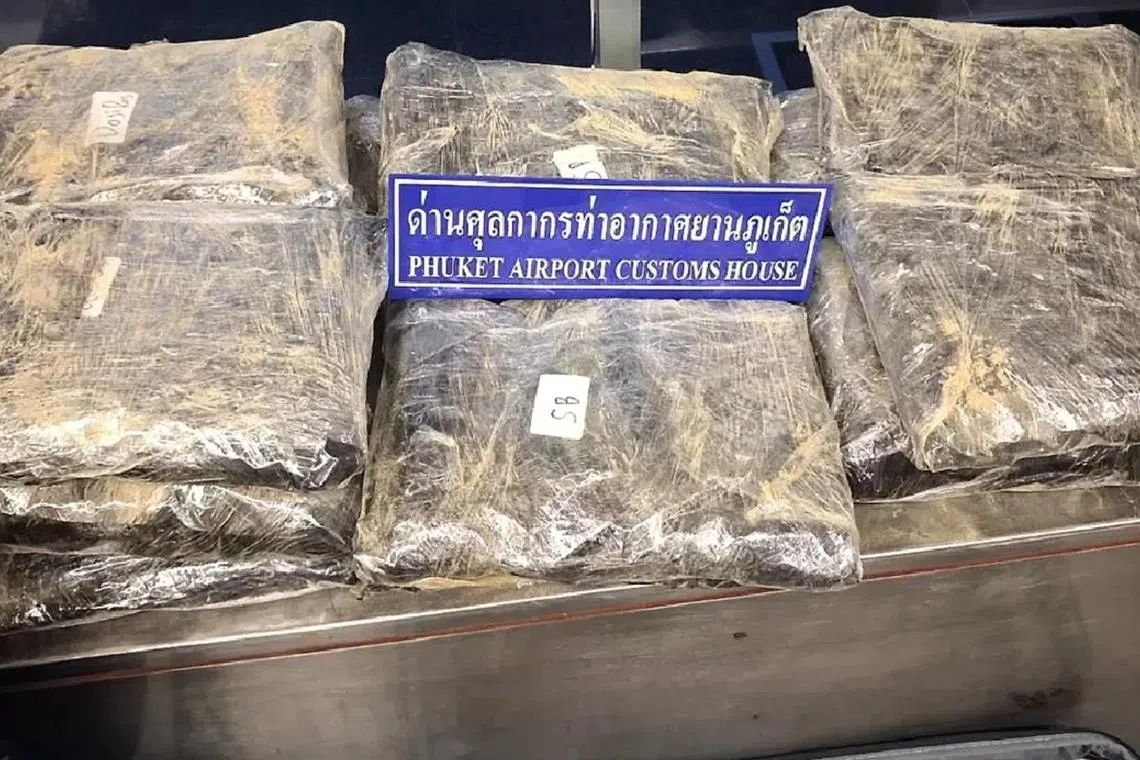
Authorities at Phuket International Airport have arrested two women in separate incidents on the same day after discovering cannabis flowers totalling over 32kg concealed in their luggage. The arrests, conducted by officers from Phuket Airport Customs House working alongside Sakhu Police Station, took place inside the international departures terminal on Thursday, July 9, and underscore ongoing efforts to stem the flow of controlled substances through Thailand's major travel hubs.
The first suspect, 18-year-old Filipino national Levannah Chelsea Guzman, was apprehended around 11am when customs inspectors examined her black Pierre Cardin wheeled suitcase. Upon opening the luggage, officers discovered 14 vacuum-sealed packages containing cannabis flowers. The packages, together with their protective wrapping, weighed 14.5kg in total. When questioned, Guzman confirmed that both the suitcase and its contents were hers, providing authorities with a straightforward admission that would form the basis of subsequent charges.
Just two hours later, at approximately 1pm, a second inspection led to another major seizure. Officers became suspicious of a green Swish Navy wheeled suitcase belonging to Penpitcha Phutsiang, a Thai national. A thorough search revealed 16 vacuum-sealed packages of cannabis flowers weighing 17.6kg combined. Like Guzman, Phutsiang admitted ownership of both the suitcase and all seized materials, streamlining the investigative process at the airport.
Both women now face multiple criminal charges under Thailand's complex framework of drug and customs legislation. The primary accusation relates to attempting to transport goods out of the kingdom without completing mandatory customs procedures, a violation of the Customs Act BE 2560 (2017). Beyond these foundational charges, prosecutors have applied offences under the Narcotics Code, leveraging Thailand's strict drug trafficking statutes that carry substantial penalties. Additional charges reference the Protection and Promotion of Traditional Thai Medicine Wisdom Act BE 2542 (1999), a statute that has been invoked in cannabis-related cases, and the Public Health Ministry's 2025 notification designating cannabis as a controlled herb.
The dual arrests reflect an intensification of screening measures at Thailand's busiest airports as authorities crack down on attempted cannabis smuggling. While Thailand decriminalized medical cannabis in 2018 and has permitted limited therapeutic use under strict conditions, exporting unprocessed cannabis flowers remains illegal without proper authorization and documentation. The fact that both women were discovered at the departures stage—rather than arriving with contraband—highlights the strategic positioning of customs enforcement to intercept outbound smuggling attempts.
For regional observers, these arrests carry significance beyond the immediate Thai context. The involvement of a Filipino national suggests that cannabis trafficking networks continue to source and transit contraband through Southeast Asia's major hubs, with Phuket's prominence as an international gateway making it an obvious chokepoint for interdiction. The volume seized—32kg—represents a commercially significant quantity that would command substantial street value in markets throughout Asia, indicating this was likely an organized trafficking operation rather than personal possession.
Thailand's approach to cannabis control has become increasingly nuanced in recent years. While the country pioneered cannabis legalization for medical purposes in the region, it maintains stringent controls on production, distribution, and international movement. The Public Health Ministry's 2025 notification on controlled herbs demonstrates the government's commitment to updating its regulatory framework as cannabis policy evolves globally. However, the gap between domestic medical access and international export restrictions creates enforcement challenges, as evidenced by the Phuket cases.
The timing and coordination of these arrests also suggest that Phuket Airport Customs House has enhanced its detection protocols. Finding two separate smuggling attempts on the same day implies either heightened vigilance, improved intelligence gathering, or both. The use of vacuum-sealed packaging indicates the smugglers understood basic concealment techniques, yet still failed to evade detection, suggesting that customs screening methods are proving effective against common evasion strategies.
For Malaysian travellers and businesses, these arrests serve as a reminder of the strict enforcement environment across Southeast Asia regarding controlled substances. While Malaysia maintains even more stringent anti-drug policies than Thailand, the regional interconnectedness of smuggling networks means that activity detected in one country often reflects broader trafficking patterns affecting the entire region. The involvement of young suspects—notably the 18-year-old Filipino—also indicates that smuggling organizations continue to recruit individuals who may be vulnerable to coercion or financial incentives.
Both suspects are now in custody at Sakhu Police Station, where investigations are ongoing and legal proceedings will determine their ultimate sentences. Under Thai law, trafficking quantities of this magnitude typically result in lengthy prison terms, particularly given the involvement of multiple legislative frameworks. The cases demonstrate that despite Thailand's relatively more liberal stance on medical cannabis compared to neighbouring countries, the kingdom maintains robust enforcement against illegal export operations.
The Phuket airport seizures illustrate a persistent challenge facing Southeast Asian governments: balancing evolving domestic cannabis policies with international drug control obligations and bilateral enforcement cooperation. As more jurisdictions reconsider cannabis prohibition, the regulatory landscape becomes increasingly complex, with grey zones emerging between domestic legalization and international trafficking restrictions. These two women will likely serve as cautionary examples within their respective communities about the consequences of attempting to circumvent such controls, while authorities will continue refining their detection and interdiction methods at key transit points.

