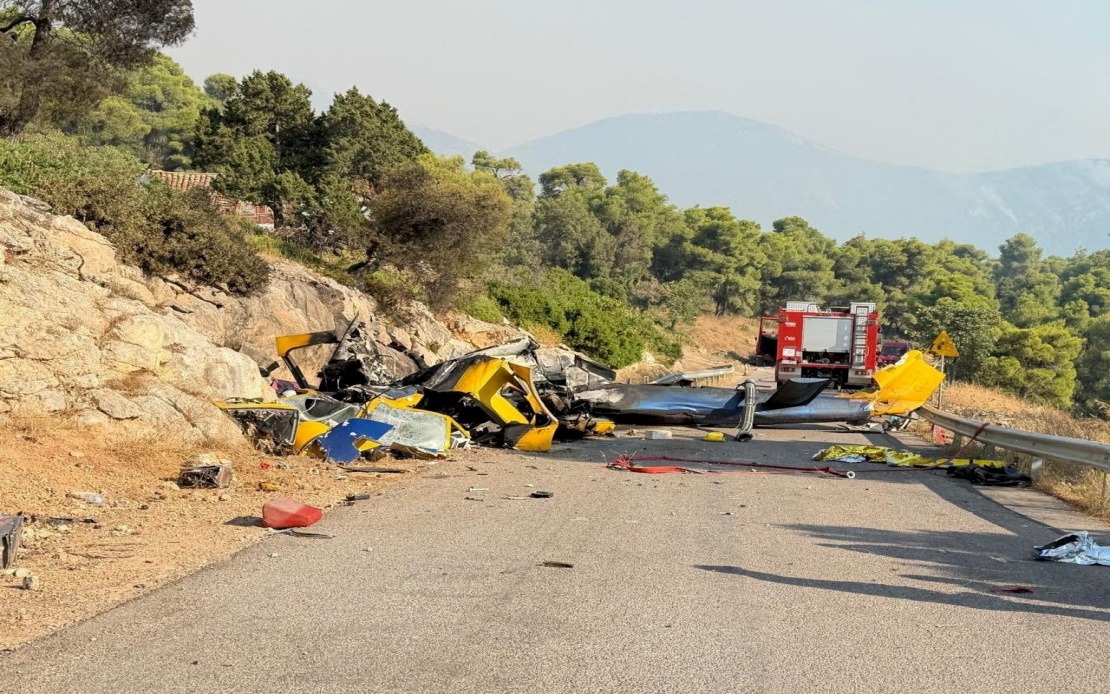
A tragic accident unfolded in western Attica on Sunday when two firefighting helicopters struck each other during aerial operations to contain a sprawling wildfire, resulting in the deaths of two crew members and leaving the other two survivors. The collision, which occurred near the coastal town of Psatha, has drawn fresh attention to the hazards inherent in aerial firefighting operations, particularly during periods of intense wildfire activity when multiple aircraft must operate in close proximity under challenging conditions.
Fire Service spokesperson Vassilis Vathrakogiannis confirmed at a press briefing that the fatalities included a Danish pilot and a Greek firefighting coordinator. The two survivors comprised a British pilot and a Greek firefighting coordinator, with one of the survivors sustaining injuries in the incident. Each of the Bell helicopters involved in the collision carried a crew of two personnel, meaning all four occupants were accounted for following the crash.
The accident took place as Greece wrestled with an extensive network of wildfires spreading across the Attica and Boeotia regions. These twin Bell helicopters had been contracted specifically to provide aerial support for firefighting efforts, dropping water and fire retardant on active fire fronts to slow their advance and protect populated areas and critical infrastructure. The coordination of such operations requires precise communication and spatial awareness, particularly in areas with difficult terrain and unpredictable wind patterns that can affect aircraft stability and visibility.
Greek authorities initiated an immediate search and rescue operation following the collision, though the recovery and investigation phase began almost immediately. The exact cause and specific circumstances leading to the mid-air collision remain under active investigation by relevant authorities, with officials declining to speculate on preliminary findings until evidence has been thoroughly examined. Such investigations typically examine factors including communication protocols, weather conditions, pilot fatigue, visibility constraints, and whether adequate separation distances were maintained between aircraft during operations.
The incident highlights the mounting pressure on Greece's firefighting resources as the country grapples with successive waves of wildfires driven by exceptionally hot, dry and windy conditions that have become increasingly common during Mediterranean summer months. Climate scientists have linked the intensification and frequency of such weather patterns to broader climatic shifts, creating a cascading demand for aerial firefighting assets that sometimes exceeds available capacity. When demand peaks, operators must push their equipment and personnel harder, increasing operational risks across the board.
For Southeast Asian readers, the collision serves as a sobering reminder of similar hazards faced during regional wildfire seasons, particularly in Indonesia and Malaysia where transboundary haze frequently necessitates extensive aerial firefighting operations. The incident underscores the importance of investing in modern coordination systems, pilot training protocols, and inter-agency communication frameworks that reduce collision risks during high-tempo operations. Many regional aviation authorities have implemented stricter standards following previous accidents, recognising that prevention represents a superior alternative to reactive investigation and reform.
The involvement of international crew members—Danish, British, and Greek personnel—reflects the global nature of firefighting expertise and the routine cross-border deployment of specialised aerial resources during emergencies. This international dimension also complicates investigation procedures, as multiple jurisdictions may have interests in the outcome and different regulatory frameworks may apply. Insurance, liability, and operational protocols across jurisdictions require careful coordination to establish definitive findings.
Greece's ongoing battle with multiple large wildfires represents a substantial drain on national resources and budgets. The contraction of additional helicopter assets from private operators, while temporarily expanding capacity, introduces additional coordination challenges and operational complexity. Each contractor brings different equipment specifications, crew training standards, and communication protocols, all of which must be harmonised to ensure safe operations within a unified command structure.
The incident will likely prompt comprehensive reviews of Greece's aerial firefighting coordination procedures, aircraft separation standards, and crew fatigue management protocols. Regulatory authorities may implement enhanced safety measures affecting how multiple helicopters operate simultaneously in wildfire zones, potentially including stricter altitude separations, expanded geographic exclusion zones, or mandated real-time tracking systems that provide ground controllers with precise three-dimensional positioning data for all aircraft.
The loss of skilled firefighting personnel represents not merely a human tragedy but also an operational setback for Greece during an active emergency period. Replacing experienced coordinators and pilots requires time, and the incident may force temporary reduction in aerial operations capacity until additional resources are mobilised or replacement personnel are certified and deployed. Such disruptions during active wildfire campaigns can have cascading consequences for ground operations and evacuation timelines in threatened communities.
As Greek authorities continue investigating this fatal collision, the incident serves as a cautionary tale regarding the operational limits of emergency response systems when faced with unprecedented demand. Both Mediterranean and Southeast Asian nations confronting intensifying wildfire seasons must balance the urgency of responding to active fires against the safety imperatives that govern aviation operations, recognising that equipment and personnel losses during firefighting campaigns ultimately reduce rather than enhance overall response capacity.

