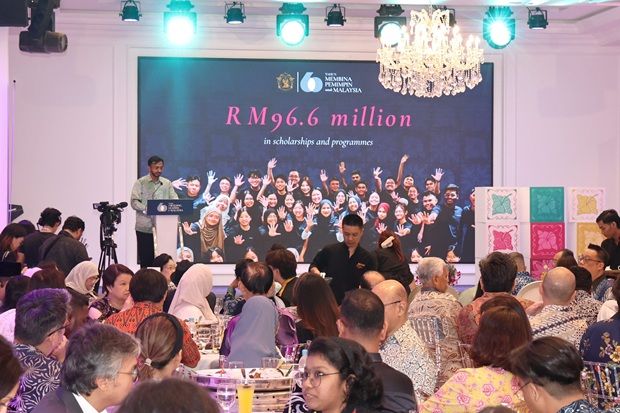
The Tunku Abdul Rahman Foundation reached a significant milestone on August 13 when it commemorated six decades of service to Malaysian youth at an anniversary ceremony held at Bangunan Sultan Abdul Samad. The occasion brought together government officials, foundation leadership, and notable alumni to reflect on an institution that has quietly shaped the nation's intellectual landscape since its establishment in 1966, transforming an initial grassroots effort into one of Malaysia's most enduring educational institutions.
The foundation's origins reveal a distinctly Malaysian story of collective purpose. What began as a proposal to establish an education fund honouring Malaysia's first Prime Minister, Tunku Abdul Rahman Putra al-Haj, evolved into a national fundraising campaign. Utusan Melayu spearheaded a crowdfunding initiative on Tunku's birthday that accumulated more than M$60,170.20—equivalent to approximately RM380,000 in contemporary currency. This citizen-driven response to creating opportunities for higher education demonstrated a shared belief in the transformative power of learning across Malaysian society. The momentum built through this popular campaign prompted then-Education Minister Tan Sri Mohamed Khir Johari to propose establishing the institution through legislation, culminating in the passage of the Tunku Abdul Rahman Foundation Fund Act 1966, which formalized the foundation as a statutory body dedicated to expanding educational access.
Over the past six decades, YTAR has become instrumental in addressing Malaysia's capacity for human capital development. The foundation has supported more than 12,000 Malaysian youths through various programmes spanning scholarships, study loans, financial assistance, and employability initiatives. Notably, YTAR's support has extended across all communities without distinction of race, colour, or creed—a principle grounded in the foundation's founding vision. National Unity Minister Datuk Aaron Ago Dagang announced during the anniversary ceremony that the institution has disbursed a cumulative total of RM96.6 million towards these educational initiatives, representing decades of accumulated investment in Malaysian potential.
The foundation's significance extends beyond its financial contributions. As YTAR chief executive officer Kularetnam Vijayakumar emphasized, the institution has evolved from a scholarship provider into a comprehensive talent identification and development body. This transformation reflects changing national needs; while the foundation's early years focused on enabling overseas study, contemporary programmes emphasize skills development and career pathways alongside academic support. The foundation's expanding remit underscores a sophisticated understanding that educational access requires multifaceted support mechanisms. Aaron Ago called upon Malaysian corporations to recognize this model, urging companies to integrate education and talent development into their corporate social responsibility frameworks by collaborating with institutions like YTAR. This appeal highlights how business participation could substantially amplify the foundation's reach and impact.
The human dimension of the foundation's work emerged powerfully through recognition of early scholarship recipients. Dr Zakaria Ali and Ch'ng Kim See, among the earliest beneficiaries in the foundation's inaugural years, have become distinguished figures in their respective fields. Ch'ng Kim See, who received her scholarship in 1967 during acute financial hardship, rose to prominence as one of Malaysia's foremost librarians and a regional authority on South-East Asian history and library science. Her journey illustrates the catalyst effect of timely educational support; receiving the scholarship when other applications had been rejected proved decisive in enabling her university completion and subsequent career. Dr Zakaria Ali similarly emerged as a pioneering figure in Malaysian fine arts, establishing himself as a painter, writer, educator and academic leader. His path began when an American instructor recognized his potential while he worked as a processing assistant, ultimately facilitating his admission and scholarship to Southwestern University in Austin, Texas. Both alumni exemplify how individual talent, properly supported at critical moments, generates multiplicative returns through subsequent service to society.
Datin Sri Sharifah Menyalara Syed Hussein, the late Prime Minister's granddaughter and current YTAR chairperson, articulated the philosophical foundation underlying the institution's longevity. She reflected that Tunku Abdul Rahman had emphasized establishing strong foundations before pursuing grand ambitions, and that foundation must be education. For Tunku, however, education transcended academic credentials; it represented the bedrock of character and purpose enabling young people to discover their societal role and contribute meaningfully to national development. This values-centered approach to educational support has distinguished YTAR from purely financial assistance models. Sharifah Menyalara highlighted how the foundation has evolved from providing study loans and financial aid into a comprehensive empowerment mechanism offering capital, opportunities, skills development, and value formation. She articulated a crucial distinction: while memorials invite reflection on the past, living institutions carry ideals forward into the future—a characterization that positions YTAR as an active custodian of Tunku's legacy rather than merely a historical monument.
The foundation's institutional continuity across six decades merit examination. Kularetnam Vijayakumar emphasized that YTAR's enduring achievement reflects the cumulative dedication of successive generations of Malaysian custodians and supporters rather than individual leadership. This institutional perspective proves significant; it suggests the foundation's resilience derives from embedded commitment across multiple constituencies—government bodies, corporate partners, volunteer supporters, and alumni networks—rather than depending upon charismatic individuals. This distributed stewardship model may explain YTAR's capacity to adapt its programmes to evolving national priorities while maintaining fidelity to core principles. The foundation's willingness to modernize, evidenced by contemporary employability programmes and skills training initiatives, demonstrates organizational learning and flexibility.
The foundation's recognition among the earliest institutions created to honour a national leader places it within a distinctive category. Many independence-era leaders inspired memorialization efforts, but few materialized into sustained operational institutions generating tangible societal benefit. YTAR's trajectory from founding through six decades of continuous operation suggests factors beyond nostalgia sustained its momentum. The foundation's explicit connection to universally valued objectives—education, social mobility, talent development—provided resilient purpose across changing political and economic circumstances. Additionally, YTAR's non-partisan positioning, serving all Malaysians regardless of background and operating within a legislative framework rather than depending upon political patronage, created institutional insulation from electoral cycles and shifting governmental priorities.
The announcement of expanded nomination procedures for the 2026 Pingat Tunku Award signals YTAR's continued institutional evolution. For the first time, the award process will accept self-nominations from graduates of public and private higher education institutions throughout Malaysia, opening the nomination window from August 31 to September 30. This expansion democratizes recognition, potentially identifying alumni whose contributions to society remain widely unacknowledged. The procedural change reflects contemporary approaches to talent recognition, acknowledging that grassroots nomination channels often identify individuals whose achievements, while profound, may not register within formal institutional hierarchies.
The foundation's six decades of operation offers instructive perspective for Southeast Asian development discourse. YTAR demonstrates that sustained investment in human capital development generates returns across multiple registers—individual empowerment, professional achievement, national capacity-building. The institution's emphasis on character formation alongside academic credentials aligns with emerging discussions about holistic development. Furthermore, YTAR's collaborative approach, seeking corporate engagement and recognizing alumni networks as development partners, suggests scalable models for expanding educational access across the region. As Malaysia and neighbouring Southeast Asian nations navigate demographic transitions and economic transformation, institutions like YTAR—combining financial support, mentorship, values formation, and career development—acquire heightened relevance. The foundation's willingness to honour early beneficiaries while simultaneously evolving its programmes demonstrates the capacity to learn from past successes while addressing contemporary challenges, a balance essential for institutions aspiring toward multigenerational impact.

