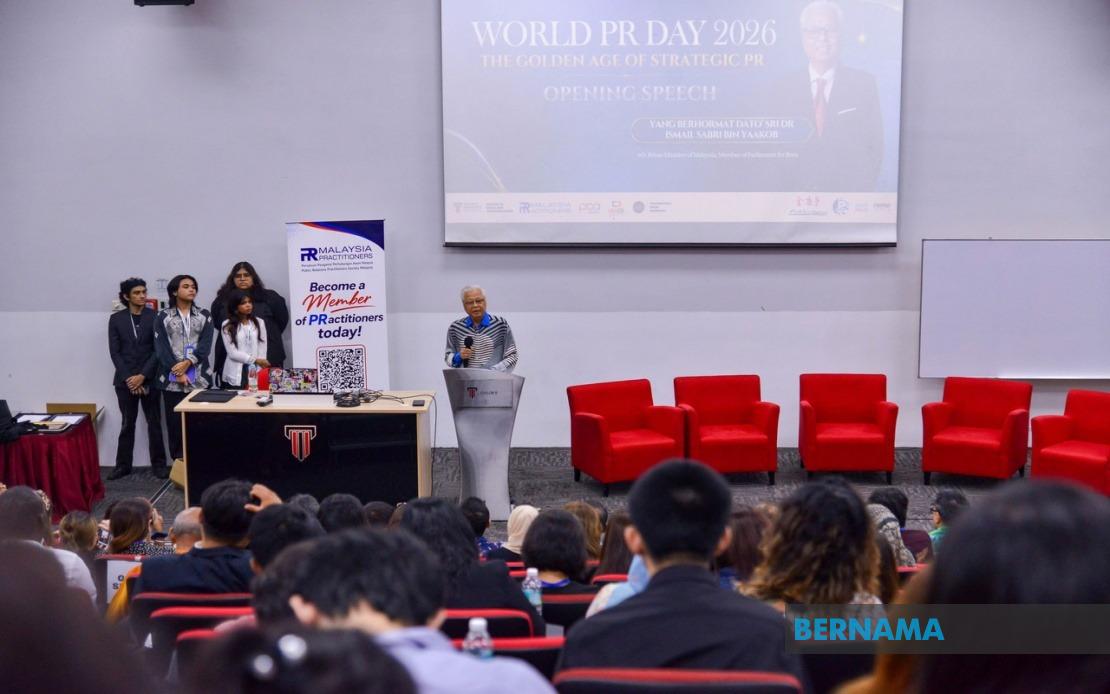
The nature of organisational success has fundamentally shifted in the 21st century, according to former Prime Minister Datuk Seri Dr Ismail Sabri Yaakob, who argues that institutions can no longer rely solely on economic metrics to measure their standing. Speaking at the launch of World PR Day 2026 at Taylor's University in Subang Jaya on July 16, Ismail Sabri drew a sharp distinction between the competitive pressures of previous decades and the landscape facing contemporary organisations: whereas the 20th century was defined by race for economic dominance, the current era represents a competition for trust itself. This conceptual reframing carries significant implications for Malaysian businesses, government agencies, and civil society organisations seeking to maintain public confidence amid rapid technological and social change.
At the heart of this trust-building endeavour lies a seemingly straightforward but increasingly rare commodity: integrity in communication. Ismail Sabri contended that the value institutions generate is no longer assessed purely through their tangible outputs and measurable results, but rather through their capacity to communicate with transparency and honesty across all circumstances. An organisation's reputation now hinges not simply on what it achieves during periods of growth and stability, but critically on how it addresses challenges, manages setbacks, and explains difficult decisions to stakeholders. This reality underscores why the public relations industry has undergone such profound transformation, moving beyond its traditional function of distributing information to assuming a far more nuanced strategic role that encompasses narrative shaping, reputation management, and stakeholder engagement.
Drawing on his tenure as Prime Minister during the COVID-19 pandemic, Ismail Sabri illustrated the practical consequences of this philosophy. The crisis demanded nearly daily media engagements to articulate evolving standard operating procedures and justify shifting public health policies. Rather than treating these interactions as mere bureaucratic obligations, Ismail Sabri recognised them as critical opportunities to establish credibility with the Malaysian public. The lesson he extracted from that experience was profound: communication transcends the mechanical function of announcing decisions; it operates as a foundational trust-building mechanism that can determine whether populations accept and comply with policy directives. This distinction proves especially relevant for Southeast Asian governments and organisations navigating similar public health, economic, or security crises where public cooperation remains essential for policy success.
However, the digital ecosystem presents paradoxes that complicate the pursuit of integrity-driven communication. Ismail Sabri acknowledged that technological advancement has created new communication channels that theoretically enable more direct engagement with audiences, yet simultaneously has multiplied the mechanisms through which falsehood spreads. Deepfake technology, fabricated content, artificial manipulation of media, and the sheer volume of competing information sources have degraded the public's capacity to distinguish reliable information from deception. For Malaysian practitioners in public relations, journalism, government communications, and corporate affairs, this environment represents both a challenge and an imperative. The proliferation of misinformation creates justified public scepticism, making authentic and verifiable communication even more valuable as a differentiating asset.
Recognising these threats, Ismail Sabri voiced support for governmental initiatives to establish an AI Governance Bill addressing digital ethics, misconduct, and the particular menace posed by malicious deployment of artificial intelligence technologies. Such regulatory frameworks become necessary precisely because the tools enabling communication have evolved faster than the norms and guardrails needed to ensure their responsible use. For Malaysia's regional standing and domestic policy objectives, the development of robust governance structures around AI deployment signals both sophistication in addressing modern governance challenges and commitment to protecting citizens from information-based harms. The establishment of such frameworks also positions Malaysia as a thoughtful voice in regional conversations about technology governance.
Simultaneously, Ismail Sabri encouraged PR practitioners to embrace artificial intelligence as an analytical tool for understanding public sentiment with greater speed and granularity. This represents a nuanced position: rather than rejecting technological innovation, he advocates for its adoption while maintaining alignment with fundamental human values and ethical standards. Practitioners who can harness AI to rapidly analyse audience perspectives, identify emerging concerns, and detect sentiment shifts gain significant advantage in crafting timely, relevant responses. Yet this capability demands constant vigilance against the temptation to manipulate data findings, misrepresent analytical conclusions, or prioritise algorithmic efficiency over human welfare. The integration of AI into public relations practice thus reflects the broader challenge facing Malaysian organisations: leveraging technology's power while resisting its potential to erode the very integrity that technology should serve.
The evolution of public relations from information distribution to strategic partnership reflects deeper changes in how organisations create and maintain legitimacy. Modern PR practitioners increasingly function as advisors to senior leadership on how communication choices shape institutional reputation and stakeholder relationships. This expanded mandate requires professionals who understand not merely media relations and message development, but also organisational strategy, stakeholder psychology, and the complex interplay between internal culture and external perception. For Malaysian universities, corporations, and government departments investing in communications talent, this shift suggests the necessity of recruiting and developing professionals with sophisticated capabilities spanning strategic thinking, ethical reasoning, and technological literacy.
The stakes of this transition extend beyond individual organisations to encompass broader social stability. When institutions communicate with integrity and transparency, they contribute to a more informed citizenry capable of holding leaders accountable and engaging constructively in democratic processes. Conversely, when organisations prioritise message control over truthfulness, or exploit communication channels to mislead, they undermine public confidence in institutions generally. Malaysia's experience with various governance challenges underscores how readily institutional trust can erode when communication failures or perceived deception come to light. Rebuilding such trust, once damaged, requires sustained commitment to integrity that extends far beyond rhetorical claims of values.
Looking forward, the principles Ismail Sabri articulated during World PR Day 2026's launch offer a reasonably clear roadmap for Malaysian organisations navigating an increasingly complex information environment. Success requires moving beyond viewing communication as a tactical function aimed at controlling narratives, toward embracing it as a strategic capability fundamentally grounded in honesty, transparency, and respect for audience intelligence. This reorientation demands investment in professional development, ethical frameworks, and organisational cultures that reward truthfulness rather than punishing bearers of bad news. For institutions willing to make these investments, integrity-driven communication offers competitive advantage precisely because it remains relatively scarce in an environment saturated with manipulation and spin.

