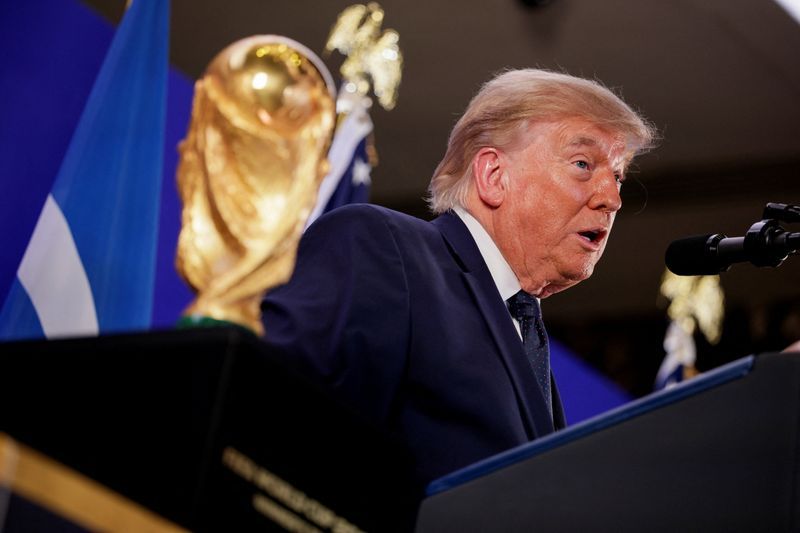
President Donald Trump is poised to take centre stage once again at the World Cup, with FIFA President Gianni Infantino confirming that the American leader will sit alongside him during Sunday's final between Argentina and Spain at New York/New Jersey Stadium and present the trophy to the victors. The appearance marks another high-profile moment for Trump at a tournament that has become as much about geopolitical positioning as sporting excellence, coming at a time when the global football showcase continues to draw record-breaking crowds to North American venues.
Trump's presence at the climactic match arrives mere days after he publicly disclosed that he had petitioned Infantino to reconsider a red card issued to United States striker Folarin Balogun, an intervention that ignited considerable debate regarding the integrity of competition and the appropriate boundaries of executive authority in sporting matters. The incident illustrates the unusual convergence of high-stakes international football and American political dynamics that has characterised this tournament since its inception.
The mutual admiration between Trump and Infantino became further evident at a lavish reception held within Manhattan's Trump Tower on Friday, where the FIFA president spoke before approximately 300 attendees, including former Brazilian football icon Ronaldo and various international sports officials. Infantino credited Trump's presidency with enabling the tournament's unprecedented success, a statement that underscores the growing entanglement between sports governance and political leadership. In reciprocal fashion, Trump declared that America had proven itself to be genuinely invested in football, having previously hosted the FIFA administrator repeatedly in the White House's Oval Office.
The road to this moment has been far from uncontroversial. Approximately one year before the tournament commenced, multiple American municipalities grappled with serious concerns about reassuring international visitors who harboured legitimate worries regarding Trump's stringent immigration policies and travel restrictions affecting several nations. These concerns were not merely theoretical preoccupations but reflected genuine anxiety about the reception that foreign supporters might encounter.
Subsequently, Trump raised the prospect of transferring matches away from cities governed by Democratic administrations, a proposal that FIFA swiftly countered by asserting that such logistical decisions remained firmly outside presidential purview. On Friday, Trump provocatively suggested that the United States should be granted another opportunity to host the tournament in 2038, but this time, he remarked, "we'll leave Mexico and Canada out," a comment that reflects his broader inclination towards unilateral decision-making in international contexts.
Over the preceding eighteen months, Trump has deliberately cultivated a presence at major sporting events as his approval ratings during his second presidential term have experienced notable decline. His reception at the Ryder Cup held on Long Island proved extraordinarily enthusiastic, with American spectators offering sustained vocal support. However, his appearances elsewhere have generated markedly different responses, with crowds booing him loudly during Game 3 of the NBA Finals last month. Additionally, enhanced presidential security arrangements at last year's U.S. Open men's tennis final at Flushing Meadows caused significant delays for ticket holders attempting to enter the venue, generating considerable frustration among attendees.
The situation presents distinctive broadcasting complications for Fox Sports, the American network responsible for covering the final. Since Fox utilises a shared global feed rather than producing independent coverage, the network has limited control over camera angles and whether television audiences will be shown Trump positioned beside Infantino or other dignitaries throughout the match. Play-by-play commentator John Strong acknowledged this uncertainty, noting that the timing and frequency of any presidential cutaways remain essentially unpredictable and beyond the broadcaster's editorial authority.
Strong's comments reveal the deeper complexity facing American media outlets: Trump remains one of the most polarising figures in contemporary American politics, rendering any significant on-screen presence inherently divisive. The commentator observed candidly that "there are no neutral opinions" concerning Trump's attendance, with substantial portions of the viewing audience eager to witness his participation whilst equally substantial segments would prefer his absence from their television screens. This fundamental division reflects deeper fractures in American society that inevitably surface when political and sporting spheres intersect.
FIFA officially allocated the tournament to co-hosts Canada, Mexico, and the United States during Trump's first presidential term in 2018, a decision that Trump has repeatedly celebrated as a personal achievement and validation of his leadership capabilities. His determination to secure and then maintain a prominent role throughout the competition speaks to his broader strategy of leveraging high-visibility sporting events as platforms for political messaging and personal brand enhancement.
The trophy presentation on Sunday will serve as the culmination of a tournament that has operated under unprecedented scrutiny regarding the balance between sporting merit and political influence. Trump's central position at the final, combined with the unresolved questions about his involvement in the Balogun red-card controversy, ensures that the match's conclusion will be remembered as much for its political dimensions as for the footballing excellence displayed on the pitch. For Malaysian and Southeast Asian observers, the episode underscores the growing reality that major sporting tournaments are no longer insulated from broader geopolitical considerations, a lesson particularly relevant as host nations across the region contemplate their own engagement with international sporting governance structures.

