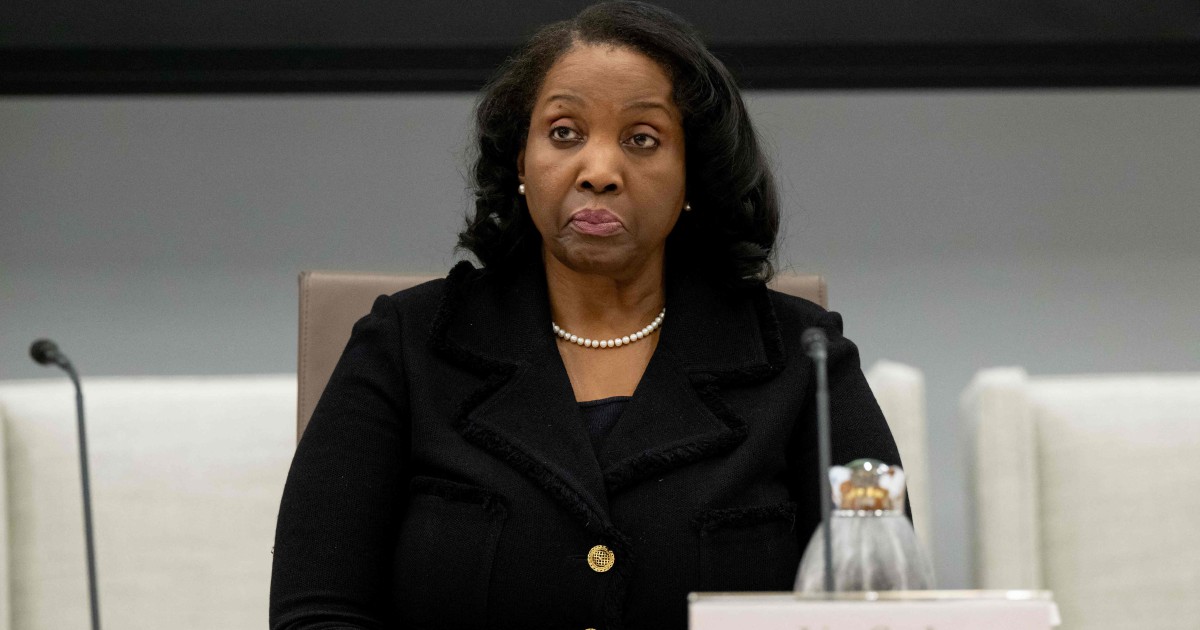
President Donald Trump has reignited his campaign to remove Federal Reserve Governor Lisa Cook from office, pursuing her dismissal on the basis of mortgage fraud allegations. A White House letter obtained by AFP on Friday reveals the administration's determination to proceed with the action despite a significant legal obstacle that emerged earlier this year.
The renewed effort marks a second attempt by Trump to unseat Cook, following an earlier bid that encountered resistance from the nation's highest court. In June, the Supreme Court had effectively blocked or rejected the President's initial move, setting back his plans to remove the governor from her position at the central bank. However, rather than accepting that judicial setback, the Trump administration has opted to pursue fresh avenues for achieving the same objective.
Lisa Cook's position at the Federal Reserve has become the subject of political controversy centring on allegations related to mortgage fraud. These claims have formed the basis of Trump's push for her removal, with the President apparently viewing them as sufficient grounds to terminate her tenure as a Federal Reserve governor. The specifics of the fraud allegations and how they bear on her fitness for office remain central to the unfolding dispute.
The Federal Reserve, as America's central banking authority, plays a crucial role in setting monetary policy and regulating the nation's financial system. Governors on its board wield considerable influence over interest rate decisions, inflation management, and oversight of major financial institutions. The identity and policy orientation of these governors thus carry significant implications for economic direction, making presidential efforts to reshape the Board a matter of broader financial and political consequence.
Trump's persistence in pursuing Cook's removal underscores the adversarial relationship between his administration and the Federal Reserve's leadership. Central banks worldwide traditionally maintain operational independence from direct political control, a principle enshrined in American law and practice. When presidents seek to remove sitting governors before the expiration of their terms, such actions test the boundaries of that independence and raise questions about institutional safeguards against politicization.
For Malaysia and other Southeast Asian economies, developments within the US Federal Reserve carry significant implications. American monetary policy, particularly decisions on interest rates and quantitative measures, influences global financial flows, currency valuations, and capital movements across emerging markets. The stability and perceived independence of the Federal Reserve are important to international confidence in American financial stewardship, affecting how regional policymakers calibrate their own economic responses.
The legal framework governing removal of Federal Reserve governors involves considerations of presidential authority, statutory protections, and constitutional principles. The Supreme Court's June decision evidently constrained Trump's options through some interpretation of existing law or constitutional limits on executive power. The White House's decision to pursue a revised approach suggests lawyers have identified alternative legal pathways or grounds that might withstand judicial scrutiny where the previous effort failed.
The mortgage fraud allegations against Cook require careful examination in terms of their substantiation and their relevance to her performance as a Federal Reserve governor. Understanding what evidence supports these claims, how thoroughly they have been investigated, and whether they represent conduct disqualifying her from office represents essential context for evaluating the merits of Trump's removal campaign. The political nature of the dispute complicates assessment, as credible observers may reasonably differ on whether the allegations constitute adequate grounds for removal.
Cook's tenure as a Federal Reserve governor has involved participation in monetary policy decisions and supervisory matters affecting the banking system. Her removal would alter the ideological and institutional balance of the Federal Reserve Board, potentially shifting the institution's approach to questions ranging from interest rate policy to financial regulation. Trump's interest in reshaping the Board's composition reflects a broader pattern of presidential efforts to influence central banking through board appointments and removals.
The institutional implications of successful removal efforts extend beyond the immediate personnel question. Each time a president successfully removes a sitting governor before term's end, such action creates precedent for future politicization of the central bank. Conversely, when courts block removal attempts, they reinforce protections for central bank independence. The outcome of Trump's renewed effort will likely send signals about the enforceability of statutory and constitutional constraints on presidential power over the Federal Reserve.
Observers across financial markets and policy circles will closely monitor how the White House pursues this matter and what legal arguments it advances. International monetary authorities and economists have reason to care about whether the Federal Reserve can maintain institutional independence when subjected to sustained executive pressure. For regional economies in Southeast Asia that depend on stable international financial conditions, the resolution of these American institutional disputes carries practical significance beyond the purely domestic political contest.

